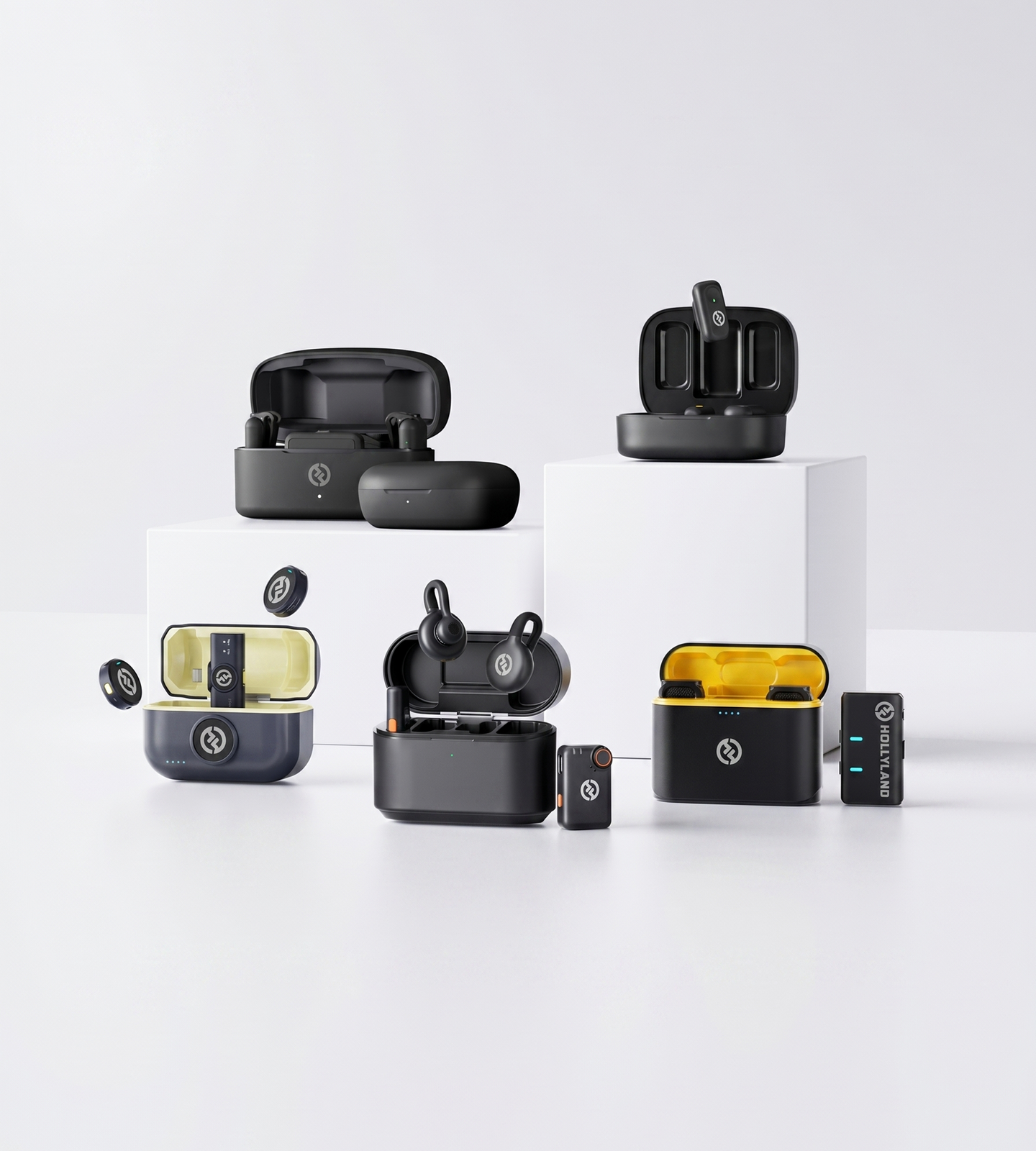
For Camera Shooters

Wireless Microphone for Camera

Professional wireless mic systems built for DSLR and mirrorless cameras. Plug directly into your 3.5mm input for clean, lag-free audio — whether you're vlogging solo, running interviews, or covering live events. Featuring 32-bit float recording, AI noise cancellation, and transmitters as light as 7g.

Shop Now Compare Models

Compatible with DSLR, Mirrorless & Cinema Cameras · 3.5mm TRS Plug-and-Play

  • Up to 32-Bit Float Audio
  • Up to 340m Stable Range
  • Transmitters from 7g
  • Direct Camera Connection
Wireless Microphone for Camera
Editor's pickLARK MAX 232-Bit Float Recording · 4 Mics, 1 RX
4.7 / 5From 1.5M+ verified creators
Shop Models

Wireless Mics for Camera

Three camera-ready wireless systems — matched to your workflow, from solo vlogging to multi-mic productions.
LARK M2

LARK M2

Run-and-gun video and on-location interview setups

  • 24-bit / 48kHz
  • 300m Range
  • 9g Transmitter
$76.00
LARK M2S

LARK M2S

Discreet on-talent audio for creators and filmmakers

  • 7g Titanium TX
  • No-Logo Design
  • ENC
$89.00
LARK MAX 2

LARK MAX 2

Multi-talent shoots, live events, and cinematic productions

  • 32-bit Float
  • 4 TX to 1 RX
  • AI Noise Cancellation
$189.00
Side-by-side

Compare Wireless Mics for Camera

Side-by-side specs to help you pick the right wireless microphone system for your camera workflow.
Model LARK M2 LARK M2 $76.00 LARK M2S LARK M2S $89.00 LARK MAX 2 LARK MAX 2 $189.00
Audio Format48kHz / 24-bit 48kHz / 24-bit 48kHz / 32-bit Float
Internal RecordingYes — up to 14 hrs
Transmission Range (LOS)300m / 1,000ft 300m / 1,000ft 340m / 1,115ft
TX Battery Life~10 hours ~9 hours ~11 hours
Camera RX Battery Life~9 hours ~8.5 hours ~12 hours
Total Battery LifeUp to 40 hours Up to 30 hours Up to 36 hours
Transmitter Weight~9g ~7g ~14g
Max SPL115dB SPL 116dB SPL 128dB SPL
SNR>70dB >70dB ≥72dB
Noise CancellationENC ENC AI Noise Cancellation
Multi-TX SupportUp to 4 TX per RX
Timecode SyncYes
Shop Shop Shop
Buying Guide

How to Choose a Wireless Microphone for Your Camera

Not all wireless microphones work directly with cameras — and among those that do, the right choice depends on your shooting style, audio priorities, and how much you're willing to carry. Here's what to evaluate before you buy.
  1. Compatibility & workflow
  2. Solo or dual recording
  3. Indoor vs. outdoor use
  4. Portability & wearability
  5. Content type or shooting style
  6. Long-term flexibility

1. Camera Compatibility First

This is the single most important starting point. Wireless microphone systems are often sold in multiple versions — one for cameras, one for smartphones — and these are not interchangeable.

For camera use, you need a dedicated camera receiver (RX) with a 3.5mm TRS output that feeds cleanly into your camera's microphone input. Always verify that the system you're considering has a camera-specific version before evaluating anything else.


2. Audio Quality: What the Specs Actually Mean

Once compatibility is confirmed, audio quality becomes the core differentiator. A few key specs to look for:

  • Bit depth & sample rate — 24-bit / 48kHz is the current standard for professional-grade camera audio. For demanding environments (loud speeches, live events, unpredictable SPL), 32-bit float recording gives you significantly more headroom, capturing audio that can be recovered in post even if the original gain was set too high or too low.
  • Signal-to-Noise Ratio (SNR) — Higher is better. Look for systems rated >70dB SNR for clean, low-noise capture.
  • Maximum SPL handling — Relevant if you're recording loud sources. A mic rated for 115dB+ SPL can handle concerts, presentations, and live events without clipping.
  • Noise cancellation — Environmental Noise Cancellation (ENC) or AI-based noise suppression is a meaningful differentiator for outdoor shoots, run-and-gun setups, or any location with ambient noise.

3. Transmission Range and Reliability

Range specs are typically listed as LOS (Line of Sight) — the maximum distance with nothing between transmitter and receiver in open space. NLOS (Non-Line of Sight) range, which reflects real-world performance through walls, crowds, or obstacles, is the more practical figure for most shooting environments.

  • For studio, indoor, or close-range shooting, standard NLOS performance (30–60m) is more than sufficient.
  • For event coverage, wedding videography, or documentary work where subjects may move far from camera, prioritize systems with stronger NLOS performance and reliable RF stability in busy environments.

Consider whether the system uses frequency-hopping or any interference-avoidance technology — this becomes critical at busy venues or in urban settings with crowded RF spectrums.


4. Internal Recording as a Safety Net

Wireless transmission can fail. A system with onboard internal recording means your transmitter captures audio locally as a backup, regardless of what happens to the wireless signal.

This is especially valuable for:

  • Event and wedding videographers who can't ask for a retake
  • Documentary and run-and-gun shooters working in unpredictable environments
  • Solo creators who can't monitor audio in real time while they're on camera

If reliability is non-negotiable for your workflow, treat internal recording as a must-have rather than a bonus.


5. Transmitter Size and On-Talent Comfort

The transmitter is what your subject wears — and its size directly affects how comfortable they are and whether it's visible on camera.

For most creators and videographers, anything under 10g sits in a category that's genuinely unnoticeable once clipped to clothing. For productions where the transmitter may be visible (interviews, talking-head shoots, on-screen talent), no-logo or minimal-branding designs reduce the chance of the mic appearing in the frame.

Consider the clip mechanism and build quality as well — a transmitter worn for 8+ hours in active shooting conditions needs to stay secure and withstand movement without picking up handling noise.


6. Battery Life Relative to Your Shoot Length

A wireless mic system has two critical battery variables: the transmitter (TX) worn by talent, and the receiver (RX) connected to your camera.

  • For shoots under 4 hours, most modern systems handle this without issue.
  • For full-day events, multi-session shoots, or travel content, look for TX battery life of at least 8–10 hours per charge, and confirm the charging case provides enough total battery to get through the day without a wall outlet.
  • Fast-charge capability can be a practical advantage if you work in tight turnaround environments.

7. Number of Transmitters: Solo vs. Multi-Talent Setups

Most wireless mic systems for cameras ship as a 1-TX + 1-RX kit — ideal for solo creators, vloggers, or single-subject interviews.

If your work regularly involves two or more subjects (panel discussions, multi-person interviews, event presentations, or corporate productions), look for systems that support multiple transmitters feeding a single receiver. This simplifies your rig significantly — one receiver on camera instead of two — and keeps your workflow cleaner in the edit.

For videographers who need to scale their audio setup without multiplying gear, a system that supports up to 4 transmitters on one receiver (such as the LARK MAX 2) offers meaningful workflow flexibility for interview-heavy or event production work.


8. Ease of Setup: Plug-and-Play vs. App-Controlled

Setup complexity is a real differentiator depending on your experience level and how fast you need to move on location.

  • Plug-and-play systems are ideal for solo creators, run-and-gun shooters, and anyone who wants to minimize pre-roll time. Connect the receiver, clip on the transmitter, and shoot.
  • App-controlled systems offer deeper control — gain adjustment, EQ, monitoring, and channel management — but require a device and a few extra steps. Worth it for users who want fine-grained control or manage complex multi-mic setups.

Some systems offer both modes, letting you choose based on the shoot.


Quick Match Guide

If you're a… Prioritize…
Solo creator or vlogger Compact TX, plug-and-play, lightweight RX
Interview or podcast videographer Multi-TX support, reliable NLOS range
Event or wedding videographer Internal recording, long battery life, strong RF stability
Cinematic or professional shooter 32-bit float, timecode sync, AI noise cancellation
Outdoor or travel content creator ENC/noise suppression, durable build, minimal footprint
Built for Every Shoot

Your Scenario. Your Signal.

From solo vlogs to multi-camera film sets, Hollyland's wireless microphones for camera are engineered around the way real creators and videographers actually work.

Solo Run-and-Gun & Vlogging

Clip the transmitter to your collar, point the camera, and roll. With transmitters weighing as little as 7g and plug-and-play camera connection, there's no sound tech required — just you, your story, and clean wireless audio from the first take.
  • Solo Shooting
  • Plug & Play
  • Cable-Free

Interviews & Two-Talent Setups

Mic up your subject without rerouting cables to your camera. Dual-transmitter systems let both voices feed into a single receiver independently, so you have full control in the edit — whether it's a sit-down interview or a walk-and-talk.
  • Dual-Channel
  • Interview
  • On-Camera Audio

Event & Wedding Videography

Ceremonies, receptions, and keynotes don't pause for RF interference. Long-range transmission and internal recording backup mean even if the wireless signal sees a crowd-heavy environment, the audio doesn't miss a word. Keep the camera at a distance without losing the moment.
  • Long Range
  • Backup Recording
  • Live Events

Outdoor & Travel Content

Wind, traffic, and open spaces are no match for built-in environmental noise cancellation. Transmitters compact enough to pocket and charge cases that extend battery life across full travel days make wireless audio just as portable as your camera.
  • Wind Noise Reduction
  • Portable
  • All-Day Battery

Documentary & Cinematic Production

Professional shoots demand a safety net. 32-bit float internal recording captures every dynamic range without clipping, timecode sync keeps audio locked to picture, and AI noise cancellation keeps dialogue pristine — all feeding directly into your cinema or mirrorless camera.
  • 32-bit Float
  • Timecode Sync
  • Pro-Grade Audio

Education & Direct-to-Camera Recording

Tutorials, online courses, and talking-head videos live or die by audio quality. A wireless mic that connects straight to your camera with zero configuration means consistent, studio-level clarity in every lesson — whether you're at a desk or presenting on location.
  • Direct-to-Camera
  • Studio Clarity
  • Minimal Setup
Trusted by creators

1.5M+ creators picked LARK microphones for their audio

A decade of wireless engineering for film crews and broadcasters — packaged for modern creator workflows.
  • 4.7 Avg. rating · 120K+ reviews
  • 1.5M+ Verified creators
  • 160+ Countries shipped
  • 98% Would recommend

I love my new LARK M2 mics. These were so good, and I really enjoyed testing out the new LARK M2 from Hollyland.

Sarah GraceSarah GraceTech Creator · 3.2M YouTube subscribers

The Hollyland LARK MAX is the wireless microphone system with the clearest and crispest audio of any wireless mic system I have ever tried.

GoenrockGoenrockCinematographer · 107K Instagram subscribers

LARK MAX is doing an excellent job of dropping the sound of the air conditioner, which is something l always have to remove and post with our shotgun mic.

Film RiotFilm RiotFilmmaking Educator · 2.2M YouTube subscribers
  • No Film School
  • Newsshooter
  • CineD
  • RedShark
  • CAMERA JABBER
  • Photowebexpo
FAQ

Your Wireless Mic for Camera Questions, Answered

Are these wireless microphones compatible with my DSLR or mirrorless camera?
Yes. The **LARK M2**, **LARK M2S**, and **LARK MAX 2** all have dedicated **Camera Versions** with a camera RX that connects directly to your camera's 3.5mm TRS mic input — the standard audio port found on most DSLR and mirrorless cameras from Sony, Canon, Nikon, Fujifilm, Panasonic, and beyond. Just plug the Camera RX into your camera's mic jack and you're ready to record. No audio interface, adapter, or software required.
Which Hollyland wireless mic is right for my shooting style?
It depends on your workflow: - **LARK M2** — The most versatile all-rounder for creators and videographers. At 9g, with a 300m LOS range, ENC noise cancellation, and 24-bit audio, it handles everything from solo vlogging to dual-person interviews. - **LARK M2S** — Built for discretion. At just **7g** with a no-logo titanium body, it sits invisibly on talent — ideal for branded video, documentary work, or any shoot where a mic showing on camera isn't acceptable. - **LARK MAX 2** — The professional flagship. With **32-bit float recording**, AI noise cancellation, timecode sync, a **340m LOS range**, and support for **up to 4 transmitters on one receiver**, it's engineered for filmmakers, event videographers, and multi-mic productions. If you're unsure where to start, the LARK M2 covers the widest range of camera shooting scenarios at an accessible price point.
How far can the wireless signal reliably reach?
All three camera-compatible systems are built for real-world shooting distances: - **LARK M2** and **LARK M2S**: Up to **300m / 1,000ft line-of-sight (LOS)**, with **40m NLOS** performance through walls and obstacles. - **LARK MAX 2**: Up to **340m / 1,115ft LOS**, with **70m / 230ft NLOS**. For typical camera use cases — event stages, presenter setups, outdoor interviews, and run-and-gun coverage — these ranges deliver a reliable safety margin well beyond what most shooters will ever need.
Will there be any lip-sync delay when recording audio directly into the camera?
Hollyland's camera wireless systems are engineered with low-latency transmission to prevent audible lip-sync drift in direct-to-camera recordings. For professional productions where frame-accurate sync is critical, the **LARK MAX 2** adds **timecode functionality** — ensuring audio and video stay locked across multi-camera setups or when using a separate audio recorder alongside your camera.
What happens if the wireless signal drops out mid-shoot?
The **LARK MAX 2** transmitters include **32-bit float internal recording for up to 14 hours**, capturing audio directly to the mic itself as a simultaneous backup. If your wireless signal is interrupted by RF interference or physical obstruction, the internal recording keeps running — giving you clean, recoverable audio in post without needing a retake. For the **LARK M2** and **LARK M2S**, robust 2.4GHz transmission and ENC circuitry minimize dropout risk under most shooting conditions. When operating in congested RF environments, switching to a cleaner channel further improves reliability.
How long do the batteries last? Is it enough for a full-day shoot?
All three systems are rated to outlast a standard shooting day on a single charge: | System | TX Battery | Camera RX Battery | Total with Charging Case | |---|---|---|---| | LARK M2 | ~10 hrs | ~9 hrs | Up to 40 hrs | | LARK M2S | ~9 hrs | ~8.5 hrs | Up to 30 hrs | | LARK MAX 2 | ~11 hrs | ~12 hrs | Up to 36 hrs | The charging case extends your total runtime well beyond a single session, so you can top up between setups without reaching for a power bank or spare batteries.
Can I connect multiple microphones to one camera receiver?
Yes, with the **LARK MAX 2**. Its camera RX supports up to **4 transmitters simultaneously on a single receiver** — the right setup for panel interviews, multi-subject event coverage, or any production where you need more than two voices captured at once. The **LARK M2** and **LARK M2S** are each available in dual-TX configurations (1 RX + 2 TX), covering two-person interviews or the classic A/B presenter setup feeding directly into one camera.
Will these mics handle loud environments without clipping or distorting?
Yes. Each system is rated for high sound pressure levels — **115dB SPL** (LARK M2), **116dB SPL** (LARK M2S), and **128dB SPL** (LARK MAX 2) — which covers everything from quiet dialogue to loud speeches, live events, and crowded venues. The **LARK MAX 2** adds an additional layer of protection through **32-bit float recording**, which captures an effectively unlimited dynamic range at the transmitter level. Even if a signal peaks in the moment, the audio is fully recoverable in post — no clipping artifacts, no lost takes.
How do I reduce wind noise when recording outdoors?
All three systems feature **ENC (Environmental Noise Cancellation)** built into the transmitter to reduce ambient and environmental noise at the source. For outdoor shooting, pairing the transmitter's onboard ENC with the included foam windscreen significantly cuts wind rumble without affecting voice clarity. For more demanding conditions — coastal locations, open fields, or moving vehicle shoots — a deadcat-style furry windshield over the transmitter offers the most reliable wind rejection and is the recommended approach for any prolonged outdoor recording.
Do I need any technical audio knowledge to get started?
No. All Camera Version systems are designed for **plug-and-play use out of the box**. The TX and RX come pre-paired from the factory — power them on, plug the Camera RX into your camera's 3.5mm mic input, and you're recording. There's no wireless configuration, channel mapping, or app required to get a clean signal. For users who want more precise control, the **Mobile Version** of the LARK M2 and the LARK M2S both support **app-based management** — including gain adjustment, ENC toggle, and real-time monitoring — when pairing with a smartphone workflow.
Explore further

A few more places to go from here

A curated link map of the surrounding content — related categories, the most useful guides, head-to-head comparisons and setup help.
Ready when you are

Wireless Audio Made for Your Camera

From 7g ultralight transmitters to 32-bit float recording — find the system that fits your shoot.
Shop Now Compare Models
  • Free shipping over $99
  • 30-day returns
  • 1-year warranty