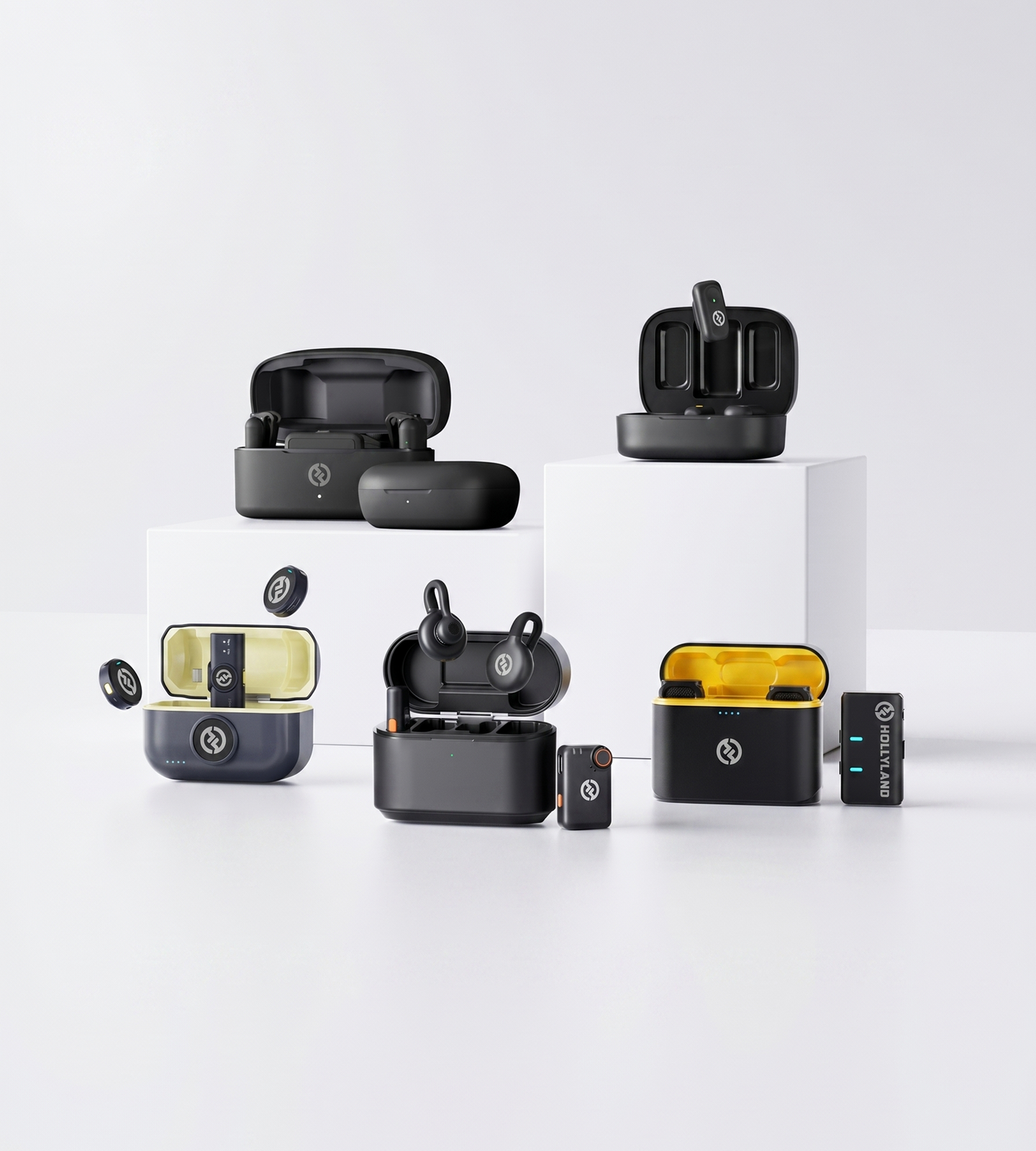
Long-Range Wireless

Long-Distance Microphones

Capture pristine audio up to 340m / 1115ft away. Built for outdoor filmmakers, event videographers, and journalists who need reliable wireless range without sacrificing sound quality — featuring 32-bit float audio, AI noise cancellation, and onboard backup recording on every take.
Shop Now Compare Models

Compatible with cameras & smartphones · 200m–340m LOS range across the lineup

  • Up to 340m / 1115ft LOS
  • 32-Bit Float Audio
  • AI & ENC Noise Cancellation
  • Onboard Backup Recording
Long-Distance Microphones
Editor's pickLARK MAX 2340m Range · 32-Bit Float
4.7 / 5From 1.5M+ verified creators
Shop Models

Wireless Mics Built for Distance

Up to 340m of wireless range — matched to your workflow, without compromising audio quality.
LARK M2

LARK M2

Lightweight all-day performer for long-distance outdoor shoots

  • 300m / 1000ft LOS
  • 9g Transmitter
  • 40-Hour Total Battery
$76.00
LARK M2S

LARK M2S

Discreet titanium build for professional on-body wear at distance

  • 300m / 1000ft LOS
  • 7g Titanium Transmitter
  • No-Logo Invisible Fit
$89.00
LARK MAX 2

LARK MAX 2

Maximum range for multi-subject, wide-area productions

  • 340m / 1115ft LOS
  • 32-Bit Float Backup Recording
  • Connects Up to 4 TX
$189.00
LARK A1

LARK A1

Smartphone-native long-range mic for mobile-first creators

  • 200m / 650ft LOS
  • 54-Hour Total Battery
  • Smartphone Plug & Play
$35.90
Side-by-side

Compare Long-Distance Wireless Mics

Side-by-side specs to help you match the right mic to your range, workflow, and recording needs.
Model LARK M2 LARK M2 $76.00 LARK M2S LARK M2S $89.00 LARK MAX 2 LARK MAX 2 $189.00 LARK A1 LARK A1 $35.90
Wireless Range (LOS)300m / 1000ft 300m / 1000ft 340m / 1115ft 200m / 650ft
NLOS Range60m (Mobile) / 40m (Camera) 60m (Mobile) / 40m (Camera) 70m / 230ft
Recording Format48kHz / 24-bit 48kHz / 24-bit 48kHz / 32-bit Float 48kHz / 24-bit
Internal RecordingUp to 14 hrs (32-bit Float)
Noise CancellationENC ENC AI Noise Cancellation 3-Level Intelligent Noise Cancellation
Total Battery LifeUp to 40 hrs Up to 30 hrs Up to 36 hrs Up to 54 hrs
Transmitter Weight9g 7g 14g 8g
Compatible WithCamera & Smartphone Camera & Smartphone Camera & Recorder Smartphone
Shop Shop Shop Shop
Buying Guide

How to Choose a Long Distance Wireless Microphone

Range specs are just the starting point. How a signal holds up in real environments, whether audio quality degrades at distance, and how long a system runs unattended — these are the factors that determine whether a wireless mic actually performs when it needs to.
  1. Wireless Range: Understand LOS vs.…
  2. Audio Quality: Range Should Never…
  3. Internal Recording: Your Safety…
  4. Battery Life: Plan for the Full…
  5. Transmitter Size: Wearable,…
  6. Noise Cancellation: Essential for…
  7. Device Compatibility: Match the…
  8. Multi-Transmitter Support: For…

Wireless Range: Understand LOS vs. NLOS Before You Buy

The advertised range on any wireless microphone is measured under LOS (Line of Sight) conditions — a clear, unobstructed path between transmitter and receiver. It's the benchmark for comparing products, but real-world shoots rarely happen in perfect open fields.

Two range specs you should always check:

  • LOS (Line of Sight) — Maximum range with no obstacles. Relevant for open exterior locations, large fields, or wide ceremony venues with clear sightlines.
  • NLOS (Non-Line of Sight) — Real-world range when walls, trees, pillars, or crowds enter the signal path. This is the number that matters most for indoor events, forested locations, or any shoot with partial obstructions.

A system rated at 300m LOS may maintain clean signal at only 40–70m once obstructions are present. If your shoots involve any degree of physical interference between mic and receiver, NLOS performance is the spec you should prioritize alongside the headline range figure.


Audio Quality: Range Should Never Come at a Cost

A long transmission range is only valuable if the audio arriving at the receiver is clean and broadcast-ready. When evaluating a system, look beyond the range spec and into the audio chain itself.

Key audio specs to assess:

  • Bit depth — 24-bit is the professional standard for clean audio capture. 32-bit float goes further, offering virtually unlimited dynamic headroom that protects recordings from clipping — critical when you can't monitor levels on a subject who's hundreds of meters away.
  • Sample rate (48kHz) — The broadcast-standard rate; ensures compatibility across professional post-production workflows.
  • Signal-to-Noise Ratio (SNR) — A higher SNR (look for >70dB) means the mic separates wanted audio from the noise floor more cleanly, even in quieter passages or at the edge of range.

The key question isn't just "how far does it reach?" — it's "how clean is the audio at that distance?"


Internal Recording: Your Safety Net When You Can't Step In

At 200–340 meters, you can't quickly intervene if something goes wrong. If the wireless signal drops — due to interference, a momentary obstruction, or an antenna issue — the audio is gone unless the transmitter has captured a local backup.

Why onboard recording matters at long range:

  • Audio is recorded directly to the transmitter, fully independent of the wireless link
  • If signal drops mid-take, the local recording continues uninterrupted
  • 32-bit float internal recording removes the risk of clipping entirely — even if gain was set before the subject walked out of reach

This feature is most critical for one-take, irreplaceable moments: live speeches, wedding ceremonies, award presentations, or documentary sequences where a retake simply isn't possible.

If your shoots regularly involve unrepeatable audio at distance, prioritize a system with onboard recording capability. The LARK MAX 2 specifically addresses this with 32-bit float internal recording and up to 14 hours of onboard storage.


Battery Life: Plan for the Full Shoot Day

The longer the range, the longer the typical shoot — and a mic worn by a subject at 200m isn't something you can quickly retrieve to swap a battery. Build your battery requirements around your worst-case day, not your average one.

What to evaluate:

  • Per-charge TX runtime — How long the transmitter lasts on a single charge. For all-day outdoor shoots, look for at least 9–11 hours of per-charge runtime.
  • Total system battery life — Includes the charging case capacity, which matters when you're moving between multiple locations or shoots in a single day.
  • Multi-TX complexity — Running 2–4 transmitters simultaneously multiplies battery management demands. Confirm every unit is fully charged before subjects move out of reach.

Battery endurance is especially important for wedding videography, live event coverage, and documentary productions where shoots routinely run 8+ hours without a natural break.


Transmitter Size: Wearable, Secure, and Out of the Way

When a subject is far away, you need a transmitter they can wear comfortably — and forget about. A heavy or bulky clip shifts position, snags on clothing, or becomes visible on camera.

What to look for:

  • Weight — Transmitters in the 7–14g range sit comfortably on clothing without pulling or shifting, even during prolonged wear
  • Low-profile / no-logo design — Important for on-camera talent where visible hardware is a concern
  • Attachment security — Clip or magnetic attachment that holds reliably through movement, without needing adjustment mid-shoot

For active subjects — speakers on stage, athletes, subjects walking through large spaces — transmitter security and discretion matter as much as the range spec itself.


Noise Cancellation: Essential for Open Environments

Distance from the camera typically means more exposure to ambient noise: wind, crowd noise, open-air environmental sounds. A mic that transmits cleanly at 300m still needs to isolate the voice from that noise floor.

Two levels of noise cancellation to understand:

  • ENC (Environmental Noise Cancellation) — Hardware-level filtering that attenuates background noise during capture. Effective across most outdoor and live event environments, and present across the full product range.
  • AI Noise Cancellation — Software-driven processing that more aggressively separates voice from complex or unpredictable background noise. Better suited to acoustically challenging environments with layered, variable ambient noise.

For the majority of long-distance use cases — outdoor ceremonies, open fields, large venues — active noise cancellation is a functional requirement, not a premium add-on.


Device Compatibility: Match the System to Your Recording Setup

Not all long-range wireless systems connect the same way. Before comparing range specs, confirm the system is compatible with how you actually record.

Main connection types:

  • Camera-mount receivers — Connect via cold shoe; designed for DSLR, mirrorless, and cinema camera setups
  • Smartphone plug-in receivers — Lightning or USB-C input for mobile-first creators
  • Combo / universal kits — Include multiple receiver types in the box, covering both camera and smartphone workflows

If you primarily shoot on a smartphone and still need meaningful long-range performance, a mobile-native system will provide a cleaner, more direct experience than adapting a camera-focused kit. The LARK A1 is built specifically for this workflow, offering 200m LOS range with smartphone plug-and-play operation.


Multi-Transmitter Support: For Multi-Subject Shoots

Many long-distance shoots involve more than one wearable mic — dual interview setups, multi-speaker panels, wedding ceremonies covering both partners, or live events with several presenters. Not every wireless system supports multiple transmitters on a single receiver.

What to check:

  • Maximum TX count per receiver — Systems supporting 2 or 4 simultaneous transmitters significantly simplify logistics when multiple subjects are spread across a wide area
  • Independent channel control — Whether each transmitter channel can be managed separately
  • Scalability — Whether the system grows with more complex production needs

For multi-subject productions or large-scale events, choosing a system that natively supports 4 TX on a single receiver — as the LARK MAX 2 does — removes the need for additional hardware and keeps your signal chain clean at range.

Use Cases

Built for the Shots That Demand Distance

When the distance between you and your subject is part of the job — not a problem to work around — long-range wireless audio changes what's possible. Here's where this collection earns its place on a kit list.

Outdoor Documentary & Interview Filming

When your camera is locked off 100m to 300m+ away from your subject — across a field, at the far end of a plaza, or down a long stretch of road — you need a wireless connection that makes the distance disappear. Long-range transmitters let documentary filmmakers and videographers place the camera exactly where the composition demands, without pulling a subject in close just to guarantee clean audio.
  • Open-Air Environments
  • Run-and-Gun
  • Long-Distance Capture

Wedding & Ceremony Videography

From the far end of a long aisle to the back wall of a packed reception hall, wedding videographers rarely get to choose their position. A long-range mic ensures the exchange of vows is captured clearly — even when you're shooting through a crowd, around pillars, or from outside the room entirely. Compact transmitters clip discreetly under a lapel, so nothing interrupts the moment.
  • Large Venue Coverage
  • Discreet Wear
  • Reliable Signal

Live Events & Stage Productions

Speakers move, panels shift, and hosts roam — and your audio coverage has to follow without hesitation. With support for up to 4 transmitters on a single receiver and up to 340m of line-of-sight range, you can cover a full conference stage, a multi-room expo floor, or an outdoor festival performance without losing the thread of a single word.
  • Multi-Speaker Setups
  • Stage Performances
  • Event Floors

Sports & Action Videography

Tracking an athlete across a pitch, a cyclist through a course, or a skateboarder down a run means your mic has to keep pace with unpredictable movement across open ground. Transmitters weighing as little as 7g stay put on a body without slowing anyone down, while extended LOS range keeps the signal alive however far the action takes your subject from the lens.
  • Moving Subjects
  • Field & Course Coverage
  • Wearable Transmitter

Real Estate & Property Tour Videography

Walking a large estate — inside, outside, and back again — while your camera operator follows from a distance puts real strain on short-range wireless systems. Long-range mics handle the indoor-to-outdoor transitions and partial obstructions of real-world properties, while a local backup recording inside the transmitter ensures nothing gets lost if a thick wall temporarily breaks the signal.
  • Indoor-Outdoor Coverage
  • NLOS Performance
  • Backup Recording

Mobile Content Creation: Travel, Vlogging & Adventure

Solo creators filming on a smartphone in open environments — along coastal trails, on mountain summits, through busy city squares — face two challenges at once: distance from the camera and ambient noise that's impossible to script away. A plug-and-play long-range mic with AI noise cancellation handles both, letting you focus on the content with up to 54 hours of total battery life between charges.
  • Smartphone-Ready
  • Outdoor Noise Cancellation
  • Extended Battery
Trusted by creators

1.5M+ creators picked LARK microphones for their audio

A decade of wireless engineering for film crews and broadcasters — packaged for modern creator workflows.
  • 4.7 Avg. rating · 120K+ reviews
  • 1.5M+ Verified creators
  • 160+ Countries shipped
  • 98% Would recommend

I love my new LARK M2 mics. These were so good, and I really enjoyed testing out the new LARK M2 from Hollyland.

Sarah GraceSarah GraceTech Creator · 3.2M YouTube subscribers

The Hollyland LARK MAX is the wireless microphone system with the clearest and crispest audio of any wireless mic system I have ever tried.

GoenrockGoenrockCinematographer · 107K Instagram subscribers

LARK MAX is doing an excellent job of dropping the sound of the air conditioner, which is something l always have to remove and post with our shotgun mic.

Film RiotFilm RiotFilmmaking Educator · 2.2M YouTube subscribers
  • No Film School
  • Newsshooter
  • CineD
  • RedShark
  • CAMERA JABBER
  • Photowebexpo
FAQ

Your Long-Distance Wireless Mic Questions, Answered

What is the maximum wireless range these microphones offer?
The microphones in this collection offer line-of-sight (LOS) ranges from 200m to 340m — enough to cover the vast majority of real-world long-distance filming scenarios: - **LARK MAX 2**: up to **340m / 1,115ft** — the longest range in the lineup - **LARK M2**: up to **300m / 1,000ft** - **LARK M2S**: up to **300m / 1,000ft** - **LARK A1**: up to **200m / 650ft** To put those numbers in perspective, 340m is roughly the length of three and a half American football fields. Even at 200m, you have ample separation for most outdoor shoots — including wedding ceremonies, documentary setups, and live event coverage — without running cable or repositioning your camera.
What does 'line-of-sight range' mean in practice? How will these mics perform when there are walls, trees, or a crowd in the way?
Line-of-sight (LOS) range is the maximum rated transmission distance when there's a clear, unobstructed path between the transmitter and receiver. Non-line-of-sight (NLOS) range reflects real-world performance when something is in the way — a tree line, indoor pillars, a crowd, or walls. Here's how the lineup compares on NLOS range: - **LARK MAX 2**: **70m / 230ft NLOS** - **LARK M2 (Mobile Version)**: 60m NLOS - **LARK M2S (Mobile Version)**: 60m NLOS - **LARK M2 / M2S (Camera Version)**: 40m NLOS For shoots with heavy or unpredictable obstructions — indoor venues, wooded outdoor locations, dense crowds — the LARK MAX 2's 70m NLOS rating gives you the most practical headroom. For lighter obstruction scenarios, the LARK M2 and M2S deliver reliable performance at 40–60m NLOS. When evaluating which mic is right for your shoot, consider your typical working environment, not just the LOS headline number.
Will audio quality degrade as I push toward the edge of the wireless range?
No. These microphones use digital wireless transmission, which means the signal is either received clearly or it isn't — there's no gradual analog fade or progressive quality loss as distance increases. Within range, you're getting the full audio fidelity the mic is capable of. All four microphones in this collection record at **48kHz / 24-bit**, with the LARK MAX 2 adding **32-bit float** support and the highest SNR in the lineup (≥72dB). Whether your subject is 10 meters away or 300 meters away, the audio quality reaching your receiver is the same — as long as you maintain a stable wireless connection. Range is never used as a trade-off for sound quality.
What happens if the wireless signal drops mid-shoot? Is there a backup recording?
The **LARK MAX 2** includes **32-bit float internal recording** — each transmitter continuously writes audio to its own onboard storage for up to **14 hours**, completely independent of the wireless link. If the wireless signal drops at the edge of range, your audio is already captured locally on the mic itself. For high-stakes shoots like weddings, live events, or documentary interviews where a missed take isn't recoverable, this is the safety net that makes long-distance wireless production genuinely reliable. The **LARK M2**, **LARK M2S**, and **LARK A1** do not include onboard backup recording. They're best suited for scenarios where you have reliable LOS or moderate NLOS conditions, or where retakes are possible.
How long will the battery last on a full-day outdoor shoot?
All four microphones are designed to cover a standard shooting day on a single transmitter charge — and then some: | Mic | TX Battery (Single Charge) | Total Battery (with Case) | |---|---|---| | LARK MAX 2 | ~11 hours | Up to 36 hours | | LARK M2 | ~10 hours | Up to 40 hours | | LARK M2S | ~9 hours | Up to 30 hours | | LARK A1 | ~9 hours | Up to 54 hours | When your subject is 100–300m away wearing a mic, walking out to swap batteries mid-shoot is not a realistic option. These mics are built so you won't have to. The **LARK A1's** 54-hour total battery (across charges from the case) makes it especially well-suited for multi-day travel or extended event shoots.
Are the transmitters small and lightweight enough for subjects to wear comfortably for long periods?
Yes. Every transmitter in this collection is purpose-built for discreet, comfortable, long-duration wear — which matters especially when subjects are moving or unattended at distance: - **LARK M2S**: **7g** — the lightest in the lineup; titanium build with a no-logo front face for a near-invisible fit under clothing - **LARK A1**: **8g** — compact magnetic design for quick, secure clip-on attachment - **LARK M2**: **9g** — button-sized; barely noticeable under a shirt or jacket - **LARK MAX 2**: **14g** — slightly larger to support its expanded feature set, but still well within comfortable wearability for extended shoots At 7–14g, none of these mics will distract your subject, pull at their clothing, or require adjustment throughout a shoot.
Will these microphones work with my camera or smartphone?
Yes — the lineup covers both camera-based and smartphone workflows: - **LARK MAX 2**: Connects to cameras via the receiver's output; compatible with most mirrorless, DSLR, and professional video camera systems - **LARK M2**: Available in Camera Version (3.5mm output) and Mobile Versions (USB-C / Lightning); a Combo Version offers universal compatibility - **LARK M2S**: Available in Camera and Mobile Versions; Combo Version for cross-device flexibility - **LARK A1**: Designed specifically for **smartphones** — plug directly into your phone's USB-C or Lightning port with no receiver, no pairing, no setup required Visit each individual product page for full compatibility details and available versions for your specific device.
How do these microphones handle outdoor ambient noise — wind, crowd noise, open environments?
Ambient noise management is built into every mic in this collection — which is especially critical for long-distance outdoor shooting, where you can't easily reposition your subject away from a noise source: - **LARK MAX 2**: **AI Noise Cancellation** — the most advanced in the lineup; intelligently identifies and reduces a broad range of environmental noise across open and complex acoustic environments - **LARK M2 / LARK M2S**: **ENC (Environmental Noise Cancellation)** — effective at reducing consistent background noise in open outdoor settings - **LARK A1**: **3-Level Intelligent Noise Cancellation** plus EQ and reverb adjustment — gives mobile creators additional on-device audio control to dial in cleaner sound For the most demanding environments — open ceremony sites, large outdoor venues, sports fields — the **LARK MAX 2's** AI noise cancellation delivers the most reliable results.
Can I connect multiple transmitters to one receiver for multi-subject shoots?
The **LARK MAX 2** supports **up to 4 transmitters connected to a single receiver simultaneously** — making it the right choice for panel interviews, multi-speaker stages, live events, or any wide-area shoot where you need to capture several subjects at once without running separate recording rigs. The **LARK M2**, **LARK M2S**, and **LARK A1** are single-transmitter systems, ideal for solo subject shoots or setups where each camera operator manages their own mic-and-receiver pair.
Explore further

A few more places to go from here

A curated link map of the surrounding content — related categories, the most useful guides, head-to-head comparisons and setup help.
Ready when you are

Distance Covered. Audio Delivered.

Shop wireless mics reaching up to 340m, with 24-bit sound and battery life for full-day shoots.
Shop Now Compare Models
  • Free shipping over $99
  • 30-day returns
  • 1-year warranty