


LARK M2
Button-Size Mic, Built for Any Device
- 9g Button-Size Design
- ENC Noise Cancellation
- Universal Compatibility
 United States
(English / $
USD)
United States
(English / $
USD)


Video Solutions

Intercom Systems

Wireless Microphones

Cameras
Video Solutions
View all
Video Accessories
Intercom Accessories

Mic Accessories

Camera Accessories
Video Accessories
View all
Hollyland Monitor Calibrator-Wireless Video Transmission System Accessory

Monitor Hood (7-Inch)

Mars 4K Transmitter

Mars 4K Receiver

D-Tap to Locking DC Power Adapter Cable

Crab Clamp

NP-F970 Battery

NP-F550 Battery

Mini HDMI to HDMI Cable

Micro HDMI to HDMI Cable

SDI Cable (1000mm)

SDI Cable (500mm)

Cold Shoe Gimbal

Rotatable Cold Shoe Mount

Side & Bottom Mounted Aluminum Handle

Screw Fitting for Stabilizer

Cylindrical Antenna (2.4GHz & 5GHz)

Paddle Antenna (2.4GHz & 5GHz)

View all


United States / English
Compatible with iPhone, Android, MacBook & Windows PC — no drivers or audio interface required.
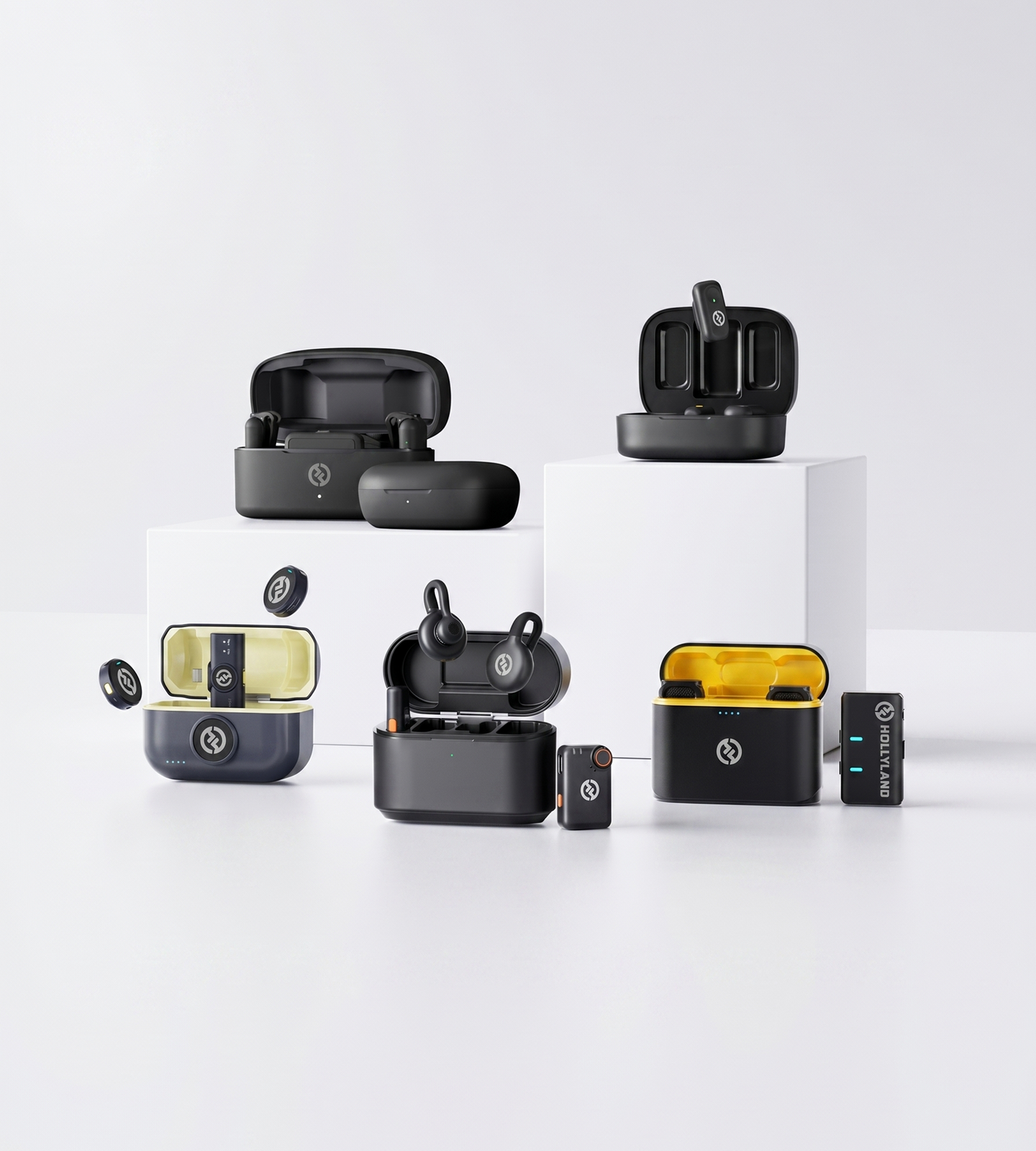
Button-Size Mic, Built for Any Device

Stay Invisible on Camera, Sound Unmistakable

Pro-Grade Audio for Podcasters and Multi-Mic Setups

The Smartphone Creator's Plug-and-Play Essential

Broadcast-Grade 32-Bit Float Audio in a 9g Scalable System

AI-Powered Clip-and-Go Mic for Smartphone Creators
| Model |
 LARK M2
$68.40
LARK M2
$68.40
|
 LARK M2S
$99.00
LARK M2S
$99.00
|
 LARK MAX 2
$189.00
LARK MAX 2
$189.00
|
 LARK A1
$35.90
LARK A1
$35.90
|
 LARK M3
$99.00
LARK M3
$99.00
|
 LARK A2
$29.99
LARK A2
$29.99
|
|---|---|---|---|---|---|---|
| Best For | Mobile & On-Location Recording | Aesthetics-First & Interview Creators | Pro Podcasters & Multi-Speaker Setups | Smartphone Creators & Vloggers | Pro & Multi-Speaker Creators Needing Scalable Systems | Smartphone Creators & Mobile Vloggers |
| Recording Quality | 48kHz / 24-bit WAV | 48kHz / 24-bit | 48kHz / 32-bit Float | 48kHz / 24-bit | 48kHz / 24-bit & 48kHz / 32-bit Float | 48kHz / 24-bit |
| Noise Cancellation | ENC Environmental NC | ENC Environmental NC | AI Noise Cancellation | 3-Level Intelligent NC | Adaptive AI Noise Cancellation | AI Noise Cancellation & Voice Tuning |
| Transmitter Weight | 9g | 7g | 14g | 8g | 9g | 8.5g |
| Wireless Range (LOS) | 300m / 1000ft | 300m / 1000ft | 340m / 1115ft | 200m / 650ft | 300m / 1000ft | 200m / 656ft |
| Total Battery Life | Up to 40 hours | Up to 30 hours | Up to 36 hours | Up to 54 hours | Up to 48 hours | Up to 42 hours |
| Device Compatibility | Smartphone & Camera (Combo Version) | Smartphone & Camera (Combo Version) | Smartphone, Camera & Laptop | iPhone & Android (USB-C / Lightning) | Smartphone, Camera & Laptop | Smartphones / Mobile Devices (Plug and Play) |
| Standout Feature | Button-Size Mini Design + App Control | No-Logo Invisible Fit + Titanium Build | 4 TX → 1 RX · 32-bit Internal Recording | Auto-Limit Clip Protection + EQ & Gain Control | Up to 4 TX & 4 RX · 4 Independent Isolated Tracks · 9g Featherweight TX | AI Auto-Limit Clip & Safety Track + 1.5H Quick Charge |
| Shop | Shop | Shop | Shop | Shop | Shop |
When most people search for a 'USB lapel microphone,' they picture a clip-on mic with a fixed cable running directly to their device. That product exists — but it's worth knowing that a better-performing alternative is available at a comparable price before you commit.
Wireless lapel mics with a USB-C receiver work identically from a setup standpoint: plug a compact receiver into your phone, tablet, or laptop via USB-C, and the device recognizes it instantly as an audio input — no drivers, no configuration. The difference is that the clip-on transmitter worn by the speaker connects wirelessly, so there's no cable running across your body, your desk, or a room.
For video recording, interviews, or any scenario involving movement, a wireless system with a USB-C receiver offers a meaningfully better experience than a tethered wired mic — with no added complexity. Both types are represented in this collection.
This is the first question to answer before evaluating anything else.
If your workflow spans multiple devices — for example, a smartphone for social video and a laptop for remote work — look for a Combo Version kit that covers more than one connection type in a single purchase.
Spec sheets can be overwhelming. For voice recording, focus on the following:
The current standard for quality voice capture is 24-bit / 48kHz. This records significantly more dynamic detail than consumer-grade 16-bit audio and is the baseline for any mic worth using in professional or semi-professional contexts.
For production environments where audio levels are hard to predict — live events, loud locations, or spontaneous interviews — 32-bit float recording goes one step further. It effectively eliminates clipping regardless of volume spikes, with no manual gain adjustment required.
A higher SNR means a cleaner signal with less background hiss. >70dB is a solid benchmark for voice recording in most real-world environments.
If you're recording in loud environments or want protection against sudden volume spikes, a higher Maximum SPL rating (e.g., 128dB) ensures the mic handles peaks without distorting.
A good USB lapel mic should be ready to record in under 30 seconds. Before buying, confirm:
Some systems also support an optional companion app for deeper control: EQ, gain, and noise cancellation adjustments. This is a useful addition for experienced users — not a requirement for everyday recording, and it shouldn't add friction to your basic setup.
Lapel mics are designed to be unobtrusive — but there's a significant range in how discreet they actually are.
Transmitter size and weight For on-camera use, smaller is almost always better. Look for transmitters under 10g to minimize on-screen visibility. Every gram and millimeter counts when the mic is visible at chest level in a close-up frame.
Logo and branding A no-logo transmitter is worth prioritizing if you're shooting professional interviews or branded content where a visible product logo would look out of place. The LARK M2S is designed specifically with this in mind — a 7g, logo-free titanium finish that blends against most clothing.
Attachment method Magnetic clips attach and remove faster than spring clips, lie flatter against clothing, and are less likely to snag fabric during quick setup changes — a practical advantage for run-and-gun or event recording.
Placement tip For the cleanest pickup, the mic capsule should sit approximately 15–20cm (6–8 inches) below the chin, which corresponds to the standard chest or upper lapel position most clips are designed for.
Battery life is easy to overlook until it becomes a problem mid-recording. Think about your typical use case:
Some transmitters also offer internal backup recording — audio saved directly to the transmitter as insurance. For high-stakes recordings where a wireless dropout would be costly, this is a feature worth having.
Recording solo: A standard 1-TX + 1-RX kit is all you need. Most systems ship in this configuration by default.
Two speakers — interviews, co-hosted podcasts, dual-presenter video: Look for a 2-TX + 1-RX system where both transmitters feed audio into a single receiver. Check whether the system records both channels as a single mixed track or as separate channels — separate channels give you more control and flexibility when editing.
Three or more speakers — panels, roundtables, multi-presenter events: This moves into territory that typically requires a multi-channel audio interface or separate recording units. Systems that support multiple transmitters feeding a single receiver — like the LARK MAX 2, which supports up to 4 TX per RX — keep the setup compact and eliminate the need for additional hardware entirely.
For most creators, educators, and remote workers, a 24-bit wireless lapel mic with ENC and plug-and-play connectivity is more than sufficient.
Consider a more feature-complete system if:
Knowing these requirements before you buy prevents both under-investing (ending up with clipped or noisy recordings) and over-investing in professional features you'll never use.
I love my new LARK M2 mics. These were so good, and I really enjoyed testing out the new LARK M2 from Hollyland.
The Hollyland LARK MAX is the wireless microphone system with the clearest and crispest audio of any wireless mic system I have ever tried.
LARK MAX is doing an excellent job of dropping the sound of the air conditioner, which is something l always have to remove and post with our shotgun mic.
 Technical Support:
support.us@hollyland.com
Technical Support:
support.us@hollyland.com
Order Support:
store.us@hollyland.com
Technical Support:
support.us@hollyland.com
Order Support:
store.us@hollyland.com