


LARK M2
Plug-and-play wireless for vloggers and run-and-gun shooters
- 9g Transmitter
- 300m LOS Range
- ENC Noise Cancellation
 United States
(English / $
USD)
United States
(English / $
USD)


Video Solutions

Intercom Systems

Wireless Microphones

Cameras
Video Solutions
View all
Video Accessories
Intercom Accessories

Mic Accessories

Camera Accessories
Video Accessories
View all
Hollyland Monitor Calibrator-Wireless Video Transmission System Accessory

Monitor Hood (7-Inch)

Mars 4K Transmitter

Mars 4K Receiver

D-Tap to Locking DC Power Adapter Cable

Crab Clamp

NP-F970 Battery

NP-F550 Battery

Mini HDMI to HDMI Cable

Micro HDMI to HDMI Cable

SDI Cable (1000mm)

SDI Cable (500mm)

Cold Shoe Gimbal

Rotatable Cold Shoe Mount

Side & Bottom Mounted Aluminum Handle

Screw Fitting for Stabilizer

Cylindrical Antenna (2.4GHz & 5GHz)

Paddle Antenna (2.4GHz & 5GHz)

View all


United States / English
Compatible with Sony, Canon, Nikon, Fujifilm & more — 3.5mm plug-and-play Camera RX included
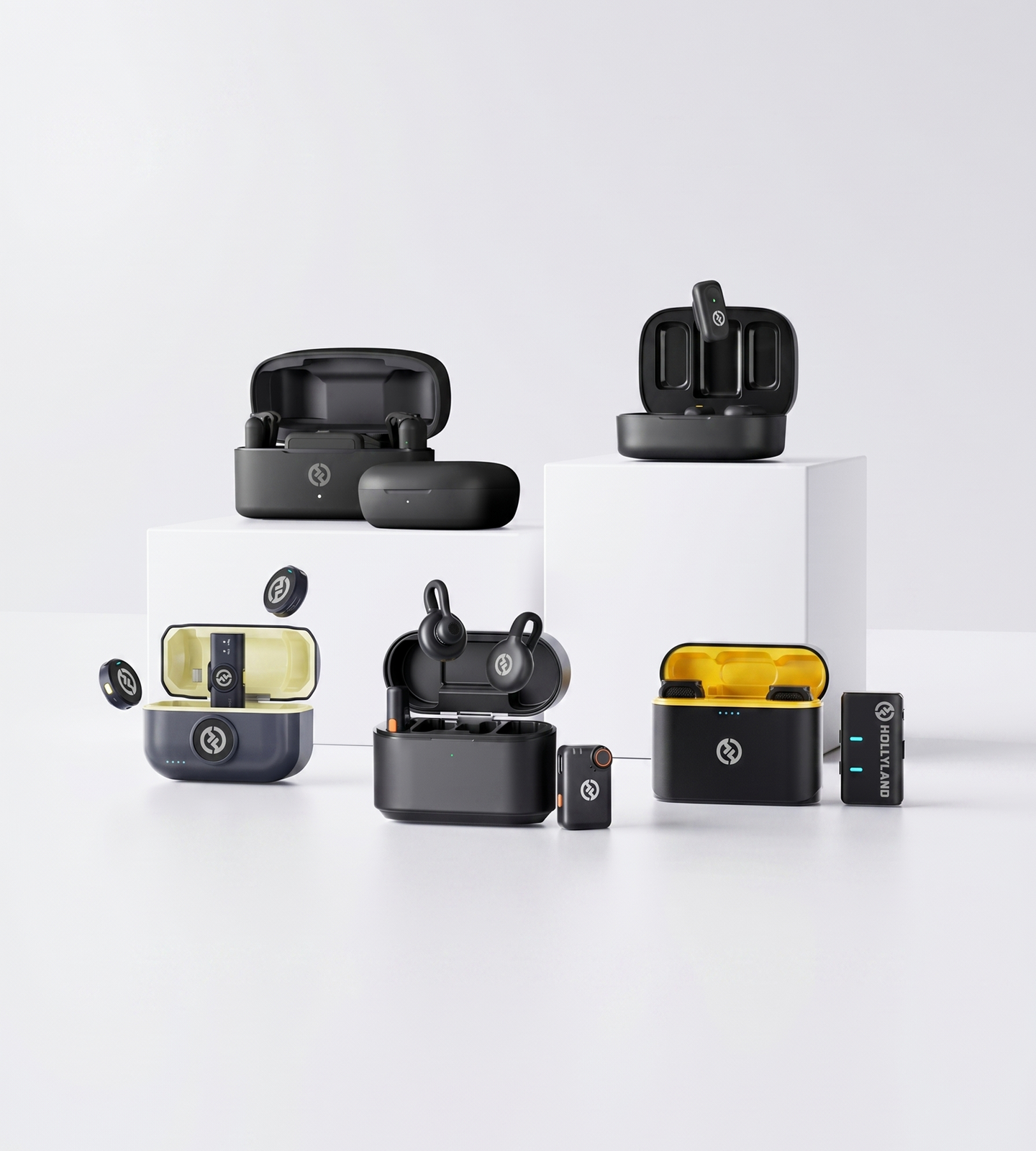
Plug-and-play wireless for vloggers and run-and-gun shooters

No-logo titanium design for professionals shooting on-talent audio

Flagship 32-bit float audio for multi-subject film and event production

32-bit float broadcast audio with scalable 4-TX support and adaptive AI noise cancellation — in a featherweight 9g body

AI-powered clip-and-go wireless mic for smartphones — studio-grade 24-bit audio, plug and play
| Model |
 LARK M2
$68.40
LARK M2
$68.40
|
 LARK M2S
$99.00
LARK M2S
$99.00
|
 LARK MAX 2
$189.00
LARK MAX 2
$189.00
|
 LARK M3
$99.00
LARK M3
$99.00
|
 LARK A2
$29.99
LARK A2
$29.99
|
|---|---|---|---|---|---|
| Recording Format | 48kHz / 24-bit | 48kHz / 24-bit | 48kHz / 32-bit Float | 48kHz / 24-bit & 48kHz / 32-bit Float | 48kHz / 24-bit |
| Wireless Range (LOS) | 300m / 1000ft | 300m / 1000ft | 340m / 1115ft | 300m / 1000ft | 200m / 656ft |
| Noise Cancellation | ENC | ENC | AI Noise Cancellation | AI Noise Cancellation | AI Noise Cancellation |
| Maximum SPL | 115dB | 116dB | 128dB | 125dB | 120dB |
| Transmitter Weight | 9g | 7g | 14g | 9g | 8.5g |
| TX Battery Life | Up to 10 hrs | Up to 9 hrs | Up to 11 hrs | Up to 8 hrs | Up to 7 hrs |
| Camera RX Battery Life | Up to 9 hrs | Up to 8.5 hrs | Up to 12 hrs | Up to 9 hrs | — |
| Multi-TX Support | 2 TX : 1 RX | 2 TX : 1 RX | 4 TX : 1 RX | 4 TX : 4 RX | — |
| Internal Recording | — | — | 32-bit Float, up to 14 hrs | 32-bit Float | — |
| Timecode | — | — | ✓ | — | — |
| Shop | Shop | Shop | Shop | Shop |
Before anything else, confirm the microphone includes a Camera RX (receiver) unit — not just a smartphone adapter. A dedicated camera receiver connects directly to your camera's 3.5mm TRS input, plugs into the cold shoe mount, and delivers audio without adapters or workarounds.
This matters because a mic designed for smartphones may require additional hardware or may not achieve a stable, clean signal chain with your DSLR or mirrorless body.
What to look for:
Range specs are listed in two ways — and both tell you something important:
For most camera shooters, NLOS range is the number that reflects everyday shooting conditions. A mic rated at 300m LOS might perform at 40–70m NLOS, which is still more than enough for interviews, event coverage, and run-and-gun filming.
If you regularly shoot in RF-congested environments — crowded venues, urban locations, or multi-camera productions — prioritize systems with advanced frequency-hopping or adaptive transmission technology.
Audio quality in wireless camera mics breaks down to three core specs:
Sample rate & bit depth: 48kHz / 24-bit is the professional broadcast standard and sufficient for most video productions. For demanding production environments — where audio may be pushed, pulled, or heavily post-processed — 32-bit float recording eliminates clipping risk entirely, capturing a virtually limitless dynamic range at the transmitter level.
Signal-to-Noise Ratio (SNR): Higher SNR means less background hiss in your recordings. Look for ≥70dB for clean, broadcast-quality audio.
Maximum SPL: Determines how loud a sound source the mic can handle before distorting. Higher SPL headroom (115dB+) matters for live events, concerts, or any situation with sudden loud audio peaks.
For professional productions where audio is non-negotiable, a system with 32-bit float internal recording in the transmitter acts as a safety net — even if levels were set incorrectly, the audio is recoverable in post.
Your setup preference will depend heavily on your shooting style:
Plug-and-play systems power on and connect automatically — zero menus, zero pairing screens. Ideal for:
App-controlled systems offer deeper control over gain, EQ, noise cancellation modes, and monitoring — useful when you want to fine-tune audio before it hits the camera, or when shooting in varied acoustic environments.
Some systems offer both modes, letting you default to plug-and-play on fast shoots and switch to app control when precision matters.
Battery life should cover your entire shooting day — not just a session. Key numbers to evaluate:
For most productions, look for 8+ hours per charge on both TX and RX. If you're shooting multi-day events or cannot stop to recharge, prioritize systems with high total battery capacity from the charging case.
The transmitter goes on the subject — clipped to clothing, hidden under a shirt, or attached to a collar. Size and weight directly affect:
Transmitter weights in this category range from 7g to 14g — all genuinely lightweight, but the difference is noticeable when discretion is critical. For narrative, documentary, or branded content where the mic must be invisible, a smaller, no-logo transmitter is worth prioritizing.
Built-in camera audio fails outdoors because it picks up everything — wind, traffic, crowd noise, HVAC hum. Wireless camera mics with ENC (Environmental Noise Cancellation) or AI noise cancellation filter ambient noise at the transmitter level, before audio ever reaches the camera.
If you regularly shoot outdoors or in uncontrolled acoustic spaces, treat noise cancellation as a required feature, not a bonus.
Once you've evaluated the technical specs, the final question is how the system fits your actual production:
| Shooting Style | What to Prioritize |
|---|---|
| Solo vlogging / content creation | Plug-and-play setup, lightweight TX, all-day battery |
| Interview & documentary | Stable NLOS range, discreet TX, reliable noise cancellation |
| Run-and-gun / event video | Fast pairing, rugged build, long battery |
| Multi-subject professional production | Multi-TX support (up to 4 TX), 32-bit float, AI noise cancellation, timecode sync |
For single-speaker shoots with straightforward setups, a compact dual-channel system covers most use cases. For complex productions — panel interviews, multi-camera shoots, or high-stakes recordings — a flagship system with 32-bit float, AI noise cancellation, timecode, and multi-TX support becomes the more reliable investment.
I love my new LARK M2 mics. These were so good, and I really enjoyed testing out the new LARK M2 from Hollyland.
The Hollyland LARK MAX is the wireless microphone system with the clearest and crispest audio of any wireless mic system I have ever tried.
LARK MAX is doing an excellent job of dropping the sound of the air conditioner, which is something l always have to remove and post with our shotgun mic.
 Technical Support:
support.us@hollyland.com
Technical Support:
support.us@hollyland.com
Order Support:
store.us@hollyland.com
Technical Support:
support.us@hollyland.com
Order Support:
store.us@hollyland.com