


LARK M2
Everyday wireless recording for tablet creators
- Plug & Play
- ENC Noise Cancellation
- Up to 300m Range
 United States
(English / $
USD)
United States
(English / $
USD)


Video Solutions

Intercom Systems

Wireless Microphones

Cameras
Video Solutions
View all
Video Accessories
Intercom Accessories

Mic Accessories

Camera Accessories
Video Accessories
View all
Hollyland Monitor Calibrator-Wireless Video Transmission System Accessory

Monitor Hood (7-Inch)

Mars 4K Transmitter

Mars 4K Receiver

D-Tap to Locking DC Power Adapter Cable

Crab Clamp

NP-F970 Battery

NP-F550 Battery

Mini HDMI to HDMI Cable

Micro HDMI to HDMI Cable

SDI Cable (1000mm)

SDI Cable (500mm)

Cold Shoe Gimbal

Rotatable Cold Shoe Mount

Side & Bottom Mounted Aluminum Handle

Screw Fitting for Stabilizer

Cylindrical Antenna (2.4GHz & 5GHz)

Paddle Antenna (2.4GHz & 5GHz)

View all


United States / English
Compatible with iPad (USB-C & Lightning) and Android tablets — plug in and start recording instantly.
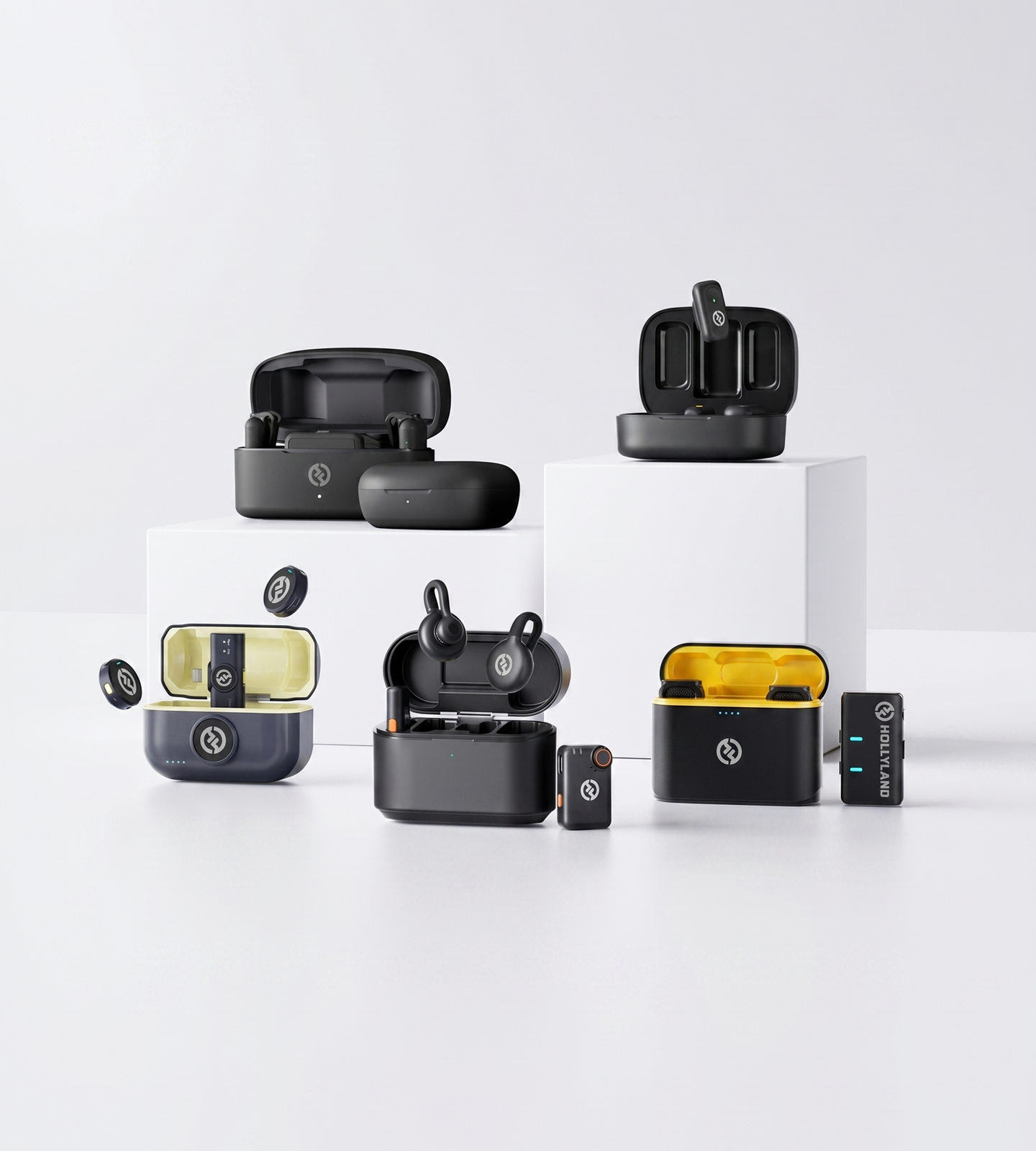
Everyday wireless recording for tablet creators

Ultra-discreet mic for on-camera tablet content

Pro-grade wireless audio for serious tablet production

Precision audio control for educators and podcasters

Broadcast-grade 32-bit float audio in a featherweight 9g body

AI-powered clip-on mic for smartphone creators on the go
| Model |
 LARK M2
$68.40
LARK M2
$68.40
|
 LARK M2S
$99.00
LARK M2S
$99.00
|
 LARK MAX 2
$189.00
LARK MAX 2
$189.00
|
 LARK A1
$35.90
LARK A1
$35.90
|
 LARK M3
$99.00
LARK M3
$99.00
|
 LARK A2
$29.99
LARK A2
$29.99
|
|---|---|---|---|---|---|---|
| Best For | Everyday creators & vloggers | On-camera creators wanting a discreet mic | Professional creators & power users | Educators, podcasters & long-session users | Creators needing broadcast-grade multi-mic audio in a compact system | Smartphone & mobile creators wanting AI audio in a compact clip |
| Tablet Compatibility | iPad & Android (Combo Version) | iPad & Android (Combo Version) | iPad & Android (Mobile / Combo RX) | USB-C & Lightning Tablets | iPad & Android (Combo Version) | Smartphones / Mobile Devices (Plug & Play) |
| Connection Type | Plug & Play | Plug & Play | Plug & Play | Plug & Play | Plug & Play | Plug & Play |
| Noise Cancellation | ENC | ENC | AI Noise Cancellation | 3-Level Intelligent Noise Cancellation | Adaptive AI Noise Cancellation | AI Noise Cancellation |
| Wireless Range (LOS) | 300m / 1000ft | 300m / 1000ft | 340m / 1115ft | 200m / 650ft | 300m / 1000ft | 200m / 656ft |
| Transmitter Weight | 9g | 7g | 14g | 8g | 9g | 8.5g |
| Battery per Charge (TX) | ~10 hrs | ~9 hrs | ~11 hrs | ~9 hrs | ~8 hrs (TX) / ~9 hrs (Camera RX) | ~7 hrs |
| Total Battery Life | Up to 40 hrs | Up to 30 hrs | Up to 36 hrs | Up to 54 hrs | Up to 48 hrs | Up to 42 hrs |
| Recording Format | 48kHz / 24-bit | 48kHz / 24-bit | 48kHz / 32-bit Float | 48kHz / 24-bit | 48kHz / 24-bit & 48kHz / 32-bit Float | 48kHz / 24-bit |
| Shop | Shop | Shop | Shop | Shop | Shop |
Before anything else, confirm that a microphone is physically and functionally compatible with your specific tablet.
Most tablets accept audio input through one of two ports:
What to look for: A wireless microphone with a plug-and-play receiver that outputs directly to your tablet's port — no audio interface, no laptop, no drivers required. The receiver simply connects to your tablet the same way a charging cable would, and your device recognizes it instantly.
If you use multiple devices or want future flexibility, look for a Combo Version that includes both USB-C and Lightning outputs in a single package. This covers your tablet today and your next device tomorrow.
A note on adapters: If a microphone uses a 3.5mm TRS output, you'll need a headphone-jack-to-USB-C or Lightning adapter. This works, but adds a step and a potential point of failure. Native plug-and-play is the cleaner solution for tablet users.
How much setup complexity are you willing to manage? The answer shapes which type of microphone system makes sense.
Plug-and-play microphones connect directly to your tablet's port and begin working immediately — no app, no Bluetooth pairing, no configuration menus. For educators, remote workers, or anyone who just wants to start recording without friction, this is the most accessible experience available.
App-assisted systems layer in additional control through a companion app on your tablet — letting you adjust gain, toggle noise cancellation modes, monitor levels, or check battery status from the same screen you're recording on. For content creators who want precise control without carrying extra hardware, this is a meaningful upgrade.
The good news: many modern tablet microphones support both — plug-and-play by default, with optional app control available when you want it. You don't have to choose one or the other.
Range specs vary significantly across microphone systems, and the right number depends entirely on how you shoot.
LOS (line-of-sight) figures represent open-space ideal conditions. For practical indoor use, always focus on the NLOS figure — it's the more honest measure of how the mic will perform in your actual environment.
The built-in microphone on a tablet is designed for convenience, not quality. It picks up room reflections, handling noise, HVAC hum, and everything else you don't want in your recording.
When evaluating audio quality in a wireless mic system, here are the features that matter most:
For most creators and educators, ENC is the essential baseline. For serious production work or unpredictable recording environments, AI noise cancellation and 32-bit float are worth the step up.
A tablet is already a lightweight, go-anywhere device. The microphone you pair with it should reinforce that portability — not undercut it.
Signs of a tablet-ready form factor:
If you record frequently in public spaces, outdoors, or on location with a tablet, a lighter and more discreet setup will always outperform a larger rig in practice — regardless of spec differences.
Most wireless transmitters in this category deliver 9 to 11 hours per charge — enough to cover a full day of typical use without recharging.
What often matters more than the per-charge figure is the total battery life including the charging case, which can extend usable time significantly across multiple charges without needing a wall outlet.
Questions to ask before you buy:
For short-form content creators and video callers, battery life is rarely a constraint. For full-day workshops, field documentary work, or live event coverage recorded on a tablet, the total case capacity becomes a meaningful differentiator.
Different use cases call for different priorities. Here's a practical framework for narrowing your choice:
Casual creators and first-time buyers Prioritize plug-and-play simplicity and ENC noise cancellation. You want something that works the moment you plug it in — no learning curve, no configuration.
Educators, presenters, and remote professionals Focus on audio clarity, stable wireless connectivity, and confirmed compatibility with your specific tablet model. Gain control is a useful bonus for adapting to different room sizes and microphone distances.
Content creators shooting vlogs, interviews, or social video Look for a compact clip-on transmitter in the lightest weight class, wireless range suited to your shooting style, and optionally app control for real-time adjustments without interrupting your recording.
Creators who need a scalable multi-mic system with broadcast-grade audio The LARK M3 is built for this workflow. At just 9g with 32-bit float recording, adaptive AI noise cancellation, and support for up to 4 TX & 4 RX with 4 independent isolated tracks, it delivers rock-solid 300m wireless transmission and up to 48 hours of total battery life — making it the right step up for panel discussions, multi-speaker interviews, and any production where audio quality and system scalability both matter.
Serious producers using a tablet as part of a larger workflow Consider a premium system with 32-bit float recording, AI noise cancellation, and multi-transmitter support. The LARK MAX 2, for example, supports up to four transmitters on a single receiver — useful for panel discussions, multi-speaker interviews, or complex field productions managed from a tablet.
Smartphone-first creators who want AI audio in the smallest possible package The LARK A2 is built for this workflow. At just 8.5g with plug-and-play smartphone compatibility, AI noise cancellation, AI Auto-Limit clip protection, and up to 42 hours of total battery life, it delivers studio-grade 48kHz / 24-bit audio without adding bulk to your mobile kit.
I love my new LARK M2 mics. These were so good, and I really enjoyed testing out the new LARK M2 from Hollyland.
The Hollyland LARK MAX is the wireless microphone system with the clearest and crispest audio of any wireless mic system I have ever tried.
LARK MAX is doing an excellent job of dropping the sound of the air conditioner, which is something l always have to remove and post with our shotgun mic.
 Technical Support:
support.us@hollyland.com
Technical Support:
support.us@hollyland.com
Order Support:
store.us@hollyland.com
Technical Support:
support.us@hollyland.com
Order Support:
store.us@hollyland.com