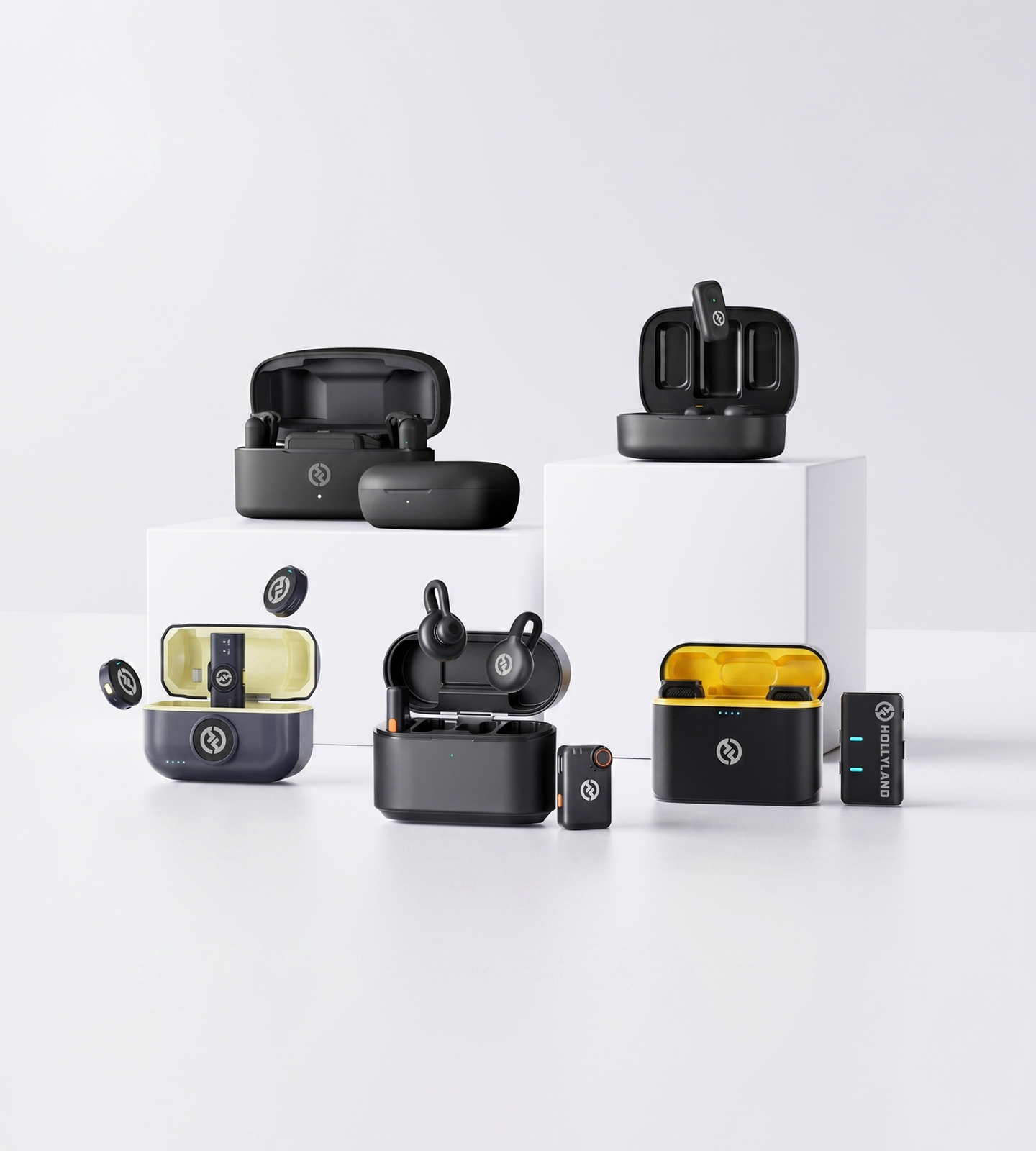
For iPhone

Interview Microphones for iPhone

Capture professional interview audio directly on your iPhone — no extra gear needed. Hollyland's wireless clip-on microphones deliver plug-and-play simplicity, ENC and AI noise cancellation, and all-day battery life for journalists, creators, and filmmakers on any shoot.
Shop Now Compare Models

Plug-and-play with Lightning & USB-C iPhones · No adapter required

  • iPhone Plug-and-Play
  • ENC & AI Noise Cancellation
  • Up to 54H Total Battery
  • Ultra-Light from 7g
Interview Microphones for iPhone
Editor's pickLARK M2SNo-Logo · 7g Titanium
4.7 / 5From 1.5M+ verified creators
Shop Models

Find the Right Interview Mic

Four wireless mics built for iPhone — each one matched to a different interview workflow.
LARK M2

LARK M2

Everyday interviews, plug in and go

  • Plug & Play
  • ENC Noise Cancellation
  • 9g TX
$76.00
LARK M2S

LARK M2S

When the mic can't be seen on camera

  • No-Logo Design
  • 7g TX
  • Titanium Build
$89.00
LARK MAX 2

LARK MAX 2

Pro-grade audio for multi-mic interview setups

  • 32-Bit Float Recording
  • Up to 4 Transmitters
  • AI Noise Cancellation
$189.00
LARK A1

LARK A1

Full audio control for unpredictable environments

  • 3-Level Noise Cancellation
  • 6-Level Gain Adjustment
  • 54-hr Total Battery
$35.90
Side-by-side

Find Your Interview Mic

Compare key specs to find the right Hollyland wireless mic for your iPhone interview setup.
Model LARK M2 LARK M2 $76.00 LARK M2S LARK M2S $89.00 LARK MAX 2 LARK MAX 2 $189.00 LARK A1 LARK A1 $35.90
Best ForEveryday field & duo interviews On-camera interviews, invisible look Pro, panel & documentary interviews Street interviews & noisy environments
iPhone ConnectionPlug & Play (Lightning or USB-C) Plug & Play (Lightning or USB-C) USB-C (iPhone 15+) Plug & Play
Noise CancellationENC ENC AI Noise Cancellation 3-Level Intelligent ENC
Wireless Range (NLOS)60m 60m 70m 200m (LOS)
TX Battery Life10 hrs 9 hrs 11 hrs 9 hrs
Total Battery Life40 hrs 30 hrs 36 hrs 54 hrs
Transmitter Weight9g 7g 14g 8g
Recording Format48kHz / 24-bit 48kHz / 24-bit 48kHz / 32-bit Float 48kHz / 24-bit
Max TX Channels2 2 4 2
Shop Shop Shop Shop
Buying Guide

How to Choose an Interview Microphone for iPhone

Not every wireless mic is built for interview work — and not every mic marketed as 'iPhone compatible' will actually plug straight into your device. Here's what to look for before you buy.
  1. iPhone Compatibility: Check Your…
  2. Noise Cancellation: Non-Negotiable…
  3. Wireless Range and Signal…
  4. Battery Life: Plan for a Full…
  5. Size, Weight, and On-Camera…
  6. One Speaker or Two? Match the Mic…
  7. Audio Control: Simple vs. Pro
  8. Quick Decision Summary

iPhone Compatibility: Check Your Port First

Before anything else, confirm which connector your iPhone uses.

  • iPhone 15 and later use USB-C — compatible with USB-C receiver outputs
  • iPhone 14 and earlier use Lightning — requires a Lightning-compatible receiver or an adapter

The easiest workflow is plug-and-play: a mic that connects directly to your iPhone's port with no app, driver, or external recorder required. This matters most in fast-moving interview situations — street vox-pops, run-and-gun documentary moments, or any setting where you don't have time to troubleshoot.

If you want additional control through a companion app (EQ, gain, monitoring), look for mics that offer app control as an option rather than a requirement. The best setups work straight out of the box and get smarter when you want them to.


Noise Cancellation: Non-Negotiable for Outdoor Interviews

Background noise is the most common reason interview audio becomes unusable. Wind, traffic, crowds, HVAC hum — any of these can overwhelm a recording made without proper noise management.

When evaluating noise cancellation, look for:

  • ENC (Environmental Noise Cancellation) — hardware-level filtering that works at the microphone capsule, reducing ambient noise before it ever reaches your phone
  • AI Noise Cancellation — software-driven processing that separates voice from background noise in real time; better suited to complex or unpredictable acoustic environments
  • Multi-level noise cancellation — the ability to dial up or down the strength of filtering depending on your environment gives you more flexibility across interview settings

For controlled indoor interviews, basic noise handling is usually sufficient. For outdoor fieldwork or public spaces, prioritize stronger, more adaptable noise cancellation.


Wireless Range and Signal Reliability

Wireless freedom matters more than many buyers anticipate — especially when the subject is moving, the space is large, or you're working with a separate camera operator.

Key things to consider:

  • LOS (Line of Sight) range is measured in open space. Real-world NLOS (Non-Line of Sight) range — through walls, around corners, in crowded spaces — is always shorter and more relevant to actual use.
  • For most interview scenarios, NLOS range in the 40–70m range is more than adequate
  • For multi-room setups, large venues, or documentary work, a higher NLOS range reduces the risk of signal dropout mid-interview

Audio sync is a related concern. Look for mics with low-latency wireless transmission to avoid noticeable delay between your subject's lips and the recorded audio — particularly important if you're also capturing video.


Battery Life: Plan for a Full Shooting Day

A microphone that dies mid-interview is worse than no microphone at all. Battery reliability is especially critical for journalists, documentary filmmakers, and anyone shooting back-to-back sessions.

What to look for:

  • Transmitter battery life of at least 8–10 hours per charge covers most full shooting days
  • A charging case that extends total battery capacity to 30–50+ hours means you can recharge transmitters between sessions without needing a wall outlet
  • Internal recording capability on the transmitter — where audio is saved directly to the mic itself as a backup — protects you if the wireless connection is interrupted

If you're shooting in locations without reliable power access, total case battery capacity matters as much as single-charge TX life.


Size, Weight, and On-Camera Appearance

For interview use, the microphone sits on your subject — often on camera, in frame. Size and visual discretion matter.

  • Transmitter weight in the 7–10g range is light enough that subjects don't notice it
  • A compact clip-on form factor keeps the mic close to the lapel without bulk
  • No-logo or minimal-branding designs are a meaningful consideration for professional productions where branded hardware in the shot can look out of place — the LARK M2S was designed specifically with this in mind
  • If the mic will occasionally be visible on camera, a neutral color finish blends more easily against clothing

One Speaker or Two? Match the Mic Count to Your Format

Your interview format determines how many transmitters you need.

Single-speaker formats (solo host, one subject):

  • A single TX + RX system is all you need
  • Simpler, lighter, faster to set up

Two-person interview formats (interviewer + subject on separate mics):

  • Look for a system that supports dual transmitters on a single receiver — this keeps your iPhone as the only recording device
  • Dual-TX systems give you independent audio tracks per speaker, which is significantly easier to edit in post

Multi-speaker or panel formats (three or more speakers):

  • Requires a receiver that can handle 3–4 transmitters simultaneously — a configuration suited to professional documentary or broadcast setups rather than casual content creation

Audio Control: Simple vs. Pro

Not every interviewer needs deep audio control. Know how much flexibility you actually need.

If you want simplicity: Look for plug-and-play mics with automatic gain and minimal settings. The fewer decisions required before pressing record, the better — especially in time-pressured field situations.

If you want control: Features like multi-level gain adjustment, EQ, and auto-limit clip protection let you dial in audio for different environments and protect against sudden loud sounds (a common issue in unpredictable field interviews). The LARK A1's 6-level gain adjustment and auto-limit make it well-suited to interviewers who want that hands-on flexibility.

If you need professional-grade capture: 32-bit float recording is the key specification for high-stakes interview work. It captures a dramatically wider dynamic range, meaning even if your gain is slightly off, the audio is recoverable in post — a critical safety net when you can't stop and redo a take. This capability is most relevant for documentary filmmakers, broadcast journalists, and professional videographers, and is found in the LARK MAX 2.


Quick Decision Summary

Your Priority What to Look For
Fastest setup, plug and play USB-C or Lightning direct connection, no app required
Outdoor interview reliability Strong ENC or AI noise cancellation
All-day shooting 10h+ TX battery; high-capacity charging case
Two-person interviews Dual-TX system with single receiver
Invisible on camera Ultra-light, logo-free transmitter design
Professional / broadcast quality 32-bit float recording, AI noise cancellation, multi-TX support
Use Cases

From Street Corners to Studio Sit-Downs

Every interview format comes with its own challenges. This collection is built to handle all of them — wireless freedom, clean dialogue capture, and plug-and-play simplicity, straight from your iPhone.

Field & Outdoor Interviews

Wind, traffic, and crowd noise don't have to ruin your takes. ENC noise cancellation isolates your subject's voice from the environment around it, so you come back from location with usable audio — every time.
  • On-Location
  • Noise Cancellation
  • Wireless Range

YouTube & On-Camera Interviews

Clip a transmitter on each speaker and let your iPhone handle the rest. Lightweight, low-profile mics stay out of the frame while you stay focused on the conversation — not the gear.
  • Two-Person Format
  • Clean Dialogue
  • Camera-Ready

Street & Vox-Pop Interviews

You have about ten seconds before the moment passes. Plug into your iPhone, clip on the transmitter, and start recording — no menus to dig through, no pairing ritual, no missed opportunity.
  • Fast Setup
  • Minimal Gear
  • Spontaneous Shooting

Studio & Sit-Down Interviews

When the environment is controlled, the audio should be flawless. Capture warm, natural dialogue at 48kHz/24-bit with a clip-on transmitter small enough to disappear on a lapel and clean enough to skip post-production cleanup.
  • Studio Quality
  • Broadcast-Ready
  • Lapel Format

Documentary & Multi-Speaker Shoots

Panel discussions, roundtable shoots, and multi-subject documentary setups need more than one mic. Connect up to four transmitters to a single receiver, back everything up with 32-bit float internal recording, and never lose a take to clipping or an unexpected level spike.
  • Multi-Mic Setup
  • 32-bit Float
  • Advanced Workflow

Run-and-Gun Mobile Creation

Your iPhone is the entire kit. Plug in directly via Lightning or USB-C, clip on the transmitter, and hit record. No external recorder, no audio interface, no extra weight — just professional sound captured into the device already in your pocket.
  • iPhone Native
  • Solo Operator
  • Plug & Play
Trusted by creators

1.5M+ creators picked LARK microphones for their audio

A decade of wireless engineering for film crews and broadcasters — packaged for modern creator workflows.
  • 4.7 Avg. rating · 120K+ reviews
  • 1.5M+ Verified creators
  • 160+ Countries shipped
  • 98% Would recommend

I love my new LARK M2 mics. These were so good, and I really enjoyed testing out the new LARK M2 from Hollyland.

Sarah GraceSarah GraceTech Creator · 3.2M YouTube subscribers

The Hollyland LARK MAX is the wireless microphone system with the clearest and crispest audio of any wireless mic system I have ever tried.

GoenrockGoenrockCinematographer · 107K Instagram subscribers

LARK MAX is doing an excellent job of dropping the sound of the air conditioner, which is something l always have to remove and post with our shotgun mic.

Film RiotFilm RiotFilmmaking Educator · 2.2M YouTube subscribers
  • No Film School
  • Newsshooter
  • CineD
  • RedShark
  • CAMERA JABBER
  • Photowebexpo
FAQ

Your Questions About iPhone Interview Microphones, Answered

Are these microphones actually compatible with my iPhone?
Yes — and compatibility is built in from the start, not handled through a workaround. The **LARK M2**, **LARK M2S**, and **LARK A1** are all available in Mobile Versions that connect directly to your iPhone via plug-and-play — no adapter, no driver installation, no configuration required before you can start recording. If you're shooting on an **iPhone 15 or later** with a USB-C port, the **LARK MAX 2** connects directly via USB-C. When ordering, confirm the connector type on your iPhone model and match it to the correct receiver version to ensure a cable-free, straight-in fit.
Will background noise ruin my outdoor interview recordings?
Not with active noise reduction working in your favor. Every microphone on this page is equipped to handle noisy, uncontrolled environments: - **LARK M2** and **LARK M2S** both feature **ENC (Environmental Noise Cancellation)** to suppress wind, traffic, and ambient crowd noise at the transmitter level — before audio even reaches your iPhone. - **LARK A1** offers **3-level intelligent noise cancellation**, so you can dial in more or less suppression depending on how loud your environment actually is. - **LARK MAX 2** applies **AI noise cancellation** for the most demanding conditions, and its **32-bit float recording** captures such a wide dynamic range that audio remains clean and recoverable even when levels spike unexpectedly. For outdoor field interviews, street vox-pops, or any location where you can't control the acoustic environment, all four options will produce dramatically cleaner dialogue than a built-in phone microphone.
Is wireless audio reliable enough for a professional interview?
Yes. These are purpose-built wireless systems using dedicated 2.4GHz transmission — not consumer Bluetooth, which is where stability problems typically originate. Operating ranges in real-world NLOS conditions (walls, furniture, moving bodies between transmitter and receiver) are **60m for the LARK M2 and M2S**, **200m line-of-sight for the LARK A1**, and **70m NLOS for the LARK MAX 2**. For any standard interview setup where the subject and camera are within the same room or within typical outdoor shooting distances, all four deliver a stable, dropout-resistant signal. The **LARK MAX 2** adds **low-latency wireless audio monitoring** via its OWS earphone, so you can catch audio problems as they happen rather than discovering them in post.
How long will the battery last during a full day of shooting?
Long enough to cover most production days without stopping to recharge: - **LARK M2**: ~**10 hours** per TX charge; up to **40 hours total** with the charging case - **LARK M2S**: ~**9 hours** per TX charge; up to **30 hours total** with the charging case - **LARK A1**: ~**9 hours** per TX charge; up to **54 hours total** with the charging case — the highest reserve capacity on this page - **LARK MAX 2**: ~**11 hours** per mic charge; up to **36 hours total**, plus each transmitter holds up to **14 hours of internal backup recording** independently of your iPhone For multi-session days or back-to-back interview shoots, the charging case keeps transmitters topped up between setups without requiring a wall outlet mid-production.
Will the microphone clip be visible on camera and look unprofessional?
These microphones are engineered to minimize their on-screen presence. The **LARK M2** transmitter weighs **9g** — about the weight of a few coins — and clips flat under a lapel or collar without creating a noticeable bulge. The **LARK M2S** is even more discreet: at **7g** with a **no-logo invisible fit design**, it's purpose-built for interviews where the mic needs to disappear entirely from frame. The **LARK A1** uses a magnetic clip at **8g** for fast, flat attachment with minimal footprint. If aesthetics matter — particularly for corporate video, documentary-style interviews, or any shoot where a clean look is non-negotiable — the **LARK M2S** is the option designed specifically for that requirement.
How fast can I set up and start recording in the field?
Fast enough for spontaneous, run-and-gun situations. The **LARK M2**, **LARK M2S**, and **LARK A1** are all plug-and-play out of the case — clip the transmitter onto your subject, connect the receiver to your iPhone, and audio begins flowing immediately. There's no manual channel pairing, no Bluetooth discovery process, and no latency calibration before you can roll. For more complex setups, the **LARK MAX 2** supports up to **4 transmitters on a single receiver simultaneously**, which means a panel interview or multi-subject shoot can be wired and live in minutes rather than requiring a full pre-production workflow.
Will there be audio sync issues when recording wirelessly to my iPhone?
No meaningful sync drift in standard use. All four systems transmit over dedicated 2.4GHz wireless with low-latency protocols built for video production, which keeps audio locked to video without any manual offset correction. For simple single-iPhone setups with the **M2**, **M2S**, or **A1**, audio and picture stay in sync without any extra steps. The **LARK MAX 2** adds **Timecode support** for multi-camera or multi-recorder interview productions where you need to sync across separate devices in post — a standard requirement on documentary and broadcast shoots.
Which microphone is right for my interview style?
It depends on how and where you shoot: - **Starting out or need a dependable everyday option?** The **LARK M2** covers the core requirements — plug-and-play iPhone compatibility, ENC noise cancellation, a 10-hour TX battery, and a 9g clip-on transmitter — at an accessible entry point. - **Need the mic to be completely invisible on camera?** The **LARK M2S** adds a no-logo design and titanium build specifically for interviews where on-screen aesthetics matter. - **Shooting in loud or unpredictable environments?** The **LARK A1** gives you 3-level adjustable noise cancellation, 6-level gain control, and auto-limit clip protection — more hands-on control for journalists and field reporters dealing with variable audio conditions. - **Running multi-person interviews, documentary productions, or broadcast-level shoots?** The **LARK MAX 2** delivers 32-bit float recording, AI noise cancellation, timecode, and support for up to 4 simultaneous transmitters — the complete professional toolkit for complex interview formats.
Explore further

A few more places to go from here

A curated link map of the surrounding content — related categories, the most useful guides, head-to-head comparisons and setup help.
Ready when you are

Find the Interview Mic That Fits Your Workflow

Plug-and-play iPhone compatible, from 7g transmitters to 32-bit float recording — explore the range.
Shop Now Compare Models
  • Free shipping over $99
  • 30-day returns
  • 1-year warranty