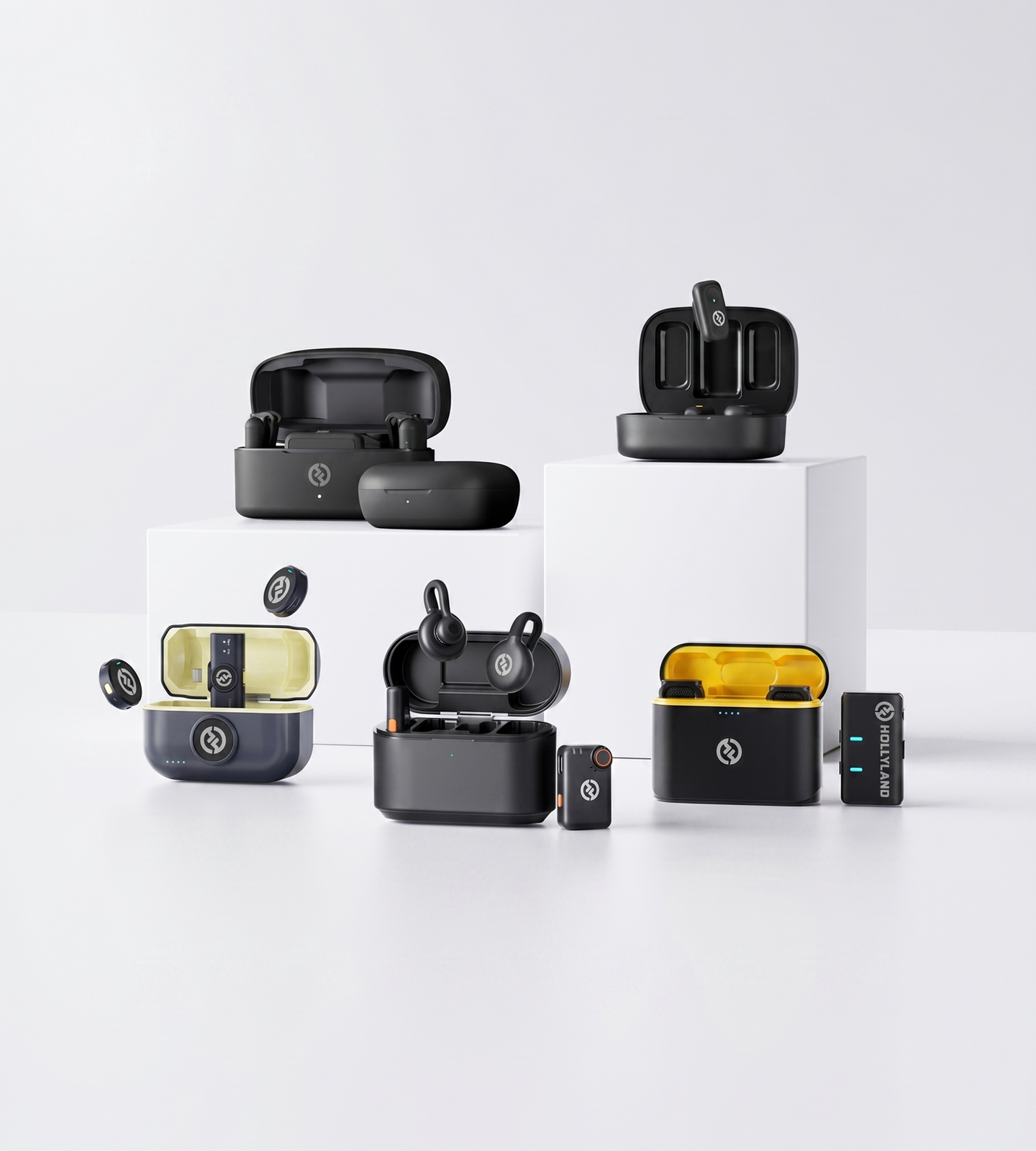
iPhone Audio Upgrade

Microphones with Noise Cancellation for iPhone

Your iPhone records everything — your voice and the noise around it. Hollyland's wireless mics bring ENC and AI noise cancellation to iPhone, delivering studio-clean audio on streets, stages, and everywhere in between. Plug in, clip on, and sound professional instantly.
Shop Now Compare Models

Works with iPhone (USB-C & Lightning) · Plug-and-play setup · No adapters or drivers needed

  • ENC & AI Noise Cancellation
  • Plug-and-Play iPhone Ready
  • Wireless Up to 340m Range
  • Ultra-Light — From 7g
Microphones with Noise Cancellation for iPhone
Editor's pickLARK MAX 2AI Noise Cancellation · 32-bit Float
4.7 / 5From 1.5M+ verified creators
Shop Models

Pick Your Mic

Four wireless mics with active noise cancellation — matched to every iPhone workflow.
LARK M2

LARK M2

The plug-and-play pick for everyday iPhone creators

  • ENC
  • 9g transmitter
  • App control
$76.00
LARK M2S

LARK M2S

Stay invisible on camera, sound crystal clear

  • No-logo invisible design
  • ENC
  • 7g transmitter
$89.00
LARK MAX 2

LARK MAX 2

Pro-grade AI noise cancellation for serious shooters

  • AI Noise Cancellation
  • 32-bit Float
  • 340m range
$189.00
LARK A1

LARK A1

Three noise cancellation levels for unpredictable environments

  • 3-Level Noise Cancellation
  • 128dB SPL
  • 54hr total battery
$35.90
Side-by-side

Compare Noise-Cancelling Mics

Match the right wireless mic to your iPhone setup and shooting style.
Model LARK M2 LARK M2 $76.00 LARK M2S LARK M2S $89.00 LARK MAX 2 LARK MAX 2 $189.00 LARK A1 LARK A1 $35.90
Noise CancellationENC Environmental ENC Environmental AI Noise Cancellation 3-Level Intelligent NC
Transmitter Weight9g 7g 14g 8g
Wireless Range (LOS)300m / 1,000ft 300m / 1,000ft 340m / 1,115ft 200m / 650ft
Total Battery Life40 hours 30 hours 36 hours 54 hours
Recording Format48kHz / 24-bit 48kHz / 24-bit 48kHz / 32-bit Float 48kHz / 24-bit
Max SPL115dB 116dB 128dB 128dB
Signal-to-Noise Ratio>70dB >70dB ≥72dB ≥67dB
Internal RecordingUp to 14 hours
Shop Shop Shop Shop
Buying Guide

How to Choose the Right iPhone Microphone with Noise Cancellation

Not all noise cancellation is the same — and the microphone that suits a studio podcaster won't necessarily suit a travel vlogger. Use this guide to understand the key factors that separate one option from another, so you can match the right mic to your iPhone, your environment, and how you actually work.
  1. Understand the Type of Noise…
  2. iPhone Compatibility: What 'Plug…
  3. Wireless Range: Match the Spec to…
  4. Form Factor and On-Camera Discretion
  5. Battery Life: Plan for Your…
  6. Audio Quality Beyond the Noise…
  7. Simplicity vs. Control: Match the…
  8. Quick-Reference Decision Framework

Understand the Type of Noise Cancellation First

Noise cancellation is the core reason most iPhone creators upgrade from the built-in microphone — but the term covers a range of technologies with real performance differences.

ENC (Environmental Noise Cancellation) The standard across most professional wireless lavalier systems. ENC uses the microphone's polar pattern and onboard DSP processing to reduce steady-state background noise: HVAC hum, ambient crowd murmur, wind. It works reliably across a wide range of environments and is a strong baseline for content creators, interviewers, and business professionals.

Multi-Level Intelligent Noise Cancellation A more adaptable approach that lets you adjust suppression intensity to match your environment. If you regularly move between quiet studios, noisy streets, and busy events, this gives you the flexibility to dial the effect up or down rather than applying a fixed filter — useful for creators who want manual control without sacrificing simplicity.

AI Noise Cancellation The most advanced tier. AI-based systems analyze incoming audio in real time, continuously separating voice from complex or unpredictable background noise. This is the right choice for serious creators, field journalists, or professionals shooting in environments where noise is loud, layered, or constantly changing.

Quick rule: For predictable indoor environments, ENC handles the job well. For outdoor, high-noise, or variable shooting conditions, prioritize AI or multi-level noise cancellation.


iPhone Compatibility: What 'Plug and Play' Actually Means

Before anything else, confirm two things about any wireless microphone you're considering for iPhone use:

  • Connector type — iPhone 15 and later models use USB-C. Older iPhones use Lightning. The receiver included in the kit must match your iPhone's port — or choose a combo kit that covers both.
  • True plug-and-play operation — A genuine plug-and-play wireless mic requires no app installation, no driver setup, and no Bluetooth pairing. Insert the receiver, open your recording app, and the microphone is recognized immediately as the active audio input. This is the baseline standard — verify it before purchasing.

A critical clarification about iPhone's built-in noise cancellation: Apple's Voice Isolation feature — which suppresses background noise during FaceTime and phone calls — is not active during video recording, Voice Memos, or third-party audio apps. When you're shooting content or recording audio outside of a call context, the iPhone's built-in noise cancellation is off entirely. An external microphone with its own noise cancellation hardware is the only reliable path to clean recordings in these scenarios.


Wireless Range: Match the Spec to Your Reality

Transmission range is typically listed under two conditions — and only one of them reflects real-world use:

  • LOS (Line of Sight) — Maximum range in open, unobstructed space
  • NLOS (Non-Line of Sight) — Through walls, around obstacles, in actual indoor environments

For most iPhone creators — vlogging within a room, recording interviews, shooting social media content — NLOS range is the number that matters most. A NLOS range of around 60m (approximately 200ft) comfortably covers the vast majority of typical recording scenarios.

For larger venues, events, or situations where transmitter and receiver need significant physical separation, prioritize systems with extended NLOS ratings.

Also factor in your RF environment. Markets, conference centers, and public spaces generate dense wireless traffic that can cause interference. Systems built on stable, interference-resistant transmission protocols will hold the connection where others drop out.


Form Factor and On-Camera Discretion

When you appear on camera, the transmitter clip becomes part of the visual frame. Several considerations apply:

  • Weight — Lightweight transmitters under 10g are more comfortable during extended wear and less likely to pull on fabric. The difference is noticeable over a long shooting day.
  • Logo visibility — If you're regularly on camera and prefer a brand-neutral appearance, choose a transmitter with a minimal or no-logo design. Some models are specifically designed to disappear against clothing.
  • Attachment mechanism — Magnetic clips allow fast, tool-free attachment and removal without snagging fabric — a practical advantage for run-and-gun workflows or high-volume shooting days.

Battery Life: Plan for Your Longest Shoot

Evaluate battery in two ways, not one:

  • Battery per charge (transmitter) — How long a single session runs before recharging is needed. Most wireless lavalier transmitters in this category offer between 9–11 hours per charge, which covers most single-day shoots.
  • Total battery life with charging case — The case extends usable time between wall power access. If you're shooting across multiple sessions in the field without easy access to charging, a higher total battery reserve significantly reduces risk mid-shoot.

If you're planning full-day or multi-session shoots — events, travel, extended interview days — prioritize total battery capacity over per-charge figures alone.


Audio Quality Beyond the Noise Cancellation

Noise cancellation removes what shouldn't be there. What remains still needs to sound good. Key specifications to evaluate:

Bit depth and recording format

  • 24-bit / 48kHz is the professional standard. It captures clean, full-fidelity audio with sufficient dynamic headroom for most recording scenarios.
  • 32-bit float recording — available on higher-end systems — provides a substantially wider dynamic range. Audio captured in 32-bit float can be recovered in post-production even if gain was set incorrectly, which is a meaningful safety net when monitoring closely isn't possible during a shoot.

SNR (Signal-to-Noise Ratio) A higher SNR means the microphone captures your voice more cleanly relative to its own internal electronic noise. Look for systems rated at ≥70dB SNR for reliably professional-quality results.

Maximum SPL If you record in loud environments — concerts, crowded venues, live events — a higher maximum SPL rating means the microphone handles loud sound sources without distorting. Systems rated at 128dB SPL can handle extreme sound pressure without clipping.


Simplicity vs. Control: Match the Mic to Your Workflow

The right feature set depends on how you actually work — not just what looks impressive on a spec sheet.

If you want to record and go: Prioritize plug-and-play operation, automatic noise cancellation with no manual adjustment, and a minimal-button workflow. The fewer steps between picking up your iPhone and capturing clean audio, the better. This approach suits beginners, social media creators, and anyone shooting fast-moving content.

If you want more control: Look for systems offering adjustable noise cancellation levels, onboard gain adjustment, EQ settings, or a companion iOS app that lets you monitor and fine-tune settings from your iPhone in real time. This is valuable when acoustic conditions vary significantly between shoots, or when you want audio as close to finished as possible before post-production.

If you're recording multiple speakers: Check whether the receiver can connect to multiple transmitters simultaneously. Some systems support up to 4 transmitters on a single receiver, which enables multi-person interviews, panel discussions, or group content without requiring separate recording setups — a significant workflow advantage for podcasters and journalists.


Quick-Reference Decision Framework

Your Priority What to Look For
Simplest iPhone setup Plug-and-play receiver · ENC · minimal button layout
On-camera aesthetics No-logo transmitter design · under 10g · magnetic clip
Loudest recording environments AI Noise Cancellation · 128dB SPL handling
Maximum audio fidelity 32-bit float recording · ≥72dB SNR
Full-day or multi-session shoots High total battery life with charging case
Multi-speaker or interview recording System supporting multiple TX per single RX
First-time external mic buyer Plug-and-play · automatic NC · companion app support
Where It Works

Built for the Environments That Challenge Your iPhone Mic

Your iPhone microphone doesn't discriminate — it captures everything around you, not just your voice. These wireless microphones are built for the real-world situations where built-in audio falls apart, from gusty city streets to echo-heavy conference rooms.

Outdoor Vlogging & Travel Content

Wind gusts, traffic, and crowd noise are constant threats the moment you step outside to shoot. ENC-equipped clip-on transmitters actively isolate your voice from surrounding interference, so destination vlogs and street walk-and-talks stay clear no matter how loud the environment gets.
  • Outdoor Recording
  • Wind Noise Rejection
  • Travel Vlogging

Podcasts & On-Location Interviews

HVAC hum, room reverb, and background chatter are the quiet killers of indoor audio. Multi-level noise cancellation lets you dial in exactly how much of the room makes it into your recording, keeping every conversation focused, warm, and listenable from the first take.
  • Indoor Recording
  • Podcast
  • Interview Audio

Social Media & Short-Form Content

Audiences scroll past bad audio as fast as bad visuals. Plug-and-play wireless mics connect directly to your iPhone — no adapters, no setup friction — so voiceovers, product reviews, and on-camera commentary always sound polished, even when you're recording solo in an imperfect space.
  • Short-Form Video
  • Voiceover
  • On-Camera Audio

Mobile Meetings & Business Presentations

Coffee shops, open offices, and co-working spaces were never built for clear audio. When your iPhone is your boardroom, a wireless mic with noise cancellation ensures colleagues hear only your voice — not the espresso machine, the air conditioning, or the conversation at the next table.
  • Video Calls
  • Remote Work
  • Voice Clarity

Field Journalism & Documentary

Real-world reporting doesn't wait for a quiet moment. AI noise cancellation and 32-bit float internal recording protect every take from unpredictable acoustic conditions — giving you broadcast-quality speech in press conferences, protest sites, or anywhere the environment is completely out of your control.
  • Field Recording
  • Documentary
  • Run-and-Gun
Trusted by creators

1.5M+ creators picked LARK microphones for their audio

A decade of wireless engineering for film crews and broadcasters — packaged for modern creator workflows.
  • 4.7 Avg. rating · 120K+ reviews
  • 1.5M+ Verified creators
  • 160+ Countries shipped
  • 98% Would recommend

I love my new LARK M2 mics. These were so good, and I really enjoyed testing out the new LARK M2 from Hollyland.

Sarah GraceSarah GraceTech Creator · 3.2M YouTube subscribers

The Hollyland LARK MAX is the wireless microphone system with the clearest and crispest audio of any wireless mic system I have ever tried.

GoenrockGoenrockCinematographer · 107K Instagram subscribers

LARK MAX is doing an excellent job of dropping the sound of the air conditioner, which is something l always have to remove and post with our shotgun mic.

Film RiotFilm RiotFilmmaking Educator · 2.2M YouTube subscribers
  • No Film School
  • Newsshooter
  • CineD
  • RedShark
  • CAMERA JABBER
  • Photowebexpo
FAQ

Your iPhone Audio Questions, Answered

Does the iPhone's built-in noise cancellation work when I'm recording video or audio?
No — and this is one of the most common misunderstandings. Apple's built-in noise cancellation applies **only to phone and FaceTime calls**, not to recordings made in the Camera app, Voice Memos, TikTok, YouTube, or any other recording app. In those scenarios, your iPhone captures raw audio from its built-in microphone, meaning every gust of wind, background voice, and HVAC hum gets recorded alongside your own. An external wireless microphone with dedicated noise cancellation — like the LARK M2, LARK M2S, LARK A1, or LARK MAX 2 — brings real, active noise suppression to every recording scenario, regardless of which app you're using.
Are these microphones compatible with my iPhone model?
Yes, all four microphones in this collection are designed for plug-and-play iPhone compatibility. **iPhones from 2023 onward (iPhone 15 and later) use USB-C**, while older models use Lightning. Before purchasing, check the product page to confirm you're selecting the correct mobile version for your specific iPhone. If you record across multiple devices — iPhone, Android, or camera — the **Combo versions of the LARK M2 and LARK M2S** offer universal compatibility out of the box.
Do I need a special app or adapter to use these microphones with my iPhone?
No adapter is required. Every microphone in this collection connects directly to your iPhone and works immediately — open any recording or camera app and you're live. For added flexibility, the **LARK M2** and **LARK M2S** offer an optional iOS companion app that lets you toggle ENC, adjust gain, and monitor audio — but the app is never required for basic operation. The **LARK A1** puts noise cancellation level switching and 6-step gain control directly on the hardware itself, so there's nothing to install.
Is the noise cancellation actually noticeable, or is it just a marketing claim?
The difference is clearly audible in real-world conditions. These microphones use dedicated noise cancellation hardware — not software post-processing — built into the transmitter itself. - **LARK M2 & LARK M2S** — ENC (Environmental Noise Cancellation) actively filters ambient noise while preserving the natural tone of your voice. - **LARK A1** — 3-Level Intelligent Noise Cancellation lets you select the right suppression intensity for your environment: lighter for quiet indoor spaces, stronger for busy streets or crowds. - **LARK MAX 2** — AI Noise Cancellation, the most advanced tier in the lineup, intelligently separates your voice from background noise in real time. All four operate at **48kHz / 24-bit audio** (the LARK MAX 2 supports **32-bit float**), with SNR ratings up to 72dB — so you're not just removing noise, you're capturing genuinely clean, high-fidelity audio.
Will the microphone transmitter be visible on camera?
These transmitters are engineered to be as discreet as possible. The **LARK M2** weighs just **9g** and is designed with a button-sized form factor that clips neatly under a collar or lapel. The **LARK M2S** takes it even further — at **7g** and featuring a **no-logo invisible fit** design, it's built specifically for on-camera talent who want a clean, unbranded look. Both can be positioned inside clothing without affecting wireless performance.
What is the wireless range, and will the signal stay stable in crowded environments?
Range and NLOS (non-line-of-sight) performance are both strong across the lineup: - **LARK M2 & LARK M2S** — Up to **300m / 1,000ft (LOS)**; 60m NLOS for the mobile version - **LARK A1** — Up to **200m / 650ft (LOS)** - **LARK MAX 2** — Up to **340m / 1,115ft (LOS)**; 70m NLOS For real-world shooting in crowded RF environments — events, markets, busy streets — NLOS performance is the more practical figure. All models use stable 2.4GHz digital transmission designed for unpredictable field conditions. The LARK MAX 2 also supports **internal 32-bit float recording** on the transmitter itself, so even if a wireless dropout does occur, your audio is never lost.
What's the difference between ENC, 3-Level Intelligent Noise Cancellation, and AI Noise Cancellation?
These represent three tiers of noise suppression technology across this collection: - **ENC (Environmental Noise Cancellation)** — Used in the **LARK M2** and **LARK M2S**. Hardware-level filtering that continuously suppresses ambient background noise while keeping your voice sounding natural. The right choice for most everyday content creation scenarios. - **3-Level Intelligent Noise Cancellation** — Available on the **LARK A1**. Gives you manual control over suppression intensity directly on the device, so you can dial it in for a quiet studio, a lively café, or a noisy outdoor environment. - **AI Noise Cancellation** — Featured on the **LARK MAX 2**. The most advanced tier in the lineup. AI-driven processing distinguishes voice from background noise in real time with greater precision, making it the best option for journalists, documentary filmmakers, and professional creators working in the most demanding acoustic conditions.
How long do the batteries last? Is one charge enough for a full shoot day?
Yes — every transmitter in this collection is built for extended use: | Microphone | Per-Charge Runtime | Total with Case | |---|---|---| | LARK M2 | ~10 hours (TX) | Up to 40 hours | | LARK M2S | ~9 hours (TX) | Up to 30 hours | | LARK A1 | ~9 hours (TX) | Up to 54 hours | | LARK MAX 2 | ~11 hours (mic) | Up to 36 hours | The **LARK A1** offers the longest total battery life at 54 hours. The **LARK MAX 2** adds a further safety net with **up to 14 hours of onboard 32-bit float internal recording**, ensuring your audio is backed up locally even across multi-hour productions.
Which microphone is right for me?
The right choice depends on your recording style and how much control you need: - **LARK M2** — Best for mobile creators and beginners wanting reliable ENC, app control, and immediate plug-and-play simplicity. A capable, approachable first wireless mic. - **LARK M2S** — Ideal for on-camera talent who prioritize discretion. The no-logo invisible design and 7g weight make it the most camera-friendly option in the collection. - **LARK A1** — The best pick if you want hands-on control over your noise cancellation intensity, plus built-in EQ, reverb, and 6-level gain adjustment. Its 128dB max SPL also handles loud environments without distortion. - **LARK MAX 2** — Built for serious creators, journalists, and video professionals who need AI noise cancellation, 32-bit float recording, wireless monitoring, and the ability to run **up to 4 transmitters from a single receiver**.
Explore further

A few more places to go from here

A curated link map of the surrounding content — related categories, the most useful guides, head-to-head comparisons and setup help.
Ready when you are

Silence the Noise. Keep the Story.

Shop plug-and-play wireless mics with ENC and AI noise cancellation, built for every iPhone creator.
Shop Now Compare Models
  • Free shipping over $99
  • 30-day returns
  • 1-year warranty