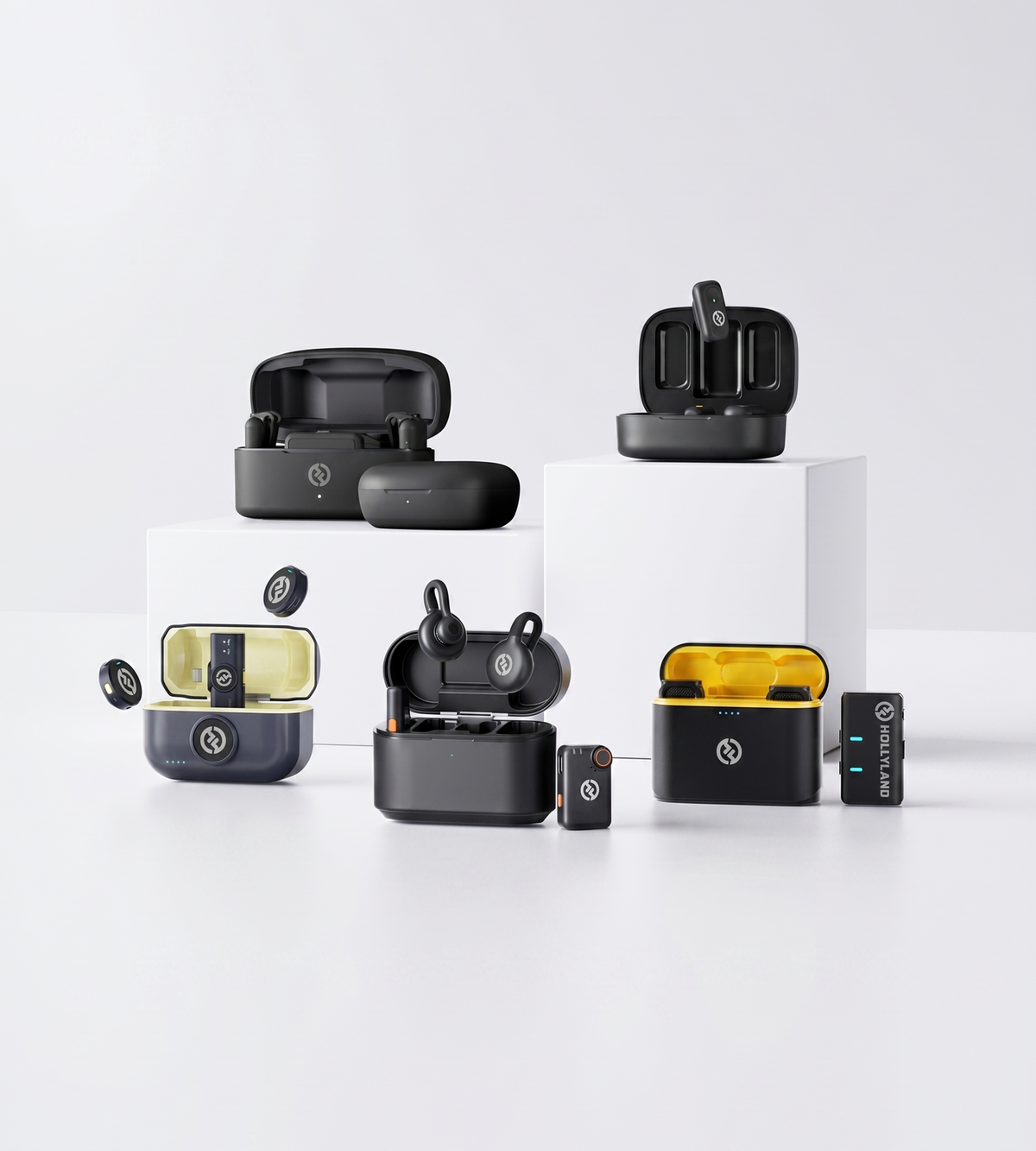
Capture broadcast-quality audio without the visible rig. Hollyland's compact wireless mics weigh as little as 7g, clip under clothing, and deliver 24-bit/48kHz sound — so your subjects stay on camera, your mic doesn't.
Not all compact mics are built the same way. Here's what actually matters when your goal is to disappear from the frame without disappearing from the soundtrack.
Weight and dimensions are the obvious starting point, but concealability goes deeper than raw measurements.
Transmitter weight determines whether the mic will tug at lightweight fabric, shift during movement, or create a visible outline under a shirt. Look for transmitters under 10g for true on-body discretion.
Clip and attachment design matters as much as size. A bulky clip that grips the outside of a collar will always be more visible than a low-profile attachment designed to sit flush against fabric.
Logo and branding on the transmitter body can make even a small unit more noticeable on camera. If you shoot at close range or in clean-frame setups, a no-logo design (like the LARK M2S) removes that visual variable entirely.
Shape affects how a mic sits under clothing. Flat, rectangular transmitters tend to lie flatter under a jacket than rounded or protruding designs.
Audio Quality — Does Small Mean Compromised?
This is the most common concern, and it's worth addressing directly: a small form factor does not have to mean a smaller sound.
What to look for in the specs:
Sample rate and bit depth — 48kHz / 24-bit is the broadcast standard for wireless audio. Anything at this level will hold up in professional post-production.
Signal-to-noise ratio (SNR) — Aim for 70dB or higher. A strong SNR means cleaner audio with less background hiss, which matters especially when the mic is worn under fabric.
Frequency response — A full 20Hz–20kHz range ensures the mic captures the natural warmth and presence of a voice, not just a narrow mid-range.
Noise cancellation — Environmental Noise Cancellation (ENC) or AI-based noise reduction is a genuine advantage for hidden-mic setups, where fabric rustling, HVAC hum, or ambient noise can bleed into the signal.
For creators who need an extra safety net against clipping — particularly in unpredictable environments — 32-bit float recording (available on the LARK MAX 2) eliminates gain-setting errors entirely, capturing audio that can be corrected in post regardless of sudden volume spikes.
Wireless Performance When the Mic Is Hidden
Wearing a transmitter under clothing introduces a real-world challenge: fabric and body mass can attenuate a wireless signal.
Key considerations:
NLOS (non-line-of-sight) range is the spec that matters most for hidden mic use — not the open-air line-of-sight figure. Look at how far the mic reliably transmits through obstructions, not just across an empty field.
Transmission stability under fabric depends on the wireless technology and antenna design. A system with a strong NLOS spec will hold a clean connection even when tucked under a blazer or beneath a shirt.
Operating frequency and interference resistance — systems that operate in less congested frequency bands or include automatic frequency selection will hold up better in busy environments like event venues or corporate conference spaces.
Battery Life for Real Shoot Days
An invisible mic only works if it keeps working. A dead transmitter mid-interview or mid-ceremony is a problem that no amount of post-production can fix.
Per-charge TX battery life — look for at least 9–10 hours on a single charge to cover a full shoot day without swapping.
Charging case capacity — most compact wireless systems come with a case that provides additional charge cycles. Total system battery life (TX + case) is the more useful figure for multi-day shoots or documentary work.
The LARK A1 stands out here with up to 54 hours of total battery life, making it a strong option for creators who shoot heavily across multiple days without reliable access to charging.
Compatibility — Camera, Smartphone, or Both?
Before choosing a mic, clarify the device it needs to connect to.
Smartphone-first creators — solo vloggers, social media content creators, and run-and-gun shooters recording directly to a phone — need a plug-and-play solution that works without an adapter or secondary receiver. The LARK A1 is designed specifically for this workflow.
Camera users — videographers shooting on mirrorless or DSLR cameras need a receiver with a standard 3.5mm TRS output and camera-compatible gain levels.
Hybrid shooters — those who alternate between camera and smartphone setups benefit from a Combo or Universal version that ships with both connection types, avoiding the need to buy separately.
Ease of Use — Setup Time Is Part of the Equation
When you're shooting solo or on a fast-moving set, a mic that requires complex pairing, manual gain staging, or multiple cables is a liability.
Plug and play pairing means powering on and shooting — no manual frequency coordination or app required unless you want it.
App control adds flexibility for adjusting gain, EQ, or monitoring settings remotely without touching the transmitter — useful when the mic is already hidden on a subject.
On-body comfort matters for longer sessions. Skin-friendly materials and lightweight builds reduce subject awareness of the mic, which in turn reduces fidgeting and handling noise.
Quick Decision Framework
Your Priority
What to Look For
Maximum invisibility and clean branding
Ultra-low weight (≤7g), no-logo design
Best-in-class audio for professional shoots
32-bit float, high SNR, AI noise cancellation
Smartphone-first, solo creator workflow
Plug-and-play, magnetic clip, extended battery
General versatility across camera + phone
Universal/Combo compatibility, ENC, 24-bit audio
Long multi-day shoots
Highest total battery life in the system
Who It's Built For
Every Shoot. Zero Visible Mic.
Whether you're wiring a wedding groom, framing a corporate presenter, or shooting your next viral short solo, the right invisible microphone makes the audio disappear from view — not from the recording. These are the scenarios where compact, clip-on wireless mics earn their place.
Solo Content Creators
On YouTube, TikTok, or Instagram Reels, a visible mic competes with the visual you've spent time building. Clip a 7g transmitter under your collar, connect in seconds, and shoot with nothing in frame that doesn't belong there. The audio is there. The mic isn't.
YouTube & Short-Form Video
Solo Shooting
Run-and-Gun
Journalists & Interviewers
Subjects speak more naturally when they forget they're miked. A low-profile transmitter tucked under a jacket or lapel captures clear omnidirectional audio with ENC noise cancellation — handling ambient noise even when worn beneath fabric — so nothing in the frame pulls focus from the conversation.
Field Interviews
On-Body Wear
Noisy Environments
Corporate & Branded Video
Talking-head videos and spokesperson content are judged on how professional they look. Hide a compact wireless transmitter under a suit jacket and let your presenter command the frame with confidence — while broadcast-grade, 24-bit audio works quietly out of sight.
Presenter Video
Branded Production
Talking Head
Wedding & Event Videographers
Ceremony audio is irreplaceable — and wiring a subject shouldn't put visible gear in your carefully composed frame. A lightweight transmitter clipped inside a lapel or dress stays hidden through every vow and first dance, with long-range wireless stability to match any venue layout.
Ceremony Audio
Event Coverage
Long-Range Wireless
Travel & Lifestyle Vloggers
When your brand is built on authenticity, a visible lav mic or handheld rig breaks the natural feel you're working to create. Clip on, connect instantly, and move freely — the mic stays hidden while the story stays front and center.
Travel Content
Minimal Gear
Plug and Play
Livestreamers & On-Camera Podcasters
On-camera podcasters and livestreamers are judged on how their setup looks as much as how it sounds. A no-logo, low-profile transmitter delivers broadcast-quality audio without cluttering your frame — keeping the visual as intentional as the content.
Livestreaming
On-Camera Podcast
Clean Frame
Trusted by creators
1.5M+ creators picked LARK microphones for their audio
A decade of wireless engineering for film crews and broadcasters — packaged for modern creator workflows.
4.7
★Avg. rating · 120K+ reviews
1.5M+
Verified creators
160+
Countries shipped
98%
Would recommend
I love my new LARK M2 mics. These were so good, and I really enjoyed testing out the new LARK M2 from Hollyland.
The Hollyland LARK MAX is the wireless microphone system with the clearest and crispest audio of any wireless mic system I have ever tried.
LARK MAX is doing an excellent job of dropping the sound of the air conditioner, which is something l always have to remove and post with our shotgun mic.
No Film School
Newsshooter
CineD
RedShark
CAMERA JABBER
Photowebexpo
FAQ
Your Questions About Invisible Microphones, Answered
How small are these microphones — will they actually be invisible on camera?
Very small. The **LARK M2S** is the lightest transmitter in the range at just **7g** — lighter than a standard paperclip — and is built around a no-logo, low-profile titanium body engineered specifically for on-camera discretion. The **LARK A1** weighs in at **8g** with a magnetic compact design, the **LARK M2** at **9g** with a button-size form factor, and the **LARK MAX 2** at **14g**.
At these sizes, each transmitter can be clipped under a lapel, collar, or jacket without creating a visible bulge. The LARK M2S goes a step further: its logo-free surface means even if it catches the light, there's nothing to identify it as a microphone — making it the strongest choice when on-camera invisibility is your primary concern.
Does the small size mean I'm compromising on audio quality?
No. Every microphone in the LARK lineup records at **48kHz / 24-bit** — the same standard used in professional broadcast and film production. Signal-to-noise ratios reach above **70dB** across the range (the LARK MAX 2 hits **≥72dB**), delivering clean, detailed audio with minimal background hiss.
The **LARK MAX 2** also supports **32-bit float internal recording**, which adds a capture safety net that prevents clipping in unpredictable shooting environments. All four models cover the full **20Hz–20kHz** frequency range. The result is full-fidelity audio in a form factor small enough to disappear.
Will the wireless signal stay stable when the transmitter is hidden under clothing?
Yes. All LARK transmitters are tested in non-line-of-sight (NLOS) conditions — which is exactly what happens when layers of fabric sit between your transmitter and receiver.
- **LARK M2S** and **LARK M2**: up to **60m NLOS** (Mobile Version) / **40m NLOS** (Camera Version)
- **LARK MAX 2**: up to **70m NLOS**
- **LARK A1**: up to **200m line-of-sight**
For the vast majority of real-world shooting environments — conference rooms, event venues, outdoor interviews — these ranges deliver a reliable, dropout-free connection even through a shirt, blazer, or jacket.
Will fabric muffle or distort the audio when the mic is worn under clothing?
This is one of the most common concerns with concealed mic setups, and it's where noise cancellation becomes critical. The **LARK M2S** and **LARK M2** both feature **ENC (Environmental Noise Cancellation)**, which actively filters unwanted noise — including the low-frequency contact rumble that fabric can introduce. The **LARK A1** takes it further with **3-level intelligent noise cancellation**, plus independent gain, EQ, and reverb controls to dial in your sound for different environments. The **LARK MAX 2** uses **AI noise cancellation**.
For best results, position the transmitter as close to the chest as possible under looser fabric, and avoid direct skin contact. The ENC systems across the range are built to keep your voice front and center regardless of what's between the mic and the frame.
How long will the battery last through a full day of shooting?
Long enough for most shoot days without mid-session charging — and often well beyond:
- **LARK M2**: TX approx. **10 hours** per charge / up to **40 hours** total with charging case
- **LARK M2S**: TX approx. **9 hours** per charge / up to **30 hours** total
- **LARK A1**: TX approx. **9 hours** per charge / up to **54 hours** total — the longest in the range
- **LARK MAX 2**: TX approx. **11 hours** per charge / up to **36 hours** total, plus **32-bit float internal recording** for up to **14 hours** as an independent safety backup
For multi-day shoots or extended event coverage, the charging case handles top-ups between sessions so you're never caught without power.
Which models are compatible with my smartphone, and which work with my camera?
Compatibility varies by model and version:
- **LARK A1** — Smartphone-first. Plug it directly into your phone's USB-C or Lightning port with zero setup. No receiver required.
- **LARK M2** — Available in a **Mobile Version** (smartphones), **Camera Version** (DSLRs and mirrorless cameras), and **Combo Version** that supports both.
- **LARK M2S** — Same structure: Mobile, Camera, and Combo versions available.
- **LARK MAX 2** — Uses a dedicated camera receiver; best suited to professional camera rigs.
For solo smartphone creators, the LARK A1 or LARK M2 Mobile Version offer the simplest plug-and-play experience. If you shoot on camera or regularly switch between devices, the Combo versions of the M2 or M2S give you the most flexibility.
What's the difference between the LARK M2S, M2, A1, and LARK MAX 2?
All four are compact wireless microphones suited to discreet, on-body audio capture. The differences are in size, materials, feature depth, and intended use case:
- **LARK M2S (7g)** — The most visibility-optimized. Titanium build, no-logo surface, ENC noise cancellation. The strongest choice when disappearing from the frame is the primary goal.
- **LARK M2 (9g)** — Button-size form factor, ENC noise cancellation, universal device compatibility. A well-rounded choice for creators who want compact, consistent audio across camera and mobile setups.
- **LARK A1 (8g)** — Smartphone-focused with a magnetic compact design and the most nuanced audio controls in the range: 3-level noise cancellation, EQ, reverb, and 6-level gain adjustment. Built for mobile-first creators who want hands-on sound shaping.
- **LARK MAX 2 (14g)** — The most feature-complete option. 32-bit float recording, AI noise cancellation, timecode sync, low-latency wireless monitoring, and support for up to 4 transmitters on a single receiver. Built for professional productions that demand broadcast-grade audio in an inconspicuous package.
Do these microphones pick up wind noise or clothing rustle?
They're designed to minimize both. The **omnidirectional polar pattern** across all four models captures your voice naturally even when the mic is angled or partially covered, without requiring precision placement. ENC and AI noise cancellation in each model actively suppress ambient noise, including fabric contact sounds and handling rumble.
For outdoor shooting, positioning the transmitter in a sheltered spot — under a collar rather than exposed on a lapel — and using the included windshield where provided will significantly reduce wind noise. The **LARK A1's** 3-level noise cancellation and independent gain control give you the most flexibility to tune out environmental interference on location.
Explore further
A few more places to go from here
A curated link map of the surrounding content — related categories, the most useful guides, head-to-head comparisons and setup help.