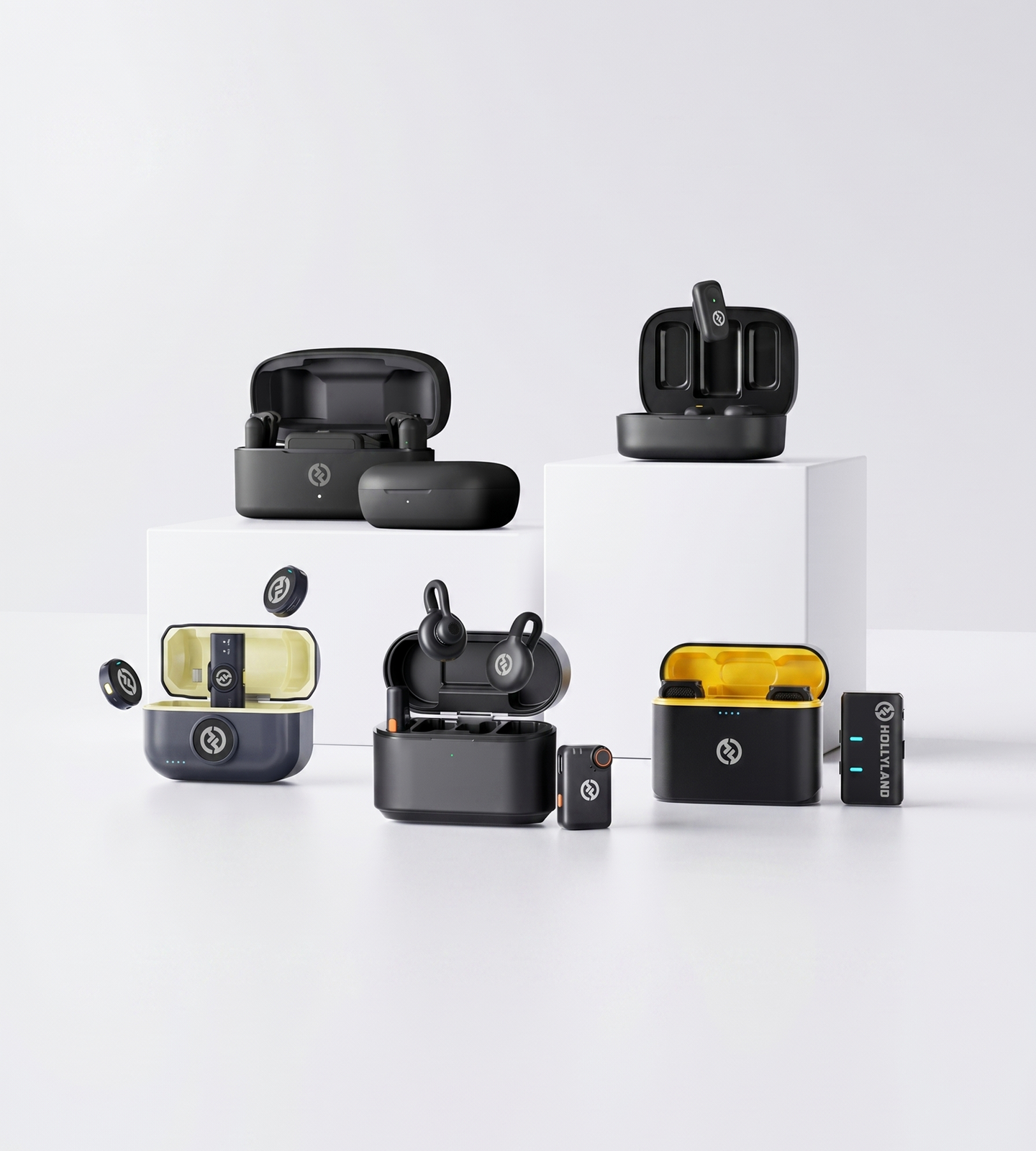
Portable Wireless Mics

Portable Microphones

Professional audio in a pocket-sized package. Hollyland's portable wireless microphone range — from the featherlight 7g LARK M2S to the pro-grade LARK MAX 2 — delivers 24-bit clarity, noise-cancelling performance, and all-day battery life for creators, journalists, and filmmakers recording anywhere.
Shop Now Compare Models

Compatible with smartphones, DSLRs & mirrorless cameras — multiple device versions available.

  • Ultra-Light from 7g
  • Up to 54-Hour Battery
  • ENC & AI Noise Cancellation
  • Universal Plug & Play
Portable Microphones
Editor's pickLARK M29g Body · 40hr Battery
4.7 / 5From 1.5M+ verified creators
Shop Models

Shop the Collection

Four wireless mics built for on-location use — find the one that fits your workflow.
LARK M2

LARK M2

The all-rounder for vloggers and run-and-gun creators

  • 9g transmitter
  • 300m range
  • 40hr total battery
$76.00
LARK M2S

LARK M2S

For creators who want great sound with zero on-camera presence

  • 7g transmitter
  • No-logo titanium design
  • 300m range
$89.00
LARK MAX 2

LARK MAX 2

Pro-grade portable audio for demanding on-location shoots

  • 32-bit float recording
  • 340m range
  • AI noise cancellation
$189.00
LARK A1

LARK A1

The plug-and-play pick for smartphone-first creators

  • Smartphone plug-and-play
  • 54hr total battery
  • 3-level noise cancellation
$35.90
Side-by-side

Compare Portable Wireless Mics

Match the right Hollyland mic to your kit, shoot style, and budget.
Model LARK M2 LARK M2 $76.00 LARK M2S LARK M2S $89.00 LARK MAX 2 LARK MAX 2 $189.00 LARK A1 LARK A1 $35.90
Transmitter Weight9g 7g 14g 8g
Wireless Range (LOS)Up to 300m Up to 300m Up to 340m Up to 200m
Total Battery LifeUp to 40 hours Up to 30 hours Up to 36 hours Up to 54 hours
Recording Format24-bit / 48kHz 24-bit / 48kHz 32-bit Float / 48kHz 24-bit / 48kHz
Noise CancellationENC ENC AI Noise Cancellation 3-Level Intelligent Noise Cancellation
Device CompatibilitySmartphone & Camera Smartphone & Camera Smartphone & Camera Smartphone
Best ForEveryday portable recording Style-conscious on-camera creators Pro-level field & location production Smartphone creators & beginners
Shop Shop Shop Shop
Buying Guide

How to Choose the Right Portable Microphone

The best portable microphone isn't simply the smallest or the most affordable — it's the one that fits how and where you actually record. Here's what to evaluate before you buy.
  1. Size and Weight — The Real Meaning…
  2. Audio Quality — What the Specs…
  3. Battery Life — Plan Beyond a…
  4. Device Compatibility — Match the…
  5. Wireless Range — What Range…
  6. Noise Cancellation — Essential for…
  7. Setup Speed — How Fast Can You Be…
  8. Matching the Right Mic to Your…

Size and Weight — The Real Meaning of 'Portable'

Portability is more than a category label. In practice, it means the transmitter you clip to your clothing should be small enough that you forget it's there — both physically and on camera.

What to look for:

  • A transmitter weighing under 10g for a genuinely discreet on-screen presence
  • A secure clip or magnetic attachment that stays put during movement
  • A charging case that protects the mic in transit and extends battery between shoots

The lighter and more compact the transmitter, the less it interrupts your workflow — and the less it distracts your audience on screen. If on-camera aesthetics matter to your content, weight and form factor should be among your first filters.


Audio Quality — What the Specs Actually Mean

A portable microphone doesn't have to compromise on sound. These are the specs that matter most:

  • Bit depth and sample rate — 24-bit/48kHz is the broadcast standard and delivers clean, professional audio for the vast majority of content creators. If you're shooting high-stakes productions where audio levels are difficult to predict in the field, 32-bit float recording is worth seeking out: it captures audio at a fixed level with no clipping risk, giving you full correction latitude in post.
  • Signal-to-noise ratio (SNR) — A higher SNR means less background hiss in your recording. ≥67dB is a workable baseline; ≥70dB or above is ideal for audio destined directly for online audiences without heavy post-processing.
  • Maximum SPL — How loud a sound source the mic can handle before distortion. 115dB+ covers most field recording scenarios; 128dB provides headroom for louder environments like live events.
  • Frequency response — 20Hz–20kHz captures the full range of human voice with clarity and detail.

For most content creators, 24-bit/48kHz with a strong SNR is the right target.

For professional or commercial productions — particularly where you can't actively monitor levels during a shoot — 32-bit float internal recording adds a meaningful layer of protection. The LARK MAX 2 supports 32-bit float across the full recording chain, making it the right choice for demanding on-location work.


Battery Life — Plan Beyond a Single Charge

Battery anxiety is a real problem on location. Look past single-charge figures and focus on total system battery life — what the transmitter plus its charging case can deliver before you need a power outlet.

  • A TX battery lasting 9–11 hours per charge handles most standard shooting days
  • A charging case that extends total runtime to 30–54 hours means you're covered for multi-day shoots or travel without hunting for a socket
  • Pay attention to the receiver battery as well — in some setups, the RX drains faster than the TX

If extended travel shoots or multi-day productions are your primary use case, treat total battery life as a non-negotiable spec, not a secondary detail. The LARK A1 leads this range with up to 54 hours of total battery life, making it especially well-suited for creators who are away from reliable power for long stretches.


Device Compatibility — Match the Mic to Your Gear

Compatibility is the one factor you must confirm before anything else.

  • Smartphone-first creators should look for plug-and-play USB-C or Lightning connectivity with no adapter needed. Some wireless mics are designed specifically for smartphones — simple to connect, nothing extra required.
  • Camera shooters (DSLR, mirrorless) need a receiver with a 3.5mm TRS or TRRS output compatible with their camera's audio input.
  • Creators who use both benefit from a combo kit that includes receivers for both a phone and a camera — eliminating the need to buy separately.
  • Multi-subject setups — two-person interviews, panel recordings, group shoots — require a system that supports multiple transmitters on a single receiver. Some systems support up to 4 TX per receiver, which is a significant advantage for more complex productions.

Always verify compatibility with your specific device before purchasing. When in doubt, a combo version offers the most flexibility.


Wireless Range — What Range Actually Means in Practice

Range specs can be misleading if you only look at the headline number. The most relevant figure is NLOS (non-line-of-sight) range, which reflects real-world conditions with obstacles, walls, or bodies between the transmitter and receiver.

  • LOS (line-of-sight) figures (200m–340m) represent ideal open-air conditions
  • NLOS range (40m–70m) is more realistic for event spaces, indoor shoots, or environments with interference
  • For most vlogging, interview, and run-and-gun content, a 40–60m NLOS range is more than sufficient
  • For larger venues, open outdoor spaces, or stage setups, higher NLOS and LOS specs become genuinely useful

Beyond raw range, look for systems with stable, dropout-free transmission. Consistent reliability matters more than peak distance on paper.


Noise Cancellation — Essential for Outdoor and Field Recording

Wind, crowd noise, and ambient sound are the most common audio challenges for portable microphone users. Environmental noise cancellation (ENC) should be treated as a core feature for outdoor recording — not a bonus.

Levels of noise handling to consider:

  • Standard ENC — Effective for everyday outdoor scenarios: light wind, moderate ambient noise, general street environments
  • Multi-level ENC — Lets you dial in the suppression intensity to match your environment, useful when you want to preserve some natural ambient sound
  • AI-powered noise cancellation — Adapts dynamically to complex, rapidly changing environments, offering stronger performance in crowds, busy transit locations, or unpredictable outdoor shoots

If outdoor and on-location recording is your primary use case, don't treat noise cancellation as an afterthought. It directly determines how usable your audio is straight out of the mic.


Setup Speed — How Fast Can You Be Ready to Record?

In the field, every second of setup is a second you could be missing the moment.

  • Plug-and-play systems power on and pair automatically — no configuration, no apps, no delay. The right choice for journalists, travel creators, and anyone who needs to be rolling within seconds.
  • App-controlled systems unlock more advanced adjustments — EQ, gain, noise cancellation level — at the cost of an extra setup step. Worth it when you need precision; unnecessary overhead when you don't.
  • Internal recording (audio recorded directly to the transmitter) provides a safety net if wireless transmission is ever interrupted. For high-stakes or one-take situations, this is a meaningful risk-reduction feature.

New and casual creators should prioritize simplicity above everything else. A mic you can set up in under 30 seconds is the one you'll actually use consistently.

Advanced creators and professionals who want precise audio control — adjustable gain, monitoring, fine-tuned noise cancellation — will benefit from app-based management and onboard recording, available on higher-tier systems like the LARK MAX 2.


Matching the Right Mic to Your Workflow

Use this as a quick orientation if you're still deciding:

If you are... Prioritize... Look at...
A smartphone-first creator or beginner upgrading from built-in audio Plug-and-play simplicity, long battery life, clean audio LARK A1
A vlogger or short-form video creator wanting reliable wireless Compact size, solid wireless performance, ease of setup LARK M2
A style-conscious creator for whom visible gear is a dealbreaker Minimum weight, no-logo discreet design LARK M2S
A professional or advanced creator working on-location 32-bit float, AI noise cancellation, multi-TX support LARK MAX 2

The right portable microphone is ultimately the one you'll actually take with you — and reach for every time.

Built for the Field

One Collection. Every Shoot.

Whether you're rolling solo on a city street or running a multi-mic interview in the field, Hollyland's portable mic range is built around how creators actually work — fast setups, unpredictable environments, and zero room for bad audio.

Vlogging & Short-Form Video

Clip a 7–9g transmitter to your collar and forget it's there. Whether you're walking, talking, or filming on the move, ENC noise cancellation and 24-bit audio keep your voice front and center — even when the background isn't cooperating.
  • Hands-Free Recording
  • On-Camera Discreet
  • Outdoor Audio

Interviews & Street Reporting

Hand one transmitter to your subject, keep the other on yourself, and capture both sides with clean, broadcast-ready audio. Up to 340m wireless range gives you space to work, while intelligent noise cancellation handles the crowd behind you.
  • Dual-Mic Setup
  • Long Wireless Range
  • Broadcast Quality

Travel & Run-and-Gun Filmmaking

Pack light without compromising sound. The entire transmitter fits in a shirt pocket, and charging-case battery life stretches up to 54 hours — so a full travel day, a festival shoot, or a back-to-back production schedule won't leave you hunting for an outlet.
  • Ultra-Compact
  • All-Day Battery
  • Fast Setup

On-Location Podcasting

Record studio-quality episodes anywhere your story takes you — a café, a conference floor, or the back of a car. Plug-and-play compatibility with smartphones and cameras means your recording rig fits in a jacket pocket and goes live in seconds.
  • Studio-Quality Audio
  • Plug and Play
  • Location Recording

Events, Conferences & Presentations

Clip on before you walk into the room and stay hands-free throughout. A discreet no-logo design keeps the focus on your message, while reliable wireless transmission ensures every word is captured clearly — even in a busy, reverberant space.
  • Hands-Free
  • Discreet Design
  • Reliable Wireless

Professional Multi-Mic Production

When one mic isn't enough, connect up to four transmitters to a single receiver for panel discussions, documentary interviews, or multi-subject scenes. Add 32-bit float internal recording and timecode sync, and you have a pro-grade field audio system that still fits in a carry-on.
  • Multi-Mic System
  • 32-Bit Float
  • Pro Field Audio
Trusted by creators

1.5M+ creators picked LARK microphones for their audio

A decade of wireless engineering for film crews and broadcasters — packaged for modern creator workflows.
  • 4.7 Avg. rating · 120K+ reviews
  • 1.5M+ Verified creators
  • 160+ Countries shipped
  • 98% Would recommend

I love my new LARK M2 mics. These were so good, and I really enjoyed testing out the new LARK M2 from Hollyland.

Sarah GraceSarah GraceTech Creator · 3.2M YouTube subscribers

The Hollyland LARK MAX is the wireless microphone system with the clearest and crispest audio of any wireless mic system I have ever tried.

GoenrockGoenrockCinematographer · 107K Instagram subscribers

LARK MAX is doing an excellent job of dropping the sound of the air conditioner, which is something l always have to remove and post with our shotgun mic.

Film RiotFilm RiotFilmmaking Educator · 2.2M YouTube subscribers
  • No Film School
  • Newsshooter
  • CineD
  • RedShark
  • CAMERA JABBER
  • Photowebexpo
FAQ

Your Portable Microphone Questions, Answered

Do wireless portable microphones actually sound as good as wired microphones?
In most real-world shooting scenarios, yes — the gap is negligible when the wireless mic records at broadcast-quality specs. Every mic in the Hollyland portable range records at **48kHz / 24-bit** with a full **20Hz–20kHz frequency response** and a signal-to-noise ratio of **>70dB**, delivering clean, natural voice audio that holds up in production. The **LARK MAX 2** goes further with **32-bit float recording**, giving you a near-unlimited dynamic range and making audio clipping virtually impossible — the same standard used on professional film sets. The more meaningful comparison is portable wireless mic vs. built-in device microphone. Built-in mics capture handling noise, room rumble, and the muddiness of distance. A clip-on transmitter placed close to the speaker eliminates all of that, regardless of the wire.
Will the battery last through a full day of shooting?
Every model in the range is designed to outlast a full shooting day on a single charge — and extend considerably further with the included charging case: - **LARK A1**: Up to **9 hours** per TX charge; **54 hours total** with charging case - **LARK M2**: Up to **10 hours** per TX charge; **40 hours total** with charging case - **LARK MAX 2**: Up to **11 hours** per mic charge; **36 hours total** with charging case; plus up to **14 hours of internal recording** on the transmitter as a standalone backup - **LARK M2S**: Up to **9 hours** per TX charge; **30 hours total** with charging case The charging case doubles as a carry case, so topping up between sessions requires no extra cables. For multi-day travel shoots or long event coverage, the LARK A1's 54-hour total capacity offers the most runway in the range.
Do these mics work with my smartphone, my camera, or both?
It depends on the model and version you choose: - **LARK A1**: Built for **smartphones** — plug-and-play directly into iOS and Android devices, no app or extra adapter needed. - **LARK M2**: Available in a **Mobile Version** (smartphone), **Camera Version** (3.5mm), or a **Universal Combo Version** that includes both receivers — one kit covering both devices. - **LARK M2S**: Available in the same Mobile, Camera, and **Universal Combo** configurations as the M2. - **LARK MAX 2**: Available in a **Camera Version**, connecting to cameras, field recorders, and professional production devices via 3.5mm. If you regularly shoot on both a phone and a camera, the **Universal Combo versions of the M2 or M2S** are the most flexible choice — full compatibility in a single purchase.
How do these microphones handle wind and background noise outdoors?
Outdoor audio conditions are one of the main design considerations across this entire range: - **LARK M2 and LARK M2S** feature **ENC (Environmental Noise Cancellation)**, which filters wind, traffic, and crowd noise from the signal in real time. - **LARK A1** includes **3-level intelligent noise cancellation**, letting you dial up or down based on how loud your environment is — useful when you need clean audio in a busy street interview versus a quieter indoor setting. - **LARK MAX 2** uses **AI noise cancellation** for the most advanced real-time processing in the range, designed to handle unpredictable and rapidly changing outdoor conditions. Beyond active noise processing, the simple fact of placing a transmitter close to the speaker — rather than relying on a camera mic several feet away — eliminates most ambient noise problems before any cancellation algorithm even engages.
How reliable is the wireless connection? Will I get dropouts?
Hollyland's portable mics use a stable 2.4GHz wireless transmission system with strong range across the lineup: - **LARK A1**: Up to **200m / 650ft** line-of-sight (LOS) - **LARK M2 / LARK M2S**: Up to **300m / 1000ft** LOS - **LARK MAX 2**: Up to **340m / 1115ft** LOS For indoor and non-line-of-sight (NLOS) use — which covers most real shooting environments — the M2 and M2S Mobile versions reach **60m**, Camera versions reach **40m**, and the LARK MAX 2 reaches **70m NLOS**. That covers conference rooms, event venues, and most run-and-gun interiors with reliable clearance. For added peace of mind, the **LARK MAX 2** records internally on the transmitter at 32-bit float — so even in the rare event of a transmission interruption, your audio exists as a local backup on the mic itself.
How difficult is it to set up a wireless clip-on microphone in the field?
All four models are built for fast, field-ready deployment: - **LARK A1, LARK M2, and LARK M2S** are **plug-and-play** — take them out of the charging case, clip the transmitter to clothing, plug the receiver into your device, and you're recording. No manual pairing. No app required to start. - The **LARK M2 and M2S** optionally pair with a companion app for advanced adjustments like gain control, noise cancellation intensity, and real-time monitoring — available when you want more control, never required for basic use. - The **LARK MAX 2** adds professional features — timecode sync, 4-transmitter multi-mic setups, wireless monitoring — which take a few minutes to configure, but are designed for users who actively need them. For most creators, setup across the range takes under 60 seconds from case to recording.
Will the mic transmitter be visible or distracting on camera?
These are among the smallest wireless transmitters on the market. Transmitter weights across the range are: - **LARK M2S**: **7g** — the lightest in the lineup - **LARK A1**: **8g** - **LARK M2**: **9g** - **LARK MAX 2**: **14g** At those sizes, all four transmitters are roughly button-sized and designed to clip discreetly behind a lapel, under a collar, or along a shirt placket. The **LARK M2S** takes on-screen discretion a step further with its **no-logo, titanium-finish design** — a deliberate choice for creators who want a clean, unbranded look when the transmitter is visible in frame. For complete concealment, the clip mount on all models allows the transmitter to be hidden beneath a layer of clothing while still maintaining a strong wireless signal.
Which Hollyland portable microphone is right for me?
The best pick depends on your device, shooting style, and how much control you need: - **LARK A1** — Best for **smartphone-first creators**: vloggers, social media creators, and traveling podcasters who want the simplest setup, the longest total battery life in the range (54 hours), and built-in EQ and reverb processing without needing external software. - **LARK M2** — Best for **versatile everyday creators and journalists** who need reliable compatibility across both phones and cameras (via the Combo version), ENC noise cancellation, and proven 300m wireless performance in a 9g body. - **LARK M2S** — Best for **style-conscious and on-screen creators** who want the same wireless performance as the M2 in the lightest, most discreet package available — the 7g no-logo titanium design is built specifically to disappear on camera. - **LARK MAX 2** — Best for **professional filmmakers, video journalists, and multi-mic productions** that demand 32-bit float recording, AI noise cancellation, timecode sync, and support for up to 4 transmitters on a single receiver. Not sure where to start? The **LARK M2 Universal Combo** covers the widest range of devices and shooting scenarios in a single kit — the most flexible entry point in the range.
Explore further

A few more places to go from here

A curated link map of the surrounding content — related categories, the most useful guides, head-to-head comparisons and setup help.
Ready when you are

Find the Portable Mic Built for Your Workflow

Transmitters from 7g, battery life up to 54 hours, and 24-bit audio — for creators at every level.
Shop Now Compare Models
  • Free shipping over $99
  • 30-day returns
  • 1-year warranty