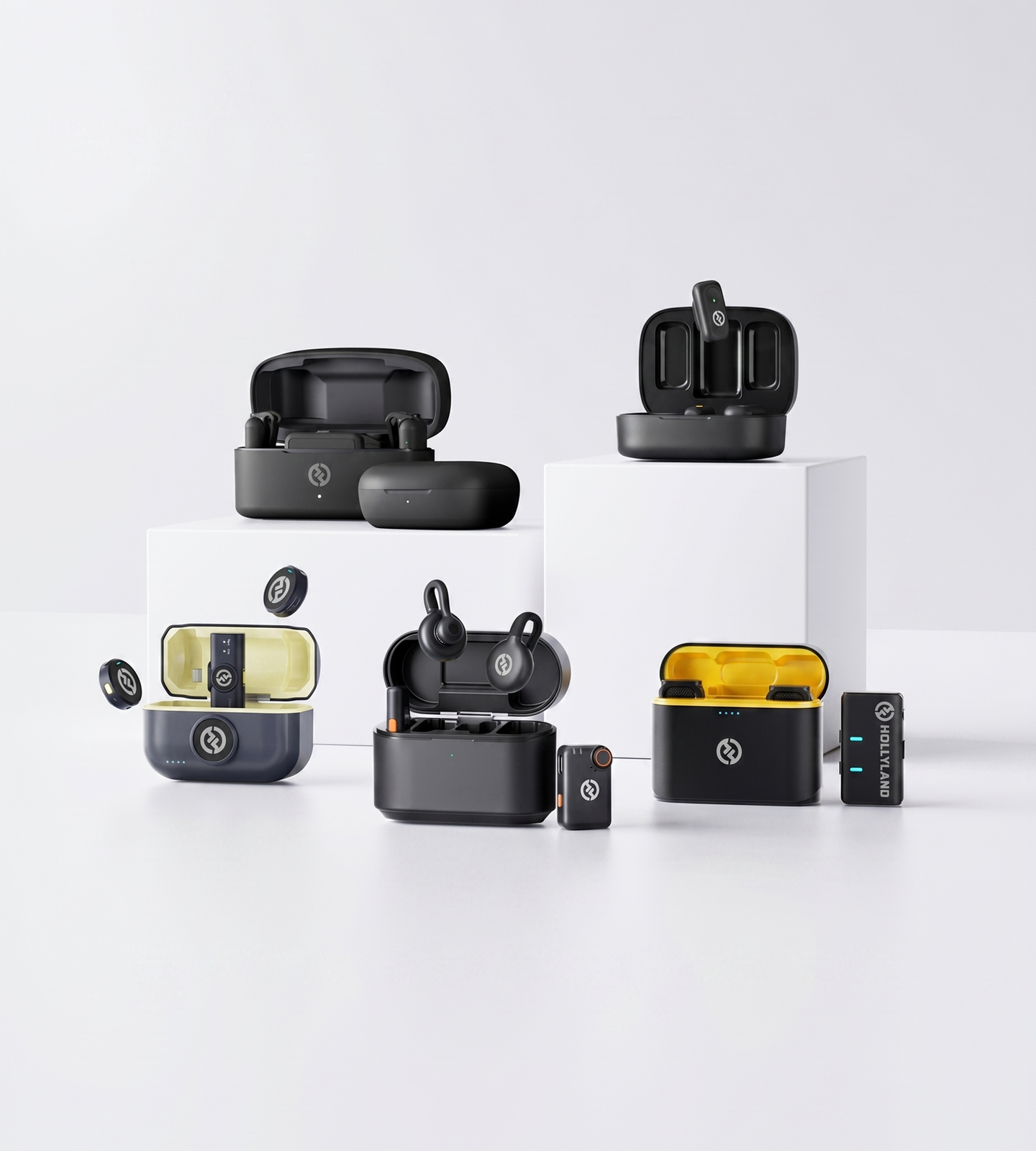
Mini Microphones

Mini Wireless Microphones for Creators

From 7g clip-on transmitters to 32-bit float recording, Hollyland mini microphones deliver professional-grade audio without the bulk. Plug-and-play ready, all-day battery life, and compatible with iPhone, Android, and cameras — compact wireless mics for creators who refuse to compromise on sound.
Shop Now Compare Models

Compatible with iPhone, Android, DSLR & mirrorless cameras

  • Featherlight from 7g
  • 24-bit & 32-bit Float Audio
  • Up to 54H Total Battery
  • Plug-and-Play Setup
Mini Wireless Microphones for Creators
Editor's pickLARK M2S7g · No-Logo Invisible Fit
4.7 / 5From 1.5M+ verified creators
Shop Models

Find Your Fit

Four compact wireless mics, each matched to a different creator workflow.
LARK M2

LARK M2

The button-size all-rounder for any device

  • 9g TX
  • ENC Noise Cancellation
  • 40hr Total Battery
$76.00
LARK M2S

LARK M2S

The lightest option for staying invisible on camera

  • 7g TX
  • No-Logo Invisible Fit
  • Titanium Design
$89.00
LARK MAX 2

LARK MAX 2

The pro-grade upgrade for demanding productions

  • 32-bit Float Recording
  • AI Noise Cancellation
  • Timecode
$189.00
LARK A1

LARK A1

The phone-first pick for mobile creators

  • Smartphone Plug & Play
  • 54hr Total Battery
  • Auto-Limit Clip Protection
$35.90
Side-by-side

Mini Mic Comparison

Compare Hollyland's wireless mics side by side and find the right fit for your setup and budget.
Model LARK M2 LARK M2 $76.00 LARK M2S LARK M2S $89.00 LARK MAX 2 LARK MAX 2 $189.00 LARK A1 LARK A1 $35.90
Transmitter Weight9g 7g 14g 8g
Recording Format48kHz / 24-bit WAV 48kHz / 24-bit 48kHz / 32-bit Float or 24-bit 48kHz / 24-bit
Signal-to-Noise Ratio>70dB >70dB ≥72dB ≥67dB
Wireless Range (LOS)300m / 1000ft 300m / 1000ft 340m / 1115ft 200m / 650ft
Wireless Range (NLOS)Up to 60m (Mobile) / 40m (Camera) Up to 60m (Mobile) / 40m (Camera) 70m / 230ft
TX Battery Life~10 hours ~9 hours ~11 hours ~9 hours
Total Battery LifeUp to 40 hours Up to 30 hours Up to 36 hours Up to 54 hours
Noise CancellationENC Environmental Noise Cancellation ENC Environmental Noise Cancellation AI Noise Cancellation 3-Level Intelligent Noise Cancellation
Device CompatibilityMobile, Camera, or Both (Combo version) Mobile, Camera, or Both (Combo version) Mobile & Camera (up to 4 TX per RX) Smartphones
Best ForEveryday creators & vloggers On-camera creators who need invisible audio Professional videographers & filmmakers Mobile-first creators & social media video
Shop Shop Shop Shop
Buying Guide

How to Choose the Right Mini Microphone

Not all compact wireless mics are built for the same job. Here's what to consider before you buy — so you match the right mic to your recording style, device, and workflow.
  1. Size and Weight: How Mini Is Mini…
  2. Sound Quality: Can a Tiny Mic…
  3. Device Compatibility: Phone,…
  4. Setup Speed: Plug and Play vs.…
  5. Battery Life: Planning Around Your…
  6. Wireless Range and Indoor…
  7. On-Camera Appearance: The…
  8. How Many Speakers Are You Recording
  9. Pro-Level Features: When to Step Up

Size and Weight: How Mini Is Mini Enough?

The whole point of a mini microphone is that it disappears — on your clothing, in your kit bag, and ideally on camera too.

Transmitter weight is the number to focus on. A clip-on transmitter that sits on your lapel or collar all day needs to be light enough that you genuinely forget it's there. Look for transmitters under 10g if portability is your top priority.

Beyond weight, consider profile and finish. A slim, low-profile transmitter sits flush against fabric without pulling or shifting. Some are built with materials like titanium that allow an even smaller footprint without sacrificing durability.


Sound Quality: Can a Tiny Mic Actually Deliver?

The short answer: yes — if you know what specs to look for.

  • Recording format — 24-bit/48kHz is the standard for clean, broadcast-quality audio capture. It gives you enough dynamic range for real-world voice recording without introducing noise.
  • Signal-to-noise ratio (SNR) — Look for ≥70dB. A higher SNR means less background hiss and more clarity, especially important when recording in less-than-ideal environments.
  • Maximum SPL — This tells you how loud a sound the mic can handle before distorting. A rating above 115dB SPL gives you headroom for dynamic speakers and unpredictable audio moments.
  • Noise cancellation — Environmental Noise Cancellation (ENC) actively reduces ambient sound like wind, crowd noise, or room hum. The more levels of control available, the better you can tune it to your environment.

For creators who work in loud or unpredictable environments, auto-limit clip protection is worth seeking out — it automatically guards against audio peaks that would otherwise distort your recording.


Device Compatibility: Phone, Camera, or Both?

This is one of the most important questions to settle before buying.

Ask yourself:

  • Do I record primarily to a smartphone?
  • Do I shoot with a mirrorless or DSLR camera?
  • Do I switch between devices depending on the shoot?

Mini wireless microphone systems typically come in mobile versions (Lightning or USB-C plug-in, optimized for smartphones) and camera versions (3.5mm output for camera audio input). Some come in a combo version that includes adapters for both — the most flexible choice if your setup isn't fixed.

Don't assume a mic that works with one device will automatically work with another. Always verify the included connectors and receiver output before purchasing.


Setup Speed: Plug and Play vs. App-Dependent

For fast-moving shoots, every second of setup time matters.

  • Plug and play systems pair automatically the moment they're powered on. No app, no manual pairing, no steps to skip. Ideal for run-and-gun creators or anyone who shoots spontaneously.
  • App-controlled systems offer deeper customization — adjustable gain, EQ, reverb, noise cancellation levels — but require a phone to unlock those settings.

The best setups offer both: instant plug-and-play as the default, with optional app control for users who want more precision. If you record in a variety of environments or want to dial in your sound, app support is a genuine asset, not a complication.


Battery Life: Planning Around Your Shoot

Running out of battery mid-interview or mid-shoot is a real risk with compact gear — the smaller the device, the smaller the cell.

There are two battery figures to pay attention to:

  1. Per-charge battery life — How long the transmitter runs on a single charge. Anything approaching or exceeding 9–10 hours covers a full day's shoot without recharging mid-session.
  2. Total battery life with charging case — The combined capacity of the transmitter(s) and case. This tells you how many full charges you can run without access to a power outlet. A total of 30–54 hours means multi-day shoots are manageable.

If you shoot long events, travel frequently, or record in locations without reliable power access, prioritise the total combined battery figure over the per-charge figure alone.


Wireless Range and Indoor Reliability

Line-of-sight (LOS) range figures look impressive on spec sheets, but most real-world recording happens indoors — in offices, studios, event venues, and homes where walls and obstacles interrupt signal.

NLOS (non-line-of-sight) range is the more useful number for practical use. Look for systems that maintain stable signal at 40–70m NLOS, which covers the distance between a roaming subject and a camera operator in most interior spaces.

If you work at large events, in crowded venues, or in spaces with heavy wireless interference, prioritise systems with robust NLOS performance and a strong SNR. More signal strength in reserve means fewer dropouts under pressure.


On-Camera Appearance: The Discretion Factor

For many creators, a microphone that's visible on screen breaks the production aesthetic — especially for social media content or on-camera presenting.

Look for:

  • No-logo or minimal branding on the transmitter — avoids visual distraction when the mic is in frame
  • Low-profile clip design — sits flat and stays in place without creating a visible bulge
  • Neutral or skin-friendly finishes — some transmitters are designed to blend into clothing or skin tone rather than stand out

If your shooting style frequently puts the transmitter in shot, appearance matters as much as audio performance.


How Many Speakers Are You Recording?

Your recording setup should match the number of voices you're capturing.

  • Solo recording — One transmitter, one receiver. Straightforward.
  • Two-person interviews — You need a dual-transmitter system (two TXs, one RX) so each speaker wears their own mic. This gives you two isolated audio tracks and clean separation in post.
  • Multi-speaker or event recording — Some advanced systems support connecting up to 4 transmitters to a single receiver, giving you significantly more flexibility for panel discussions, events, or ensemble coverage.

Always confirm whether a system is sold as a single-transmitter or dual-transmitter kit, and whether additional transmitters can be added later.


Pro-Level Features: When to Step Up

Most creators will find everything they need in a standard 24-bit wireless system with ENC and plug-and-play setup. But some workflows justify additional capability.

Consider stepping up if you need:

  • 32-bit float recording — Captures audio with an extended dynamic range that essentially eliminates clipping, even without perfect gain staging. Invaluable for live events, documentary work, or any situation where audio levels are unpredictable.
  • Internal recording on the transmitter — A safety net that captures audio locally even if the wireless signal drops. Particularly useful for high-stakes, one-take recordings.
  • Timecode support — Critical for multi-camera productions where audio and video need to sync precisely in post.
  • Wireless audio monitoring — The ability to monitor your audio live, wirelessly, while the subject moves freely on set.

The LARK MAX 2 is built for this tier — 32-bit float, AI noise cancellation, timecode, and support for up to four transmitters make it the right choice when professional-grade control matters. For everyday creators, the LARK M2, LARK M2S, and LARK A1 cover the full range of solo and interview use cases without the added complexity.

Who It's Built For

One Collection. Every Shoot.

From solo vlogs to professional field interviews, Hollyland mini mics are designed around how creators actually work — fast setups, unpredictable environments, and zero tolerance for audio that lets the visuals down.

Solo Content Recording

Clip it on, hit record. Whether you're filming YouTube videos, TikToks, or Instagram Reels, a Hollyland mini transmitter keeps you cable-free and consistently on-mic — no matter where in the frame you're standing. Plug-and-play setup means audio is the last thing on your mind.
  • Cable-Free
  • Plug & Play
  • Phone & Camera

Run-and-Gun Vlogging

At 7–9g, the transmitter weighs less than a coin and clips without pulling or shifting as you move. Walk, turn, talk to the camera — the mic stays put and the signal holds. Built for creators who shoot on instinct, not on a tripod.
  • Ultra-Lightweight
  • Stable Signal
  • Hands-Free

Interviews & On-Camera Conversations

Two speakers, one receiver. Clip a transmitter on each person and capture both voices cleanly — in noisy cafés, busy event floors, or outdoor locations where background sound doesn't cooperate. ENC noise cancellation handles what you can't control.
  • Dual Transmitter
  • Noise Cancellation
  • Indoor Range

Short-Form & Social Media Video

No logo. No dangling cable. No visible gear breaking the aesthetic. The no-logo transmitter design and low-profile clip let you stay polished on camera, while 24-bit audio makes sure the sound matches the look. From idea to upload — fast.
  • No-Logo Design
  • Discreet Clip
  • Quick Setup

Travel & On-Location Shoots

The full kit — transmitters, receiver, charging case — fits in a jacket pocket. With up to 54 hours of total battery life across the range, you're covered through full shoot days without hunting for an outlet between locations. Light to carry, serious to listen to.
  • Pocket-Sized Kit
  • Long Battery Life
  • All-Day Shooting

Online Teaching & Remote Presentations

Clear, professional-grade audio without a studio mic cluttering your desk or your frame. Clip on, connect to your phone or laptop, and deliver lectures, coaching sessions, or webinars that sound as credible as what you're saying. No room treatment required.
  • Zoom & Webinar Ready
  • Noise Cancellation
  • Clean On-Screen Look
Trusted by creators

1.5M+ creators picked LARK microphones for their audio

A decade of wireless engineering for film crews and broadcasters — packaged for modern creator workflows.
  • 4.7 Avg. rating · 120K+ reviews
  • 1.5M+ Verified creators
  • 160+ Countries shipped
  • 98% Would recommend

I love my new LARK M2 mics. These were so good, and I really enjoyed testing out the new LARK M2 from Hollyland.

Sarah GraceSarah GraceTech Creator · 3.2M YouTube subscribers

The Hollyland LARK MAX is the wireless microphone system with the clearest and crispest audio of any wireless mic system I have ever tried.

GoenrockGoenrockCinematographer · 107K Instagram subscribers

LARK MAX is doing an excellent job of dropping the sound of the air conditioner, which is something l always have to remove and post with our shotgun mic.

Film RiotFilm RiotFilmmaking Educator · 2.2M YouTube subscribers
  • No Film School
  • Newsshooter
  • CineD
  • RedShark
  • CAMERA JABBER
  • Photowebexpo
FAQ

Questions About Mini Microphones, Answered

Can a mini microphone actually deliver professional-quality audio?
Yes — and the specs back it up. Every mic in this range records at **48kHz / 24-bit**, the same format used in professional video production. The LARK MAX 2 goes further with **32-bit float recording**, which captures an extended dynamic range so quiet speech and loud bursts are both preserved without manually adjusting gain. All models include active noise cancellation — ENC Environmental Noise Cancellation on the LARK M2 and M2S, 3-level intelligent noise cancellation on the LARK A1, and AI noise cancellation on the LARK MAX 2 — to isolate your voice from wind, ambient crowd noise, and room hum. Signal-to-noise ratios start at 67dB and go up to 72dB across the range. The short version: these microphones are small enough to disappear on camera and clean enough to use in professional productions.
Which Hollyland mini mic works with my phone, my camera, or both?
It depends on which version you choose: - **Smartphones only:** The **LARK A1** is built exclusively for mobile — plug in via Lightning or USB-C and it's ready instantly. The LARK M2 Mobile Version and LARK M2S Mobile Version also connect directly to phones. - **Cameras (DSLR, mirrorless, camcorder):** The LARK M2 Camera Version and LARK M2S Camera Version connect via 3.5mm TRS. - **Both phone and camera:** The **LARK M2 Combo** and **LARK M2S Combo** versions include both receiver types in one kit. The **LARK MAX 2** also supports multi-device use. If you regularly switch between a phone and a camera, a Combo version or the LARK MAX 2 is the most flexible choice.
How long does the battery last on a full day of shooting?
All transmitters in this range offer **9–11 hours per charge** — enough to cover a full shoot day on a single top-up. The more useful number is total battery life when the charging case is factored in: | Model | Total Battery Life | |---|---| | LARK A1 | Up to **54 hours** | | LARK M2 | Up to **40 hours** | | LARK MAX 2 | Up to **36 hours** | | LARK M2S | Up to **30 hours** | In practice, you can recharge the transmitter in the case between sessions without needing a wall outlet — useful on location or while traveling. The **LARK MAX 2** adds a further safety net: up to **14 hours of internal recording** stored directly on the transmitter, independent of the wireless connection.
Will the wireless signal stay reliable indoors or in a crowded space?
Line-of-sight (LOS) range numbers are impressive — 200m to 340m depending on the model — but what matters more for most creators is non-line-of-sight (NLOS) performance in real-world conditions: inside a venue, through walls, or in RF-busy environments. - **LARK M2 (Mobile version):** 60m NLOS / Camera version: 40m NLOS - **LARK M2S (Mobile version):** 60m NLOS / Camera version: 40m NLOS - **LARK MAX 2:** 70m NLOS - **LARK A1:** 200m LOS (smartphone use, indoor range is solid for typical room-to-room distances) For a studio apartment, conference room, or wedding reception hall, any model in the range will hold a stable signal. For larger venues or outdoor events with heavy obstructions, the **LARK MAX 2's 70m NLOS** gives the most reliable headroom.
How fast can I set one up and start recording?
Fast. All Hollyland mini mics in this range are **plug-and-play** — pair the transmitter and receiver before you leave, clip the TX to your subject, plug the receiver into your device, and you're rolling. No app is required for basic recording on any model. Optional app control is available on the LARK M2, M2S, and LARK MAX 2 for deeper adjustments — EQ, gain, noise cancellation level — when you want it. The **LARK A1** keeps everything on the microphone itself with physical controls, so there's no phone menu-diving involved at all. For fast-moving shoots — run-and-gun vlogging, street interviews, event coverage — the setup time is measured in seconds, not minutes.
Will the transmitter be visible on camera?
Discretion is a design priority across the range, not an afterthought. - **LARK M2S** (7g): The lightest transmitter in the range with a **no-logo front face** and titanium build — it reads as minimal hardware, not branded gear, when visible on screen. - **LARK A1** (8g): A magnetic compact design that lies flat against fabric and holds securely without visible bulk. - **LARK MAX 2** (14g): Uses **excimer nano-coated skin-friendly material**, designed for close-to-body wear during long shoots. - **LARK M2** (9g): Button-sized form factor that tucks easily under a shirt collar or into a lapel fold. At 7–14g, any transmitter in this range sits near-flush against clothing. The LARK M2S is the best choice if on-camera appearance is your top priority.
What happens if someone speaks too loudly — will the audio clip?
It's a real concern on any microphone if gain is set incorrectly. Hollyland addresses this in different ways across the range: - **LARK A1:** Includes **6-level gain adjustment** plus **Auto-Limit Clip Protection** — the system automatically pulls the signal back before distortion occurs, no manual intervention needed. - **LARK MAX 2:** **32-bit float full-chain audio transmission** captures up to 128dB SPL across the widest possible dynamic range, which means even a sudden shout or volume spike is fully recoverable in post without audible distortion. - **LARK M2 / M2S:** Capsule-level max SPL of 115–116dB handles loud environments without distorting at the source. For high-stakes recordings — live events, interviews where you can't control vocal delivery, any situation where you can't stop and adjust — the **LARK MAX 2's 32-bit float** is the safest choice.
Which Hollyland mini microphone should I choose?
Here's a quick guide based on your setup and priorities: | Your situation | Best pick | |---|---| | Phone-only creator, simplest possible setup | **LARK A1** | | Solo or two-person content, phone or camera | **LARK M2** | | Most discreet transmitter, no logo on camera | **LARK M2S** (7g) | | Professional shoots, 32-bit float, multiple mics | **LARK MAX 2** | All four weigh between 7–14g and record at 48kHz / 24-bit or better. The difference is how much control and professional-grade features you need. If you're unsure where to start, the **LARK M2** is the most versatile all-rounder for the widest range of creator use cases.
Explore further

A few more places to go from here

A curated link map of the surrounding content — related categories, the most useful guides, head-to-head comparisons and setup help.
Ready when you are

Find the Mic That Fits Your Kit

Four wireless mics from 7g. 24-bit audio, noise cancellation, and up to 54 hours battery included.
Shop Now Compare Models
  • Free shipping over $99
  • 30-day returns
  • 1-year warranty