


LARK M2
The all-around pick for athletes and active creators
- 9g Transmitter
- ENC Noise Cancellation
- 10-Hr Battery
 United States
(English / $
USD)
United States
(English / $
USD)


Video Solutions

Intercom Systems

Wireless Microphones

Cameras
Video Solutions
View all
Video Accessories
Intercom Accessories

Mic Accessories

Camera Accessories
Video Accessories
View all
Hollyland Monitor Calibrator-Wireless Video Transmission System Accessory

Monitor Hood (7-Inch)

Mars 4K Transmitter

Mars 4K Receiver

D-Tap to Locking DC Power Adapter Cable

Crab Clamp

NP-F970 Battery

NP-F550 Battery

Mini HDMI to HDMI Cable

Micro HDMI to HDMI Cable

SDI Cable (1000mm)

SDI Cable (500mm)

Cold Shoe Gimbal

Rotatable Cold Shoe Mount

Side & Bottom Mounted Aluminum Handle

Screw Fitting for Stabilizer

Cylindrical Antenna (2.4GHz & 5GHz)

Paddle Antenna (2.4GHz & 5GHz)

View all


United States / English
Compatible with iPhone, Android, DSLR & mirrorless cameras — plug-and-play ready
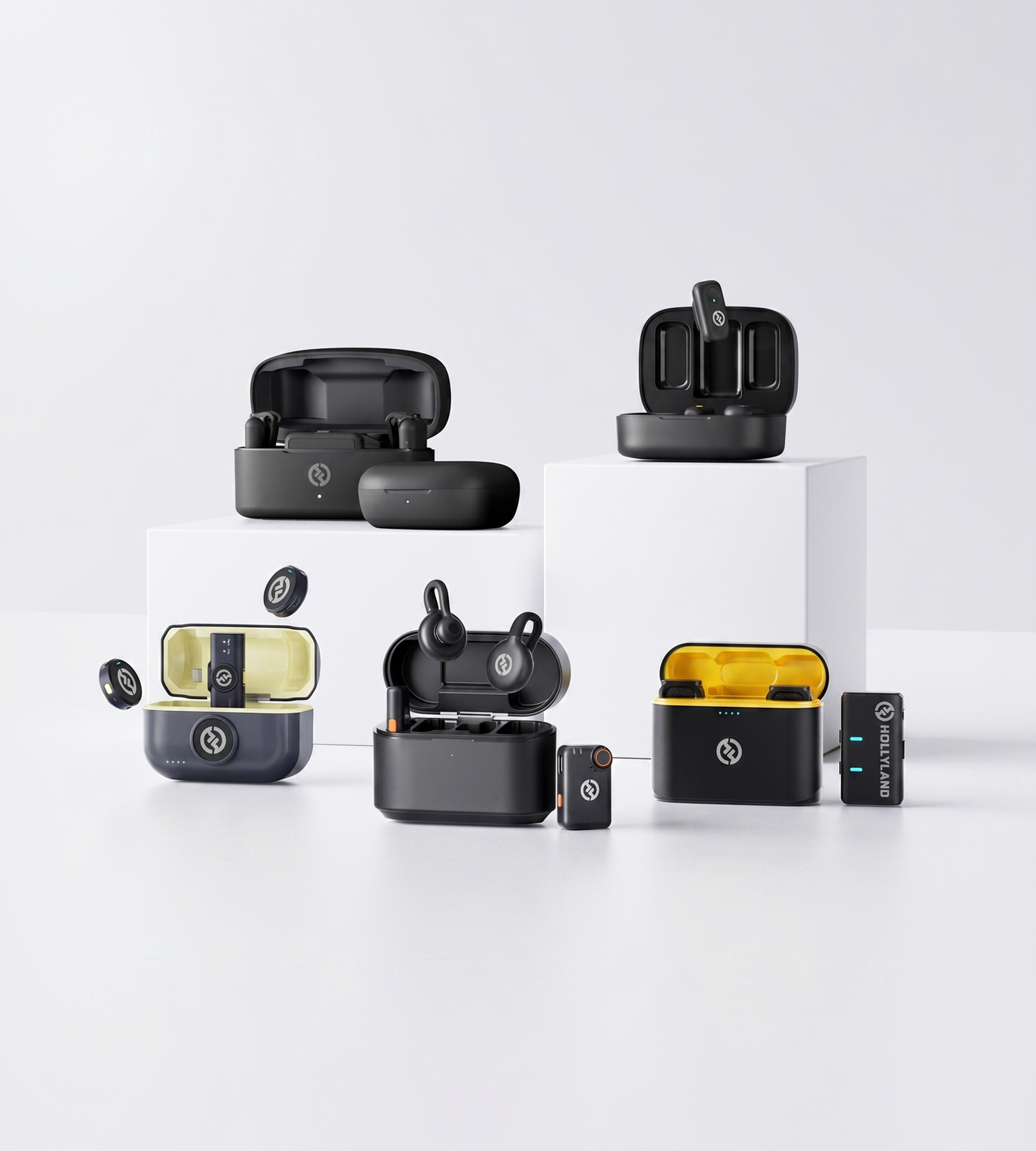
The all-around pick for athletes and active creators

When performance demands a truly invisible mic

Pro-grade capture for field professionals and multi-speaker sessions

The smartphone-native choice for fitness coaches and creators
| Model |
 LARK M2
$76.00
LARK M2
$76.00
|
 LARK M2S
$99.00
LARK M2S
$99.00
|
 LARK MAX 2
$189.00
LARK MAX 2
$189.00
|
 LARK A1
$39.90
LARK A1
$39.90
|
|---|---|---|---|---|
| TX Weight | 9g | 7g | 14g | 8g |
| Noise Cancellation | ENC | ENC | AI Noise Cancellation | 3-Level Intelligent |
| Wireless Range (LOS) | 300m / 1000ft | 300m / 1000ft | 340m / 1115ft | 200m / 650ft |
| TX Battery Life | ~10 hrs | ~9 hrs | ~11 hrs | ~9 hrs |
| Max SPL | 115dB | 116dB | 128dB | 128dB |
| Works With | Camera, Mobile, Combo | Camera, Mobile, Combo | Camera, Mobile | Smartphones |
| Best For | Athletes and creators who want reliable plug-and-play audio with long range | Active users who want the lightest, most discreet mic possible | Pro sports creators and field broadcasters needing multi-mic, broadcast-grade audio | Fitness creators and coaches filming on a smartphone |
| Shop | Shop | Shop | Shop |
When you're recording during athletic activity, added weight creates distraction — and distraction costs performance.
Look for a transmitter in the 7–10g range. At this weight, a well-designed mic clips to a shirt collar or lapel and essentially disappears during movement. Anything heavier starts to register physically, especially during high-intensity activity or extended wear.
Beyond weight, consider the overall profile. A compact, button-sized unit that sits flush against clothing causes minimal interference. Larger body-pack designs may offer more features, but they shift more, catch on fabric, and become more of a mental presence during performance.
For athletes and on-camera creators where appearance matters — fitness tutorials, live coaching, sports journalism — a discreet, no-logo design helps the microphone fade out visually as well as physically.
Gyms echo. Crowds roar. Wind hits hard on open trails. Without effective noise suppression, these environments will overwhelm your audio before you've finished the first take.
The most common noise problems in sports recording include:
ENC (Environmental Noise Cancellation) is the baseline to look for — hardware-level filtering that suppresses consistent background noise in real time. For more demanding or acoustically unpredictable environments, AI-powered noise cancellation adds an adaptive layer that responds as conditions change.
If you move between indoor and outdoor settings or need to adjust tone on location, look for a mic with adjustable noise cancellation levels alongside basic gain or EQ control. This lets you dial in cleaner audio in the field rather than relying entirely on post-production.
For professional field use — sports broadcasting, multi-location shoots, or any environment where noise profiles shift constantly — AI noise cancellation (as found on the LARK MAX 2) provides the most robust and adaptive suppression.
How much range you need depends directly on how far you'll be from your recording device.
A rough guide:
Pay close attention to both LOS and NLOS figures. Real-world conditions — obstacles, crowd density, terrain, and building materials — will always reduce maximum range. A mic rated at 300m LOS but only 40m NLOS may struggle the moment a camera operator loses direct sightline.
For coaches, field broadcasters, or creators working across large outdoor areas, prioritize mics with both high LOS range and a strong NLOS rating.
Training sessions, game days, and multi-hour shoots don't run on a schedule — and neither should your microphone.
A practical benchmark for sports use is 9–11 hours of transmitter battery life per charge. This covers most full-day events, back-to-back sessions, and field shoots without forcing a mid-activity recharge.
Beyond per-charge life, consider:
For the most demanding long-form field recording, internal recording capability acts as a critical safety net when signal reliability can't be guaranteed — particularly valuable in high-movement or obstacle-heavy environments.
A microphone that shifts, slides, or falls during a session is worse than no microphone at all.
Attachment security is one of the most underrated factors in sports microphone selection. The clip mechanism needs to grip fabric reliably through:
Look for clip designs that lock firmly without over-tightening fabric and that don't require adjustment between takes. The placement also matters — avoid mounting the transmitter anywhere that concentrates sweat exposure or where it will be caught by clothing in motion.
For mics worn directly against skin or thin athletic wear, a smooth, skin-friendly surface material improves comfort and reduces the chance of irritation during extended use. The LARK MAX 2 uses an excimer nano-coated material specifically designed with body-contact wear in mind.
While most wireless mic transmitters in this category are not rated as fully waterproof, choosing a design that tolerates light sweat and incidental moisture is a reasonable baseline expectation for active-use recording.
Sports creators and coaches record on a wide range of devices. Before buying, identify your primary recording platform — then choose accordingly.
| Recording Setup | What to Look For |
|---|---|
| Smartphone only | Plug-and-play connection (USB-C or Lightning), mobile app support |
| Mirrorless or DSLR camera | Cold shoe-mounted receiver with 3.5mm TRS output |
| Action camera | Compact receiver with USB-C adapter compatibility |
| Multiple devices (phone + camera) | Combo version with both receiver types included |
Plug-and-play connectivity removes the need for external adapters or manual configuration — essential when setup time is limited and conditions are changing. If you regularly switch between recording devices depending on the activity or shoot type, a combo-version mic that includes multiple receiver formats offers the most flexibility without requiring separate purchases.
The LARK A1 is purpose-built for smartphones, making it a focused, efficient choice for mobile-first fitness creators and coaches. The LARK M2 and LARK M2S both offer combo versions covering mobile and camera workflows for creators who shoot across both.
Athletes, coaches, and active creators can't afford a lengthy setup process.
The best sports microphones are truly plug-and-play from the start — clip the transmitter on, connect the receiver, and you're recording. Auto-pairing between transmitter and receiver eliminates manual syncing steps. Clear status indicators (LEDs or a small display) confirm at a glance that everything is live before the session begins.
App control is a useful secondary feature for adjusting settings or reviewing recordings, but it should enhance workflow — not gate basic operation. A mic that requires an app to function creates unnecessary friction in field conditions.
For coaches and instructors running repeat sessions with the same device, a microphone that powers on and re-pairs automatically removes one more variable from an already busy routine. Reliability and repeatability are as important as any spec on the sheet.
I love my new LARK M2 mics. These were so good, and I really enjoyed testing out the new LARK M2 from Hollyland.
The Hollyland LARK MAX is the wireless microphone system with the clearest and crispest audio of any wireless mic system I have ever tried.
LARK MAX is doing an excellent job of dropping the sound of the air conditioner, which is something l always have to remove and post with our shotgun mic.
 Technical Support:
support.us@hollyland.com
Technical Support:
support.us@hollyland.com
Order Support:
store.us@hollyland.com
Technical Support:
support.us@hollyland.com
Order Support:
store.us@hollyland.com