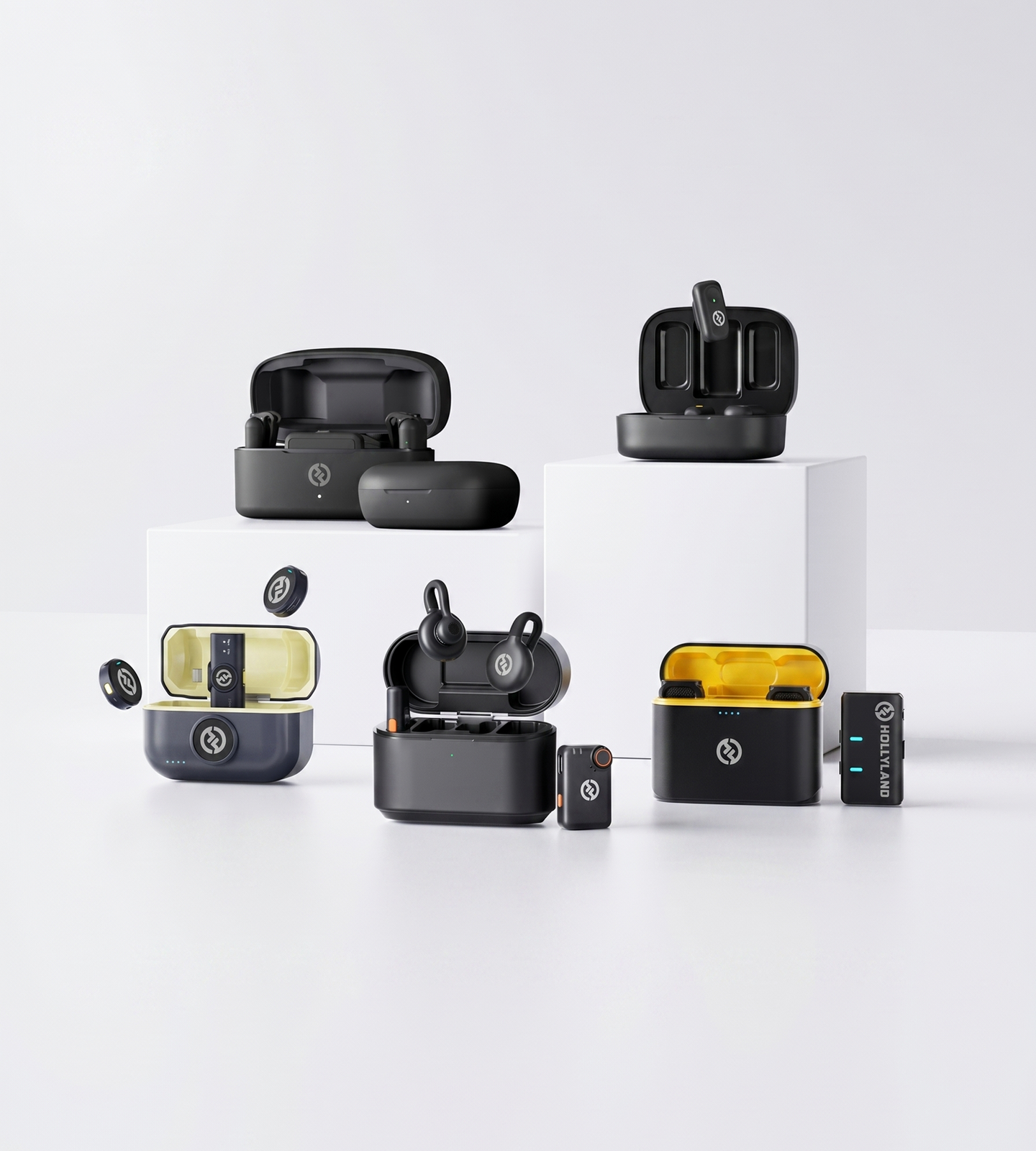
Audio Enhancement

Microphones with Built-In Audio Enhancement

Cut background noise at the source. Hollyland wireless microphones deliver hardware-level audio enhancement — ENC, AI noise cancellation, real-time gain control, and clip protection — so every recording sounds polished and professional, with less time spent in post-production.
Shop Now Compare Models

Compatible with iPhone, Android, DSLR & mirrorless cameras — plug-and-play ready.

  • ENC to AI Noise Cancellation
  • Gain, EQ & Clip Protection
  • Up to 340m Wireless Range
  • Plug-and-Play, Any Device
Microphones with Built-In Audio Enhancement
Editor's pickLARK MAX 2AI Noise Cancellation · 32-bit Float
4.7 / 5From 1.5M+ verified creators
Shop Models

Find Your Match

Four wireless mics with built-in audio enhancement — matched to your workflow, device, and level of control.
LARK M2

LARK M2

Effortless ENC for everyday content creators

  • ENC Noise Cancellation
  • 48kHz / 24-bit
  • Up to 300m Range
$76.00
LARK M2S

LARK M2S

Invisible-fit ENC for on-screen creators

  • 7g No-Logo Design
  • ENC Noise Cancellation
  • 48kHz / 24-bit
$89.00
LARK MAX 2

LARK MAX 2

AI-enhanced pro audio for advanced workflows

  • AI Noise Cancellation
  • 32-bit Float Recording
  • Wireless Monitoring
$189.00
LARK A1

LARK A1

Deep audio control for smartphone creators

  • 3-Level Noise Cancellation
  • 6-Level Gain Control
  • Auto-Limit Protection
$35.90
Side-by-side

Compare Audio Enhancement Mics

Match noise cancellation tier, audio specs, and enhancement controls to your recording workflow.
Model LARK M2 LARK M2 $76.00 LARK M2S LARK M2S $89.00 LARK MAX 2 LARK MAX 2 $189.00 LARK A1 LARK A1 $35.90
Noise CancellationENC Environmental Noise Cancellation ENC Environmental Noise Cancellation AI Noise Cancellation 3-Level Intelligent Noise Cancellation
Recording Format48kHz / 24-bit WAV 48kHz / 24-bit 48kHz / 32-bit Float & 48kHz / 24-bit 48kHz / 24-bit
Signal-to-Noise Ratio>70dB >70dB ≥72dB ≥67dB
Max SPL115dB 116dB 128dB 128dB
Audio Enhancement Controls32-bit Full-Chain AI Processing, Timecode, Wireless Monitoring EQ & Reverb Adjustment, 6-Level Gain Control
Clip Protection32-bit Float Internal Recording (Clipping-Free) Auto-Limit Clip Protection
Wireless Range (LOS)300m / 1,000ft 300m / 1,000ft 340m / 1,115ft 200m / 650ft
Total Battery LifeUp to 40 hours Up to 30 hours Up to 36 hours Up to 54 hours
Transmitter Weight~9g ~7g ~14g ~8g
Device CompatibilitySmartphone & Camera Smartphone & Camera Smartphone & Camera Smartphone
Shop Shop Shop Shop
Buying Guide

How to Choose an Audio Enhancement Microphone

Not every wireless microphone is built the same way. Audio enhancement microphones go beyond simple capture — they actively process sound at the hardware level, reducing background noise, protecting dynamic audio, and delivering cleaner output before you ever open an editing timeline. Here's what to evaluate before you buy.
  1. What Separates an Audio…
  2. Noise Cancellation: The Core…
  3. Audio Fidelity: Enhancement Should…
  4. Level of Control: Simple vs.…
  5. Device Compatibility: Confirm…
  6. Portability and Form Factor
  7. Battery Life and Wireless Range
  8. Matching the Right Features to…
  9. How to Narrow Down Your Choice

What Separates an Audio Enhancement Mic From a Standard Wireless Mic

A standard wireless microphone captures and transmits audio. An audio enhancement microphone processes it — using built-in noise cancellation, gain management, EQ adjustment, or AI-driven filtering to improve audio quality at the point of recording.

The practical benefit: less reliance on post-production cleanup, cleaner results straight from the device, and a more professional output regardless of where you're shooting.

The features that deliver this vary significantly across products. Knowing which ones matter for your workflow is the key to making the right choice.


Noise Cancellation: The Core Feature to Evaluate First

Noise cancellation is the defining capability of this product category — but the quality and flexibility of that cancellation differs meaningfully between products.

ENC (Environmental Noise Cancellation)

ENC is the standard entry point. It filters out steady-state ambient noise — wind, crowd chatter, HVAC hum, traffic — while preserving vocal clarity. For most creators shooting in varied but not extreme environments, ENC delivers a reliable, automatic level of noise reduction with no configuration required.

  • Best for: solo creators, vloggers, mobile journalists, run-and-gun shooters
  • Works well in: moderate outdoor noise, casual interview settings, travel content
  • Trade-off: limited user control — cancellation intensity is fixed

Multi-Level Intelligent Noise Cancellation

A step up in flexibility. Instead of a single fixed filter, adjustable noise cancellation lets you choose how aggressively the mic suppresses background noise. This is valuable when your recording environment changes frequently — you can reduce cancellation in quieter settings to preserve natural ambience, or increase it when noise conditions worsen.

  • Best for: content creators who shoot across different environments and want manual control
  • Works well in: street interviews, mixed indoor/outdoor shoots, variable noise conditions
  • Trade-off: requires a small amount of intentional setup

AI-Powered Noise Cancellation

The most advanced approach. AI processing distinguishes between voice and non-voice sounds in real time, adapting dynamically rather than applying a static filter. It handles complex, layered noise environments — overlapping voices, sudden sound spikes, unpredictable acoustic conditions — more effectively than rule-based ENC alone.

  • Best for: videographers, live event creators, professional workflows
  • Works well in: crowded venues, live broadcasts, high-stakes recordings where standard ENC may fall short
  • Trade-off: typically found in higher-tier, more feature-rich systems

Ask yourself: Do you need set-it-and-forget-it simplicity, or do your recording environments demand more precision?


Audio Fidelity: Enhancement Should Complement Quality, Not Mask Its Absence

Processing features are only as effective as the core hardware running beneath them. A microphone with strong noise cancellation but poor baseline audio quality will produce processed-sounding results rather than genuinely clean ones.

When evaluating specs, look for:

  • 48kHz / 24-bit recording — The professional standard for voice capture. Delivers full dynamic range and frequency accuracy with enough headroom for processing without degrading the signal.
  • 32-bit float recording — The highest available dynamic range. Eliminates clipping entirely and allows recovery of otherwise unusable audio in post. Critical for unpredictable live or outdoor situations.
  • SNR (Signal-to-Noise Ratio) ≥70dB — A higher SNR means a cleaner baseline signal before any enhancement processing is applied. This matters: noise cancellation works best when there's already a strong voice-to-noise ratio to work with.
  • Frequency response: 20Hz–20kHz — Full audible spectrum coverage ensures vocals are reproduced naturally and completely.

Key point: Noise cancellation reduces unwanted sound. Good audio specs ensure the sound you want to keep is captured faithfully. Both matter.


Level of Control: Simple vs. Adjustable Enhancement

Different workflows call for different relationships with audio settings. Before buying, be honest about how much control you actually want versus how much you'll realistically use.

Plug-and-play automatic enhancement The mic handles all processing decisions for you. Connect it, clip it on, and record. No app, no menus, no configuration.

  • Right for: fast-moving shoots, solo creators, journalists who prioritize speed over fine-tuning

App-based control Adjust EQ, reverb, gain, and noise cancellation intensity from a companion smartphone app. Adds meaningful flexibility without requiring dedicated hardware controls.

  • Right for: creators who want more polish without technical complexity; mobile-first workflows

Multi-parameter manual control (gain, EQ, noise cancellation levels) Full hands-on adjustment of how the microphone captures and processes audio. Suited to experienced creators, videographers, and hybrid production setups where audio conditions vary significantly between jobs.

  • Right for: semi-professional to professional users who record in diverse environments; those who want to minimize post-production work

Auto-limit / clip protection Automatically prevents audio peaks from distorting during sudden loud sounds — applause, shouts, close-range bursts. This isn't a luxury feature; it's critical insurance for live events, interviews, and any shoot where audio levels are unpredictable. Look for it specifically if your work takes you into dynamic sound environments.


Device Compatibility: Confirm Before You Buy

One of the most common purchasing mistakes in this category is buying a microphone that doesn't match the device you're actually using.

  • Smartphone-first setups — Some receivers connect directly to iOS (Lightning) or Android/USB-C devices without an intermediary receiver box. Fast, minimal, ideal for mobile creators.
  • Camera setups (DSLR / mirrorless) — Require a separate receiver unit connecting via 3.5mm input or cold shoe mount. Verify the product version matches your camera's input type.
  • Universal / combo kits — Include adapters for both smartphones and cameras. Best option if you regularly switch between devices.

Note: The mobile and camera versions of the same product often differ in wireless range and output specs. Always check which version you're purchasing.


Portability and Form Factor

For creators who clip a transmitter directly to clothing or wear it on camera, size and weight are functional decisions, not just aesthetic ones.

  • Transmitter weight (7–9g) — At this weight, a mic is virtually invisible in the shooting frame and imposes no discomfort on the subject. This range represents the current benchmark for compact wireless transmitters.
  • No-logo / discreet design — Relevant if the transmitter is visible on screen. Some products are specifically designed without visible branding for a cleaner on-camera appearance — the LARK M2S is purpose-built for this use case.
  • Magnetic clip attachment — Speeds up placement when efficiency on set matters. Useful for multi-subject shoots or when subjects are frequently rotating in and out of frame.

Form factor involves trade-offs. Smaller transmitters may carry marginally less battery capacity than larger ones, though most modern compact options deliver sufficient runtime for a full day of shooting.


Battery Life and Wireless Range

Two practical factors that directly affect shooting confidence:

Battery Life

  • Look for TX battery life of 9+ hours per charge as a reliable baseline for full-day shoots.
  • A charging case multiplies total available battery life significantly — some systems offer 30–54 hours of combined capacity, eliminating mid-shoot charging concerns.
  • If you shoot in demanding or high-stakes environments, look for onboard internal recording within the transmitter itself. This acts as a safety net if the wireless signal drops unexpectedly.

Wireless Range

  • LOS (line-of-sight) range is measured in open conditions — useful as a ceiling, not a real-world expectation.
  • NLOS (non-line-of-sight) range — through walls, around obstacles, in indoor spaces — is the more meaningful number for most creators. For typical content production (YouTube, vlogging, interviews), 40–70m NLOS is sufficient. For live events, large venues, or complex spaces, prioritize systems rated for longer NLOS distances.

Matching the Right Features to Your Recording Environment

Recording Environment Priority Features
Outdoor / street / travel Strong ENC, wind noise handling, compact lightweight design
Controlled interview setting Voice clarity, adjustable gain, consistent noise floor
Live events / crowded venues AI noise cancellation, clip protection, wide dynamic range
Solo mobile shooting Plug-and-play simplicity, direct smartphone connection, app control
Corporate / educational video 24-bit or 32-bit audio specs, clean voice output, reliable transmission

How to Narrow Down Your Choice

Use these as decision-making shortcuts:

  • You want zero setup friction and automatic noise reduction → Prioritize compact plug-and-play designs with built-in ENC. Both the LARK M2 and LARK M2S fit this profile.

  • You need adjustable enhancement with more hands-on audio control → Look for multi-level noise cancellation, EQ adjustment, 6-level gain control, and clip protection. The LARK A1 is built specifically for this level of control and is optimized for smartphone-first workflows.

  • You're working on professional or semi-professional productions that demand the highest fidelity → AI noise cancellation, 32-bit float recording, and wireless audio monitoring are your benchmarks. The LARK MAX 2 addresses this tier, including support for multi-transmitter setups and real-time monitoring via OWS earphone.

  • Discretion and on-camera appearance are a priority → The LARK M2S (7g, no-logo titanium design) is the purpose-built choice for creators who don't want visible hardware in frame.

The right audio enhancement microphone is the one that processes audio the way your workflow actually demands — not the one with the longest feature list.

Who It's Built For

Clean Audio for Every Shoot, Every Setting

Background noise is unpredictable. Your audio doesn't have to be. Whether you're filming on a city street, recording a sit-down interview, or going live in a crowded venue, these microphones actively process sound at the source — so your voice comes through clear, wherever you create.

Outdoor Vlogging & Travel Content

Street noise, wind, and crowd chatter are constant threats when filming on location. ENC and AI-powered noise cancellation filter environmental interference at the hardware level — capturing your voice while rejecting the world around it, no windscreen or editing suite required.
  • Outdoor Recording
  • Wind & Noise Rejection
  • On-Location Filming

Interview & Documentary Shooting

When your subject's voice is the story, clarity can't be compromised. Stable long-range wireless transmission keeps audio locked even as subjects move, while multi-level noise cancellation and gain control deliver intelligible dialogue — with far less work in post.
  • Interview Recording
  • Voice Clarity
  • Dialogue Capture

Solo Smartphone Content Creation

No audio crew, no problem. Clip-on transmitters connect directly to your iPhone or Android via plug-and-play, while built-in EQ adjustment, 6-level gain control, and auto-limit clip protection give you broadcast-quality sound from a single compact setup.
  • Smartphone Compatible
  • Solo Shooting
  • Plug & Play

Live Streaming & Event Coverage

Real-time events leave no room for post-edit fixes. Low-latency wireless transmission and live audio monitoring let you hear exactly what your audience hears — and make adjustments before a bad take becomes a permanent broadcast.
  • Live Streaming
  • Real-Time Monitoring
  • Event Coverage

Corporate & Professional Video Production

Presentations, training videos, and branded content demand consistent, polished audio across every take. 24-bit and 32-bit float recording capture full dynamic range with professional-grade fidelity — minimizing post-production time and delivering results clients can hear.
  • Corporate Video
  • Professional Audio
  • Broadcast Quality
Trusted by creators

1.5M+ creators picked LARK microphones for their audio

A decade of wireless engineering for film crews and broadcasters — packaged for modern creator workflows.
  • 4.7 Avg. rating · 120K+ reviews
  • 1.5M+ Verified creators
  • 160+ Countries shipped
  • 98% Would recommend

I love my new LARK M2 mics. These were so good, and I really enjoyed testing out the new LARK M2 from Hollyland.

Sarah GraceSarah GraceTech Creator · 3.2M YouTube subscribers

The Hollyland LARK MAX is the wireless microphone system with the clearest and crispest audio of any wireless mic system I have ever tried.

GoenrockGoenrockCinematographer · 107K Instagram subscribers

LARK MAX is doing an excellent job of dropping the sound of the air conditioner, which is something l always have to remove and post with our shotgun mic.

Film RiotFilm RiotFilmmaking Educator · 2.2M YouTube subscribers
  • No Film School
  • Newsshooter
  • CineD
  • RedShark
  • CAMERA JABBER
  • Photowebexpo
FAQ

Your Questions About Audio Enhancement Microphones, Answered

Does the noise cancellation on these microphones actually work in real-world noisy environments?
Yes — and each microphone processes noise at the hardware level, meaning audio is cleaned up before it ever reaches your device or recording app. The **LARK M2** and **LARK M2S** use ENC (Environmental Noise Cancellation) to filter ambient interference like wind, traffic, and crowd noise during capture. The **LARK A1** takes it further with 3-level intelligent noise cancellation, letting you dial in the right suppression intensity for your specific environment. For the most demanding conditions, the **LARK MAX 2** deploys AI Noise Cancellation, which continuously analyzes and separates voice from background noise in real time. In all cases, you're getting actively enhanced audio — not a raw capture that needs fixing later.
What's the difference between ENC, intelligent noise cancellation, and AI noise cancellation?
These represent three tiers of processing sophistication, each delivering more adaptive noise removal than the last: - **ENC** *(LARK M2, LARK M2S)* — applies consistent filtering to suppress common ambient frequencies like HVAC hum, wind, and crowd noise. It works automatically with no setup required. - **3-Level Intelligent Noise Cancellation** *(LARK A1)* — gives you manual control over suppression intensity, so you can match the processing level to your actual environment rather than relying on a single fixed setting. - **AI Noise Cancellation** *(LARK MAX 2)* — uses machine learning to dynamically distinguish your voice from background interference in real time, adapting as acoustic conditions change. For most everyday content creation, ENC delivers a clear, noticeable improvement. For professional workflows or consistently high-noise environments, the LARK A1 or LARK MAX 2 will produce a more refined result.
Will audio enhancement processing add noticeable latency or create sound artifacts?
No — hardware-level audio processing on these microphones is designed to be transparent. You won't hear pumping, unnatural compression, or distortion artifacts during normal use. The **LARK MAX 2** is specifically built for real-time monitoring with its low-latency OWS wireless earphone system (monitoring range up to 100m / 328ft), so you can hear your processed audio live without meaningful delay. The **LARK A1**'s auto-limit clip protection works silently in the background, preventing sudden loud sounds from overloading the recording without altering the natural character of your voice. Enhancement on all four products is engineered to add clarity, not audible processing noise.
Can I control how much noise cancellation is applied, or is it always automatic?
It depends on the model you choose. The **LARK M2** and **LARK M2S** apply ENC automatically — ideal for creators who want instant improvement without adjusting any settings. The **LARK A1** offers the most hands-on control: 3 selectable noise cancellation levels, 6-level gain adjustment, and EQ and reverb adjustment, all accessible through the app. The **LARK MAX 2** pairs AI Noise Cancellation with app control, giving you intelligent automation alongside manual oversight. If the ability to fine-tune your enhancement is important to your workflow, the LARK A1 or LARK MAX 2 are the right choices.
Will these microphones work with my iPhone, Android phone, DSLR, or mirrorless camera?
Yes, across the range. The **LARK M2** and **LARK M2S** both offer universal compatibility through their Combo versions, covering smartphones and cameras with plug-and-play connection — no drivers or apps required to get started. The **LARK A1** is optimized for smartphones (iOS and Android) with direct plug-and-play support and app-based control. The **LARK MAX 2** supports both camera and mobile workflows, with one receiver capable of connecting up to 4 transmitters simultaneously — making it a flexible option for multi-mic interview and event setups. Specific connector compatibility is detailed on each product page.
After recording with one of these microphones, will I still need to do a lot of audio editing?
Significantly less than you would with a standard microphone. Because noise cancellation, gain management, and clip protection all happen during capture, your files arrive cleaner and more balanced from the start. The **LARK A1**'s auto-limit clip protection prevents overload distortion from sudden loud moments — one of the most common reasons creators need to reshoot or spend time in post. The **LARK MAX 2**'s 32-bit float internal recording (up to 14 hours on the transmitter) captures an extremely wide dynamic range, meaning audio that might otherwise peak or clip can be recovered cleanly in editing without quality loss. For most creators, these microphones meaningfully reduce the time spent on noise reduction, level correction, and EQ work.
What does 32-bit float recording mean, and do I actually need it?
32-bit float is a recording format that captures a far wider dynamic range than standard 24-bit audio — in practical terms, it's nearly impossible to clip or distort your recording, even when volume levels change suddenly and dramatically. This makes it especially valuable in unpredictable environments: live interviews where a subject raises their voice unexpectedly, events with sudden loud sounds, or any situation where you can't monitor gain in real time. The **LARK MAX 2** supports 48kHz / 32-bit float recording with up to 14 hours of internal backup storage on the transmitter itself. The **LARK M2**, **LARK M2S**, and **LARK A1** record at 48kHz / 24-bit — which is broadcast-standard quality, more than sufficient for YouTube, podcasting, and professional video production. Unless you're regularly shooting in high-stakes, unpredictable audio environments, 24-bit will deliver outstanding results.
Explore further

A few more places to go from here

A curated link map of the surrounding content — related categories, the most useful guides, head-to-head comparisons and setup help.
Ready when you are

Get Cleaner Audio — Right Out of the Box

Choose from four wireless microphones with built-in noise cancellation, engineered for creators at every level.
Shop Now Compare Models
  • Free shipping over $99
  • 30-day returns
  • 1-year warranty