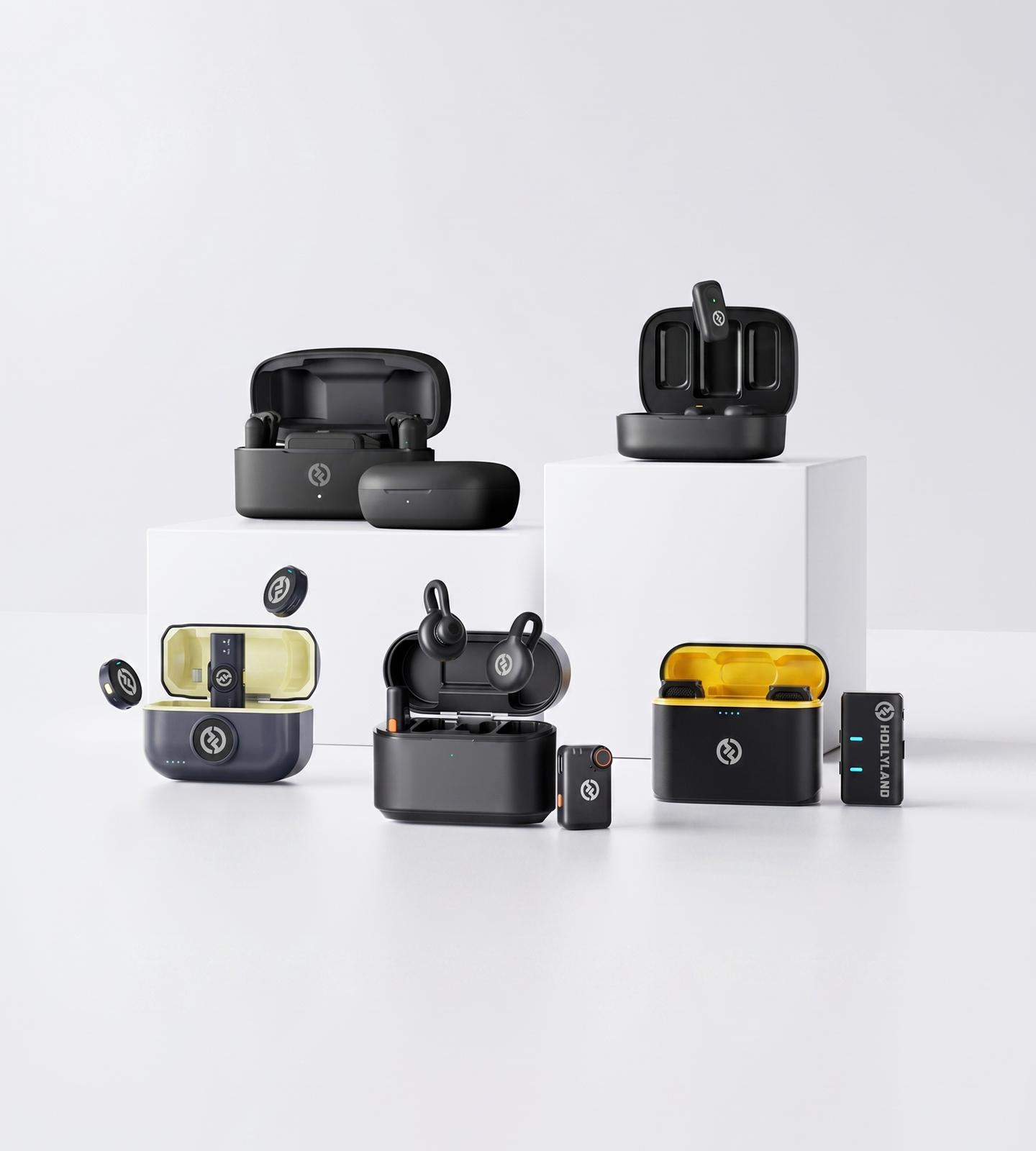
Micro Wireless Mics

Micro Microphones

Hollyland's wireless micro microphones weigh as little as 7g yet deliver 24-bit studio-grade audio with ENC noise cancellation. Clip on, hit record — no cables, no visible bulk. Built for creators, journalists, and mobile filmmakers who demand crystal-clear sound in the smallest possible package.
Shop Now Compare Models

Compatible with iPhone, Android & cameras · Plug and Play · From 7g

  • From 7g — Lighter Than a Coin
  • 24 / 32-Bit Studio Audio
  • Up to 54 Hours Total
  • ENC & AI Noise Cancellation
Micro Microphones
Editor's pickLARK M2S7g · Invisible on Camera
4.7 / 5From 1.5M+ verified creators
Shop Models

Find Your Match

Four compact wireless mics — each built for a different creator, workflow, and device.
LARK M2

LARK M2

The plug-and-play compact for everyday content creators

  • 9g Transmitter
  • ENC Noise Cancellation
  • Up to 40 hrs Total Battery
$76.00
LARK M2S

LARK M2S

The invisible-on-camera mic for a clean on-screen look

  • 7g Transmitter
  • No-Logo Invisible Fit
  • Titanium Build
$89.00
LARK MAX 2

LARK MAX 2

The professional-grade compact for creators who want it all

  • 32-bit Float Recording
  • AI Noise Cancellation
  • 340m Wireless Range
$189.00
LARK A1

LARK A1

The smartphone-native mic built for all-day mobile shooting

  • 8g Transmitter
  • Up to 54 hrs Total Battery
  • Smartphone Plug & Play
$35.90
Side-by-side

Find Your Perfect Micro Mic

Compare the specs that matter most and choose the compact wireless mic built for your workflow.
Model LARK M2 LARK M2 $76.00 LARK M2S LARK M2S $89.00 LARK MAX 2 LARK MAX 2 $189.00 LARK A1 LARK A1 $35.90
Transmitter Weight9g 7g 14g 8g
Audio Format48kHz / 24-bit 48kHz / 24-bit 48kHz / 32-bit Float 48kHz / 24-bit
Signal-to-Noise Ratio>70dB >70dB ≥72dB ≥67dB
Wireless Range (LOS)300m / 1000ft 300m / 1000ft 340m / 1115ft 200m / 650ft
Total Battery LifeUp to 40 hours Up to 30 hours Up to 36 hours Up to 54 hours
Noise CancellationENC ENC AI Noise Cancellation 3-Level Intelligent Noise Cancellation
Device CompatibilityPhone & Camera Phone & Camera Phone & Camera Smartphone Only
Best ForBeginners & plug-and-play simplicity On-camera invisibility & discreet wear Professional output & multi-mic setups Mobile-first creators & all-day shoots
Shop Shop Shop Shop
Buying Guide

How to Choose the Right Micro Microphone

Micro wireless microphones have come a long way — but compact size doesn't automatically mean the right fit for every creator. Here are the key factors to consider before choosing the one that suits your workflow.
  1. Size and Weight: How Micro Is…
  2. Audio Quality: Does Small Mean…
  3. On-Camera Discretion: Will It Show…
  4. Battery Life: Planning Around a…
  5. Compatibility: Match the Mic to…
  6. Wireless Range: Enough for Your…
  7. Noise Cancellation: Recording in…
  8. Setup Complexity: Plug-and-Play…

Size and Weight: How Micro Is Micro Enough?

The transmitter — the piece you clip to your body or clothing — is the part that defines how genuinely compact a wireless mic system actually is. Spec sheets often list total system weight, but transmitter weight is the number that affects discretion and wearability.

What to look for:

  • Transmitters under 10g are button-sized and clip-friendly — roughly the weight of a few coins — making them easy to hide under a shirt collar or inside a jacket
  • Transmitters in the 10–15g range are still compact by professional wireless standards, especially when they carry more advanced feature sets
  • Pay attention to physical footprint, not just weight — a flat, button-shaped body sits flush against fabric far more easily than a longer capsule design

Audio Quality: Does Small Mean Compromised?

Skepticism about whether a tiny mic can deliver broadcast-quality audio is one of the most common concerns — and it's a fair one. The key is knowing which specs to focus on.

Specs that actually indicate audio quality:

  • Signal-to-Noise Ratio (SNR): Look for ≥67dB as a working baseline for clear voice capture. Higher is better — anything approaching or exceeding 72dB is strong for dialogue and voiceover
  • Bit depth: 24-bit is the standard for clean, wide dynamic-range recording. 32-bit float is the professional benchmark — it eliminates clipping risk entirely, even if gain is set incorrectly
  • Frequency response: 20Hz–20kHz means the mic captures the full audible spectrum without rolling off highs or lows
  • Maximum SPL handling: A higher SPL ceiling (e.g., 115–128dB) means the mic handles louder sound sources without distorting

If 32-bit float recording is a priority — particularly for documentary work, live events, or any scenario where gain is hard to predict — look at options like the LARK MAX 2, which supports full 32-bit float chain transmission at a compact 14g.


On-Camera Discretion: Will It Show Up in the Shot?

For video creators, whether the mic appears on camera is a genuine functional concern — not just a cosmetic one. A visible transmitter in frame can look unprofessional and distract viewers.

What affects on-camera discretion:

  • Logo placement and finish: A mic with no visible branding is far less noticeable if it peeks into frame
  • Body profile: Flat, button-sized transmitters are easier to hide under clothing than taller or wider units
  • Color options: Neutral tones (black, silver, light gold) tend to disappear against most clothing
  • Clip design: A low-profile clip that holds the transmitter close to the body prevents it from shifting into the shot during movement

The LARK M2S is designed specifically around on-camera invisibility, featuring a no-logo finish and a slim titanium-look body that stays discreet even in close-up or wide-angle compositions.


Battery Life: Planning Around a Full Shoot Day

A micro transmitter runs on a small internal battery — which makes real-world runtime more important to evaluate than for larger systems.

How to read battery specs:

  • Per-charge TX runtime: 9–11 hours of continuous use is sufficient for a full day of filming without needing to recharge the transmitter mid-session
  • Total system battery life: Most micro wireless systems include a charging case. The total figure — case capacity plus transmitter charges — is the better metric for multi-day or extended use
  • Onboard recording: Some transmitters record audio internally as a backup. If the wireless connection drops, you still have a local file — which effectively extends the reliability of the system

If all-day (or multi-day) battery life is a top priority, the LARK A1 offers up to 54 hours of total battery life across its case and transmitter — the highest in this category.


Compatibility: Match the Mic to Your Device

Buying a micro wireless mic that doesn't connect to your primary recording device is one of the most avoidable mistakes. Different versions of the same mic often exist for a reason.

The three main configurations:

  • Smartphone (USB-C or Lightning): The receiver plugs directly into your phone — no adapter, no extra gear. Best for mobile-first creators recording to iOS or Android
  • Camera (3.5mm / cold shoe mount): The receiver mounts on a camera hot shoe and connects via 3.5mm jack. Best for mirrorless or DSLR shooters
  • Combo (multi-output): Includes connections for both — the most flexible option if you switch between a phone and a camera

Ask yourself before buying:

  • Do I shoot primarily to phone, camera, or both?
  • Does my phone use USB-C or Lightning?
  • Does my camera have a 3.5mm microphone input?

The LARK A1 is designed exclusively for smartphone use and excels in that context. For creators who move between devices, combo versions of the LARK M2 and LARK M2S cover both scenarios.


Wireless Range: Enough for Your Environment?

Line-of-sight (LOS) range figures in marketing specs are measured in ideal conditions. What matters more for real-world use is NLOS (non-line-of-sight) range — how the mic performs through walls, around corners, and in RF-congested spaces.

Practical guidance:

  • 40–70m NLOS covers the vast majority of indoor content creation: rooms, corridors, event halls, and studio spaces
  • A stronger LOS rating generally signals a higher-quality RF transmission system, which tends to correlate with better NLOS performance
  • For environments with heavy wireless interference — crowded venues, trade shows, urban outdoor shoots — prioritize systems that use adaptive frequency hopping to avoid congested channels

Noise Cancellation: Recording in the Real World

Micro mics are frequently used in uncontrolled environments — outdoors, busy locations, moving vehicles — where background noise is unpredictable. Noise handling is no longer a premium-only feature; it's a baseline expectation for practical usability.

What to compare:

  • ENC (Environmental Noise Cancellation): DSP-based filtering that reduces consistent ambient noise — wind, traffic, crowd hum — during capture. Standard across most modern compact wireless mics
  • AI Noise Cancellation: More adaptive processing that separates voice from variable or complex background noise in real time. Better suited to high-noise or unpredictable environments
  • Wind protection: Check whether the mic includes a windscreen or fur cover if outdoor shooting is a regular use case

For indoor or predictable environments, ENC is typically sufficient. If you regularly record outdoors or in loud, variable settings, the AI noise cancellation on the LARK MAX 2 offers a more robust solution.


Setup Complexity: Plug-and-Play vs. App Control

Micro wireless mics range from zero-configuration (plug in, press record) to feature-rich systems with companion apps for fine-tuned audio control. Neither approach is objectively better — it depends entirely on your workflow.

Which suits your needs:

  • Plug-and-play is best for beginners, fast-moving creators, and anyone who wants to focus entirely on content rather than settings
  • App control adds value for creators who want gain adjustment, EQ presets, noise cancellation levels, and real-time monitoring — useful once you've outgrown default settings
  • Onboard controls (physical buttons or dials on the transmitter) offer a middle ground: quick adjustments without pulling out a phone

If you're new to wireless microphones, start with plug-and-play and layer in app features only when you have a clear reason to use them. The best micro mic is the one you can deploy in seconds — not the one with the most options you'll never touch.

Where It Works

One Mic. Every Shoot, Every Setting.

Whether you're filming solo on a city rooftop or wiring talent on a crowded event floor, Hollyland micro mics disappear into the scene — and deliver audio that doesn't.

Solo Content Creation

Clip it on, hit record, and forget it's there. At 7–9g with no visible logo, Hollyland transmitters stay completely out of frame while delivering studio-clean, 24-bit audio for YouTube, vlogs, and direct-to-camera shoots.
  • On-camera discreet
  • Clip-on wireless
  • Clean frame

Interview & Field Journalism

Wire up a subject in seconds without drawing a second glance. The button-sized, no-logo design keeps talent at ease and gear invisible — whether you're on a press floor, a street corner, or a live event.
  • Fast deploy
  • Discreet on talent
  • On-location recording

Travel & Run-and-Gun Filming

Your entire audio rig fits in a jacket pocket. Ultra-light transmitters, all-day battery life, and up to 340m wireless range mean you're always ready to roll — from airport terminals to mountain trails.
  • Pocket-sized kit
  • Lightweight rig
  • All-day battery

Short-Form Social Media

Plug into your phone and shoot. Native smartphone compatibility and true plug-and-play setup get you from idea to publishable audio in under a minute — no app, no configuration, no delay.
  • Phone-native
  • Zero-config setup
  • Reels & Shorts

Online Meetings & Presentations

Skip the desktop mic clutter. A micro transmitter clipped inside your collar delivers crisp, professional voice audio with no cables on desk and no gear visible on camera — just clean, confident sound.
  • Cord-free audio
  • Professional voice
  • Camera-invisible

Education & Online Course Recording

Record clear lessons anywhere — from a spare bedroom to an open classroom. ENC and AI noise cancellation automatically filter HVAC hum, background chatter, and room echo so every word lands clearly.
  • Noise cancellation
  • Multi-environment
  • Crystal-clear voice
Trusted by creators

1.5M+ creators picked LARK microphones for their audio

A decade of wireless engineering for film crews and broadcasters — packaged for modern creator workflows.
  • 4.7 Avg. rating · 120K+ reviews
  • 1.5M+ Verified creators
  • 160+ Countries shipped
  • 98% Would recommend

I love my new LARK M2 mics. These were so good, and I really enjoyed testing out the new LARK M2 from Hollyland.

Sarah GraceSarah GraceTech Creator · 3.2M YouTube subscribers

The Hollyland LARK MAX is the wireless microphone system with the clearest and crispest audio of any wireless mic system I have ever tried.

GoenrockGoenrockCinematographer · 107K Instagram subscribers

LARK MAX is doing an excellent job of dropping the sound of the air conditioner, which is something l always have to remove and post with our shotgun mic.

Film RiotFilm RiotFilmmaking Educator · 2.2M YouTube subscribers
  • No Film School
  • Newsshooter
  • CineD
  • RedShark
  • CAMERA JABBER
  • Photowebexpo
FAQ

Your Micro Mic Questions, Answered

Will such a small microphone actually sound professional?
Yes — every Hollyland micro wireless mic records at **48kHz / 24-bit** with a full **20Hz–20kHz frequency response**, the same standard used in professional audio production. Signal-to-noise ratios range from 67dB on the LARK A1 up to 72dB on the LARK MAX 2, which means clean, low-noise audio even in quiet environments. The LARK MAX 2 goes further with **32-bit float recording**, giving you enough dynamic headroom to recover audio from virtually any recording situation in post. Compact form factor is a hardware engineering achievement — it has no bearing on audio specifications.
How small are these microphones, and will they show up on camera?
The transmitters in this range weigh between **7g and 14g** — lighter than a set of keys. The **LARK M2S** is the most discreet option at just 7g, built with a **no-logo invisible fit** and a titanium housing designed specifically to disappear under clothing. The **LARK M2** uses a button-size clip form that sits flat against fabric, and the **LARK A1** features a low-profile magnetic design. When placed under a collar or lapel, all four models are effectively invisible on camera. If a completely clean on-screen look is your top priority, the LARK M2S is the recommended choice.
Which Hollyland micro mic is compatible with my phone or camera?
Compatibility depends on your recording device: - **Smartphones only:** The **LARK A1** is designed exclusively for smartphones with a direct plug-and-play connection — no app or manual pairing required. - **Phones or cameras (your choice):** The **LARK M2** and **LARK M2S** are available in a Mobile Version (for smartphones), a Camera Version (for DSLRs and mirrorless cameras), and a **Combo Version** that includes adapters for both. - **Camera-primary with professional monitoring:** The **LARK MAX 2** is the best fit for camera-based productions where you also need wireless audio monitoring via the OWS Monitor Earphone. If you shoot across multiple devices, the Combo versions of the LARK M2 or LARK M2S offer the most flexibility for a single purchase.
How long does the battery last — can it handle a full day of filming?
All four microphones are built for extended shoots, not just short-form clips: - **LARK A1:** Up to **9 hours per TX charge**, with up to **54 hours total** battery across the system — the longest in the range. - **LARK M2:** Approximately **10 hours per TX charge**, up to **40 hours total**. - **LARK MAX 2:** Approximately **11 hours per mic charge**, up to **36 hours total**. The transmitter also supports **32-bit float internal recording for up to 14 hours** as an independent backup track. - **LARK M2S:** Approximately **9 hours per TX charge**, up to **30 hours total**. For most single-day shoots, one charge on the transmitter is more than sufficient. The charging case on each model extends total runtime significantly, so you can top up between scenes without interrupting your workflow.
Will the wireless signal drop out indoors or in crowded environments?
These microphones are engineered for real-world conditions, not just open-air testing. Line-of-sight (LOS) range reaches up to **340m / 1115ft** on the LARK MAX 2 and **200m / 650ft** on the LARK A1. In non-line-of-sight (NLOS) environments — through walls, in buildings, or in crowds — expect a reliable working range of **40–70m** depending on the model, with the LARK MAX 2 leading at **70m / 230ft NLOS**. For the vast majority of indoor content creation, interview, event, and presentation use cases, this range is more than adequate. The main risk of dropout is usually distance or dense RF interference, not normal room-scale movement.
Are these microphones complicated to set up and use?
Not at all. Every Hollyland micro mic is designed for fast deployment — clip on the transmitter, attach the receiver to your device, and start recording. The **LARK A1**, **LARK M2**, and **LARK M2S** all support **plug-and-play** operation with no Bluetooth pairing, manual channel scanning, or driver installation required. For creators who want deeper control, the **LARK M2** (Mobile Version) and **LARK M2S** offer optional **app control** to manage gain, ENC settings, and monitoring levels. The **LARK A1** includes **6-level gain adjustment**, **EQ and reverb options**, and **Auto-Limit Clip Protection** directly on-device. Advanced features are there if you want them — but you'll never need them just to get a clean recording out of the box.
Can I use these microphones outdoors or in noisy environments?
Yes — active noise management is built into every model in this range: - **LARK M2 and LARK M2S:** **ENC (Environmental Noise Cancellation)** filters ambient background noise during wireless transmission. - **LARK A1:** **3-Level Intelligent Noise Cancellation** lets you dial in the right amount of noise reduction to match your environment. - **LARK MAX 2:** **AI Noise Cancellation** uses machine learning to isolate your voice from competing sounds — the most powerful noise handling in the range. For outdoor shooting, using the included windscreen foam on the capsule significantly reduces wind noise artifacts. All four models are designed to perform in uncontrolled real-world conditions — busy streets, event venues, outdoor interviews — without requiring a treated studio space.
Which Hollyland micro microphone should I choose?
Here's a quick guide based on your primary use case: - **LARK M2S** — Best if on-camera discretion is your top priority. At 7g with a no-logo finish and titanium build, it's the most invisible mic in the range. Ideal for presenters, vloggers, and on-screen talent. - **LARK A1** — Best for smartphone-first creators. The 54-hour total battery life is unmatched in the range, and its magnetic compact design and 3-level noise cancellation make it a natural pick for mobile creators and travelers. - **LARK M2** — Best all-around choice for creators who want ENC, plug-and-play simplicity, and the option of a Combo version that works with both phones and cameras. - **LARK MAX 2** — Best for professional and advanced creators who need 32-bit float recording, AI noise cancellation, wireless audio monitoring, and multi-transmitter support (up to 4 TX per receiver).
Explore further

A few more places to go from here

A curated link map of the surrounding content — related categories, the most useful guides, head-to-head comparisons and setup help.
Ready when you are

Go Small. Sound Professional.

From 7g transmitters to 32-bit float recording, there's a Hollyland mic built for how you create.
Shop Now Compare Models
  • Free shipping over $99
  • 30-day returns
  • 1-year warranty