


LARK M2
Reliable all-day wireless for creators and interviewers
- 9g Transmitter
- Up to 40h Battery
- ENC Noise Cancellation
 United States
(English / $
USD)
United States
(English / $
USD)


Video Solutions

Intercom Systems

Wireless Microphones

Cameras
Video Solutions
View all
Video Accessories
Intercom Accessories

Mic Accessories

Camera Accessories
Video Accessories
View all
Hollyland Monitor Calibrator-Wireless Video Transmission System Accessory

Monitor Hood (7-Inch)

Mars 4K Transmitter

Mars 4K Receiver

D-Tap to Locking DC Power Adapter Cable

Crab Clamp

NP-F970 Battery

NP-F550 Battery

Mini HDMI to HDMI Cable

Micro HDMI to HDMI Cable

SDI Cable (1000mm)

SDI Cable (500mm)

Cold Shoe Gimbal

Rotatable Cold Shoe Mount

Side & Bottom Mounted Aluminum Handle

Screw Fitting for Stabilizer

Cylindrical Antenna (2.4GHz & 5GHz)

Paddle Antenna (2.4GHz & 5GHz)

View all


United States / English
Compatible with iPhone · Android · DSLR · Mirrorless Camera
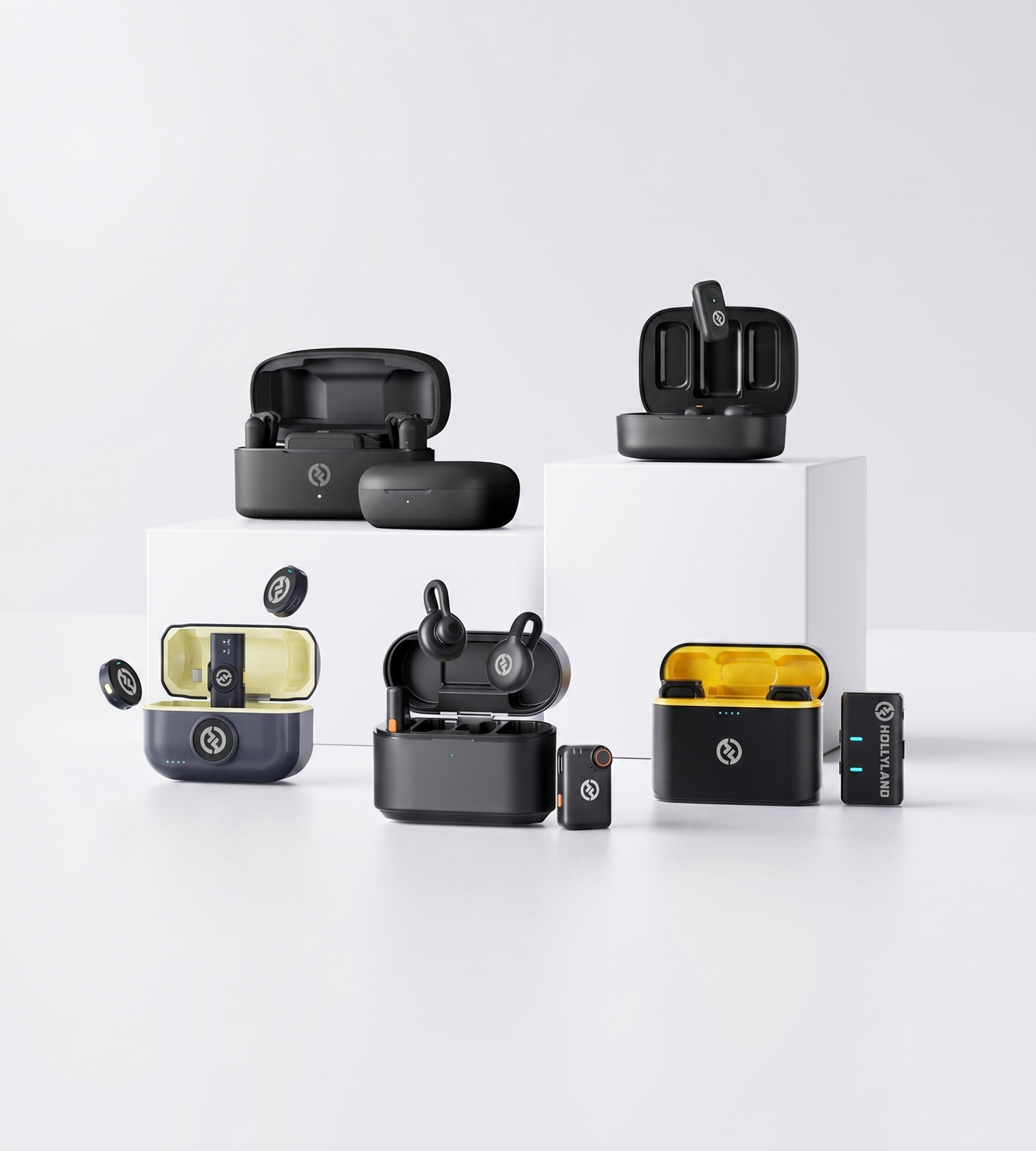
Reliable all-day wireless for creators and interviewers

Featherlight, no-logo wireless for on-camera creators

Pro-grade wireless for filmmakers and advanced productions

Smartphone-native wireless for mobile-first content creators
| Model |
 LARK M2
$60.80
LARK M2
$60.80
|
 LARK M2S
$99.00
LARK M2S
$99.00
|
 LARK MAX 2
$189.00
LARK MAX 2
$189.00
|
 LARK A1
$39.90
LARK A1
$39.90
|
|---|---|---|---|---|
| Recording Format | 48kHz / 24-bit | 48kHz / 24-bit | 48kHz / 32-bit Float | 48kHz / 24-bit |
| Wireless Range (LOS) | 300m / 1000ft | 300m / 1000ft | 340m / 1115ft | 200m / 650ft |
| Transmitter Weight | 9g | 7g | 14g | 8g |
| Total Battery Life | Up to 40 hours | Up to 30 hours | Up to 36 hours | Up to 54 hours |
| Noise Cancellation | ENC Environmental Noise Cancellation | ENC Environmental Noise Cancellation | AI Noise Cancellation | 3-Level Intelligent Noise Cancellation |
| Device Compatibility | Camera / Mobile / Universal | Camera / Mobile / Universal | Camera | Smartphones |
| Standout Feature | Plug & Play + Optional App Control | No-Logo Invisible Fit + Titanium Build | 32-bit Float + Timecode + 4 TX per RX | Auto-Limit Clip Protection + EQ & Gain Control |
| Best For | Versatile everyday creators | Camera-conscious & style-forward creators | Pro filmmakers & advanced content creators | Mobile-first creators |
| Shop | Shop | Shop | Shop |
Audio quality in a wireless mic comes down to three core specifications.
Bit depth determines how much dynamic range your recording captures and how much headroom you have in post-production:
Signal-to-noise ratio (SNR) measures how clearly the mic captures your voice above the noise floor. An SNR of 70dB or higher is the reliable threshold for clean, low-hiss recordings in most environments.
Maximum SPL tells you how loud a sound source the mic can handle without distorting. A higher SPL rating — particularly anything above 115dB — gives you meaningful headroom during high-volume moments like live events, crowds, or close-range speech bursts.
Omnidirectional pickup captures sound from every direction, which raises a legitimate concern: will the mic pull in too much background noise?
The answer depends almost entirely on the noise cancellation technology built into the system.
ENC (Environmental Noise Cancellation) processes the signal in real time to suppress ambient noise — HVAC hum, crowd chatter, wind rustle — while preserving natural voice tone. This is the standard for professional wireless clip-on mics and performs reliably in moderate-noise environments.
AI Noise Cancellation uses machine learning to more precisely separate human voice from background sounds. It's better suited to louder, more unpredictable conditions: outdoor events, busy streets, or multi-person shoots with competing sound sources.
Multi-level noise cancellation gives you manual control over how aggressively noise is filtered. This matters when you want to preserve some ambient sound — common in travel content, documentary, or environmental storytelling — while still protecting voice clarity.
If your shoots regularly take place in noisy or outdoor environments, treat noise cancellation capability as a primary filter, not a secondary feature.
Most wireless mic spec sheets lead with a headline range figure. That number is almost never the one that determines real-world performance.
Two specs to understand:
Matching range specs to your environment:
When comparing systems, always look for the NLOS spec alongside the LOS number. If a spec sheet only cites LOS, treat the real-world range as significantly lower.
Before anything else, confirm the microphone works with the device you're already using — and will continue to work if your gear changes.
Common compatibility configurations:
If your workflow spans both a smartphone and a camera, a combo variant is usually worth the marginal price difference over buying two separate systems.
For wearable, clip-on recording, the physical profile of the transmitter affects both the quality of your audio and the look of your content.
Key form factor considerations:
If your subjects will regularly be on camera with the transmitter visible, treat form factor as a near-equal consideration alongside audio quality.
Wireless mic battery specs typically present two different figures, and it's important to understand what each one means for your workflow.
Practical guidance:
Also worth checking: whether the charging case supports USB-C pass-through charging, which allows the case to charge devices while simultaneously being charged itself — a small but practical detail in fast-moving production environments.
Wireless microphones in this category range from fully plug-and-play to configurable professional systems with app-based controls, advanced audio processing, and multi-transmitter support. Choosing the right level means being honest about your workflow.
Plug-and-play — no app, no configuration, no settings to adjust. Clip on, connect, record.
Best for:
App-controlled — adjustable gain, EQ, noise cancellation level, and real-time monitoring through a companion app.
Best for:
Pro-level features — 32-bit float recording, AI noise cancellation, timecode sync, multi-transmitter pairing (up to 4 TX per single receiver), and internal backup recording.
Best for:
The LARK MAX 2 is built for this tier, combining the full pro feature set into a wearable wireless system.
A practical rule of thumb: if you've never adjusted audio settings before, start with plug-and-play. If you know what gain staging means, app-controlled options give you meaningful creative control. If you're billing clients or running multi-mic setups, the pro-level feature set will pay for itself on the first critical shoot.
| Your Priority | What to Look For |
|---|---|
| Recording on a smartphone | Smartphone-native compatibility, plug-and-play setup |
| On-camera invisibility | Ultra-light (≤7g), logo-free transmitter design |
| Noisy or outdoor environments | AI noise cancellation, multi-level ENC, high max SPL |
| Preventing audio clipping | 32-bit float recording, auto-limit clip protection |
| Extended or multi-day shoots | High total battery life (with case) |
| Professional or multi-mic production | 32-bit float, timecode, 4 TX per RX, internal backup recording |
| Fast, beginner-friendly setup | Plug-and-play, ENC, universal compatibility |
I love my new LARK M2 mics. These were so good, and I really enjoyed testing out the new LARK M2 from Hollyland.
The Hollyland LARK MAX is the wireless microphone system with the clearest and crispest audio of any wireless mic system I have ever tried.
LARK MAX is doing an excellent job of dropping the sound of the air conditioner, which is something l always have to remove and post with our shotgun mic.
 Technical Support:
support.us@hollyland.com
Technical Support:
support.us@hollyland.com
Order Support:
store.us@hollyland.com
Technical Support:
support.us@hollyland.com
Order Support:
store.us@hollyland.com