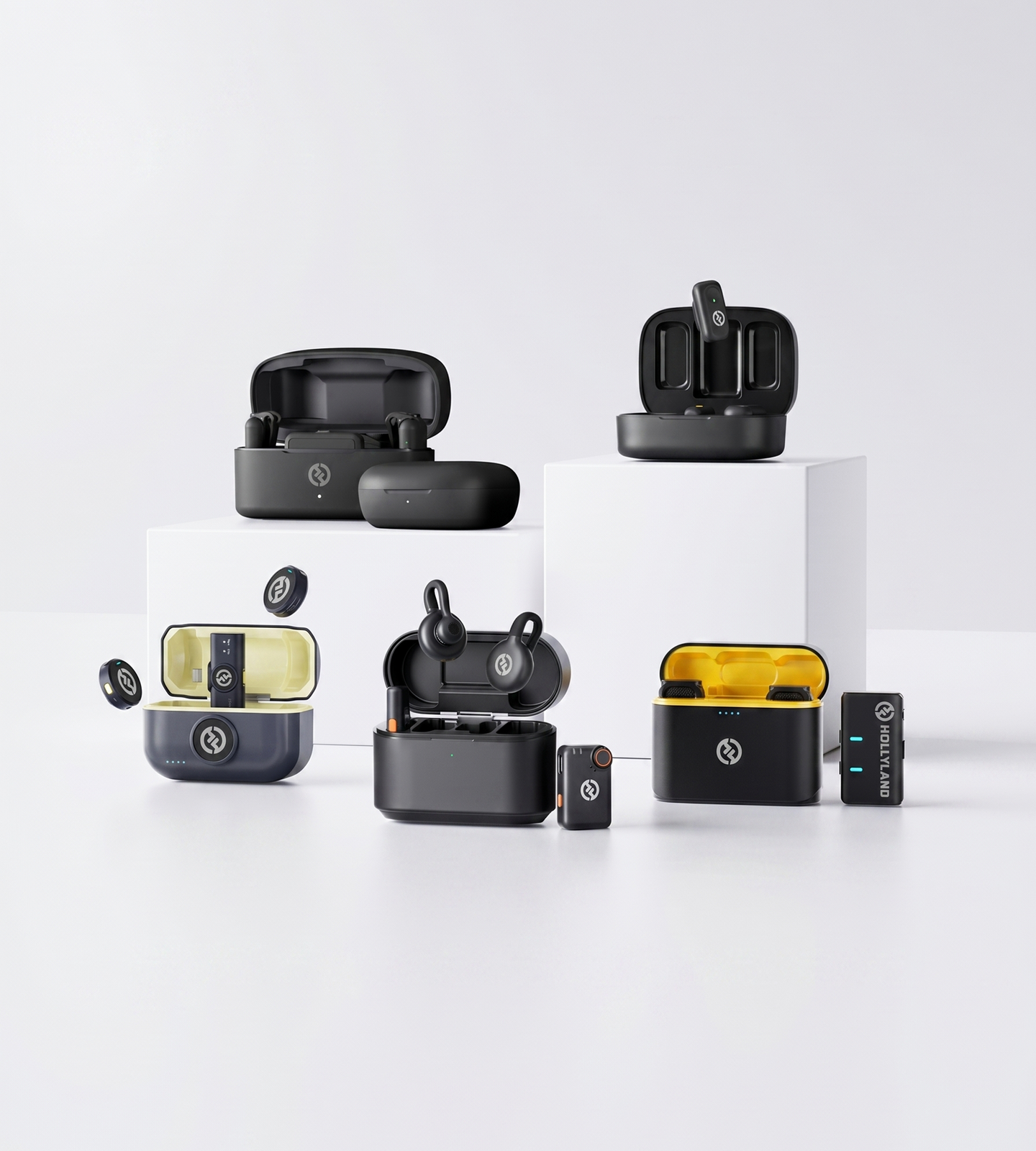
Built for the Field

Microphones for Outdoor Recording

Capture broadcast-quality audio wherever the shoot takes you. Hollyland's outdoor wireless microphones combine AI noise cancellation, up to 340m range, and all-day battery life — purpose-built to cut through wind, crowds, and unpredictable environments without missing a word.
Shop Now Compare Models

Compatible with cameras, smartphones & hybrid rigs — plug-and-play setup

  • ENC & AI Noise Cancellation
  • Up to 340m Wireless Range
  • All-Day Battery Life
  • From 7g Transmitter Weight
Microphones for Outdoor Recording
Editor's pickLARK MAX 2340m Range · AI Noise Cancellation
4.7 / 5From 1.5M+ verified creators
Shop Models

Outdoor Mics for Every Workflow

From solo vloggers to professional multi-speaker productions, find the wireless mic built for your outdoor shoot.
LARK M2

LARK M2

Everyday outdoor vlogging and travel content

  • ENC
  • 300m LOS Range
  • 10-Hr TX Battery
$76.00
LARK M2S

LARK M2S

On-camera talent who need an invisible, on-location mic

  • No-Logo Design
  • 7g Transmitter
  • 300m LOS Range
$89.00
LARK MAX 2

LARK MAX 2

Professional outdoor shoots with multiple speakers or subjects

  • AI Noise Cancellation
  • 340m LOS Range
  • 32-Bit Float Recording
$189.00
LARK A1

LARK A1

Mobile creators recording in loud outdoor environments

  • 3-Level Noise Cancellation
  • 128dB Max SPL
  • 54-Hr Total Battery
$35.90
Side-by-side

Compare Outdoor Wireless Mics

Find the right Hollyland wireless mic for your outdoor shoot — from solo vlogging to professional multi-subject productions.
Model LARK M2 LARK M2 $76.00 LARK M2S LARK M2S $89.00 LARK MAX 2 LARK MAX 2 $189.00 LARK A1 LARK A1 $35.90
Noise CancellationENC Environmental Noise Cancellation ENC Environmental Noise Cancellation AI Noise Cancellation 3-Level Intelligent Noise Cancellation
Wireless Range (LOS)300m / 1000ft 300m / 1000ft 340m / 1115ft 200m / 650ft
TX Battery Life~10 hours ~9 hours ~11 hours ~9 hours
Total Battery LifeUp to 40 hours Up to 30 hours Up to 36 hours Up to 54 hours
Transmitter Weight9g 7g 14g 8g
Max SPL115dB 116dB 128dB 128dB
Recording Format24-bit / 48kHz 24-bit / 48kHz 32-bit Float + 24-bit / 48kHz 24-bit / 48kHz
Device CompatibilityCamera & Smartphone (Combo Version) Camera & Smartphone (Combo Version) Camera & Smartphone Smartphone (Plug & Play)
Best ForOutdoor creators and vloggers needing reliable, discreet wireless audio On-camera talent who need the lightest, most invisible transmitter on location Professional outdoor productions — events, documentaries, and multi-subject shoots with up to 4 TX Mobile-first creators and outdoor podcasters who shoot on a smartphone
Shop Shop Shop Shop
Buying Guide

How to Choose an Outdoor Microphone

Shooting outdoors introduces audio challenges that no amount of post-production can fully fix — wind noise, unpredictable distances, all-day battery demands, and the need to keep talent comfortable on camera. The right microphone handles these realities at the point of capture. Here's what to evaluate before you buy.
  1. Wind Noise & Noise Cancellation
  2. Wireless Range
  3. Battery Life
  4. Portability & On-Camera Discretion
  5. Audio Quality & Clipping Protection
  6. Setup Speed & Device Compatibility
  7. Single Subject vs. Multi-Subject…

Wind Noise & Noise Cancellation

This is the single most important factor for outdoor audio. Even a moderate breeze can overwhelm a microphone that lacks effective noise handling, making recordings unusable regardless of how well everything else performs.

When evaluating noise handling, look for two layers of protection:

  • ENC (Environmental Noise Cancellation) — hardware-level filtering that reduces ambient noise at the point of capture, before it enters the signal chain
  • AI noise cancellation — software-driven processing that intelligently separates voice from background noise in real time
  • Adjustable cancellation levels — the ability to dial in processing intensity to match your environment, rather than a fixed, one-size-fits-all filter

Beyond noise cancellation, also check the microphone's maximum SPL (Sound Pressure Level) rating. Outdoor environments can produce sudden loud events — traffic, crowd surges, live event audio — that cause clipping and distortion. A higher SPL tolerance (115dB and above) provides a meaningful safety margin against audio overload when sound levels spike without warning.

Wireless Range

Outdoors, the distance between your subject and your camera is rarely fixed or predictable. A filmmaker trailing an athlete, a journalist working a crowd, or a videographer covering an open-air ceremony all need a connection that stays stable without requiring subjects to stay within a tight radius.

Two range figures matter:

  • LOS (line-of-sight) range — the distance the system can cover in an unobstructed outdoor environment. This is the most relevant spec for open outdoor spaces. Prioritize systems with at least 200m LOS range if you regularly shoot in wide, open environments.
  • NLOS (non-line-of-sight) range — what the connection can maintain when obstacles like buildings, vehicles, trees, or crowds break the signal path. A higher NLOS rating reflects real-world outdoor resilience, not just performance under ideal test conditions.

Creative freedom outdoors depends directly on range. If your subject needs to move away from the camera — or you're covering a large venue — a system with limited range will force compromises in composition and coverage.

Battery Life

Full-day outdoor productions leave no room for mid-shoot recharging. Battery life is a practical safety net, not just a spec point.

When comparing battery life, look at two figures together:

  • Battery life per charge on the transmitter — how long you can continuously record before needing a top-up; 8–10 hours per charge covers most single-day outdoor sessions
  • Total battery life including the charging case — how many full charges you get on the go without access to a power outlet; critical for multi-location days, travel shoots, or back-to-back event coverage

For shorter outdoor sessions or mobile creators, per-charge battery life is the priority. For long production days, multi-day shoots, or event professionals, total system battery capacity matters more — it determines how many sessions you can complete before the case itself needs charging.

Portability & On-Camera Discretion

Outdoor microphones are worn by real people in real environments. Heavy, conspicuous transmitters add discomfort for active subjects, interfere with natural movement, and can visually break the look of a shot.

Key factors to evaluate:

  • Transmitter weight — ultra-lightweight transmitters (under 10g) are barely perceptible to the wearer, which is especially valuable for athletes, performers, or subjects on camera for extended periods
  • Profile and visibility — a low-profile or no-logo design keeps the mic out of the frame and preserves clean footage without requiring wardrobe workarounds
  • Build quality — outdoor use means the transmitter will face sweat, rough handling, and occasional exposure to light weather; durable materials and construction quality directly affect long-term reliability in the field

If on-camera aesthetics matter — for interview-driven content, branded productions, or narrative work — the transmitter's visual footprint deserves as much attention as its audio specifications.

Audio Quality & Clipping Protection

Outdoor environments are acoustically unforgiving. There's no controlled reflection, no sound dampening, and often significant competing noise in the background. The microphone needs to deliver clean, intelligible audio despite all of it.

Prioritize:

  • High SNR (signal-to-noise ratio) — a higher SNR means more of what you capture is clean voice signal and less is unwanted noise floor. Look for SNR ratings of 70dB or above for professional-grade outdoor audio.
  • Recording format24-bit/48kHz is the broadcast-quality standard for location audio. For productions where monitoring levels in real time isn't possible, 32-bit float recording provides a significantly wider dynamic range headroom — audio captured at the wrong gain level can still be corrected in post without introducing distortion or noise.
  • Clipping protection features — auto-limit, gain adjustment, and clip protection modes are practical tools for outdoor recording, where audio levels can spike suddenly and without warning

32-bit float recording is particularly valuable for run-and-gun documentary work, solo operators, and any outdoor shoot where a dedicated sound engineer isn't available to manage levels on the fly.

Setup Speed & Device Compatibility

Outdoor shoots rarely offer a long setup window. A microphone that requires lengthy pairing sequences, app-dependent configuration, or gear-specific adapters introduces friction at exactly the wrong moment.

Look for:

  • Plug-and-play operation — connects and begins transmitting immediately without manual pairing steps; essential for solo operators who need to move quickly between setups
  • Broad device compatibility — the system should work with your specific camera, smartphone, or recording device without additional adapters or workarounds; confirm connector type and check supported output formats before buying
  • Optional app control — access to granular settings like gain, EQ, or noise cancellation through an app adds useful flexibility, but it should be an option rather than a requirement for basic operation

The ability to clip on a transmitter, plug in a receiver, and start recording in under a minute is a meaningful advantage in outdoor environments where conditions — and opportunities — change quickly.

Single Subject vs. Multi-Subject Shoots

The number of people you're recording simultaneously will significantly shape which system fits your workflow.

For solo subjects or one-on-one interviews: A standard 1 TX + 1 RX wireless setup covers the majority of outdoor vlogging, journalism, and interview scenarios. These systems are simpler, lighter, faster to deploy, and easier to manage without an audio assistant.

For multi-subject shoots: Panel discussions, event coverage, documentary work with multiple on-camera speakers, or live productions all benefit from a system where a single receiver can connect to multiple transmitters at once. This keeps your kit manageable while maintaining full coverage across all subjects.

If you're regularly producing content that requires more than one wireless microphone in simultaneous use — multi-speaker interviews, event broadcasts, or wedding videography with multiple subjects — prioritize a system designed to scale. The LARK MAX 2 supports up to four transmitters on a single receiver, making it a purpose-built solution for complex, multi-subject outdoor productions where managing separate receivers for each subject would be impractical.

Real-World Applications

Built for Every Outdoor Scenario

Wind, distance, movement, and crowds — whatever your outdoor shoot demands, there's a Hollyland microphone engineered to handle it.

Travel & Adventure Vlogging

Capture clean dialogue and narration on the trail, in the city, or wherever the shoot takes you. ENC and AI noise cancellation cut through wind and ambient noise, while featherlight transmitters stay hidden and on-camera aesthetics stay clean.
  • Wind-Prone Conditions
  • Solo Creator
  • Run-and-Gun

On-Location Interviews

Interview subjects on busy streets, open plazas, or event floors without ambient noise competing with every word. Long wireless range keeps the connection solid even when the subject and camera operator are far apart.
  • Field Interviews
  • Noisy Environments
  • Wireless Freedom

Sports & Action Recording

Mic up athletes and action subjects without slowing them down. Ultra-light transmitters stay secure through high-intensity movement, and durable builds hold up against sweat, dust, and the rough handling that outdoor action shoots demand.
  • High-Movement Shoots
  • Active Athletes
  • Rugged Use

Wedding & Event Videography

Cover vows, speeches, and candid moments at open-air ceremonies and receptions without missing a word. All-day battery life and discreet low-profile transmitters keep talent comfortable, and backup internal recording ensures nothing is ever lost.
  • Open-Air Venues
  • All-Day Battery
  • Discreet Wearable

Documentary & Field Production

Handle wide-area field recording and multi-subject shoots with industry-leading wireless range and multi-transmitter support. 32-bit float internal recording delivers a reliable safety net when unpredictable outdoor conditions put your audio at risk.
  • Long-Range Wireless
  • Multi-Subject
  • Broadcast-Grade Audio

Outdoor Live Streaming

Broadcast outdoor sports, concerts, and open-air events with stable wireless audio and real-time monitoring. High SPL tolerance absorbs sudden crowd surges and unexpected loud peaks — no clipping, no distortion, no retakes.
  • Live Broadcasting
  • Crowd Noise
  • Low-Latency Monitoring
Trusted by creators

1.5M+ creators picked LARK microphones for their audio

A decade of wireless engineering for film crews and broadcasters — packaged for modern creator workflows.
  • 4.7 Avg. rating · 120K+ reviews
  • 1.5M+ Verified creators
  • 160+ Countries shipped
  • 98% Would recommend

I love my new LARK M2 mics. These were so good, and I really enjoyed testing out the new LARK M2 from Hollyland.

Sarah GraceSarah GraceTech Creator · 3.2M YouTube subscribers

The Hollyland LARK MAX is the wireless microphone system with the clearest and crispest audio of any wireless mic system I have ever tried.

GoenrockGoenrockCinematographer · 107K Instagram subscribers

LARK MAX is doing an excellent job of dropping the sound of the air conditioner, which is something l always have to remove and post with our shotgun mic.

Film RiotFilm RiotFilmmaking Educator · 2.2M YouTube subscribers
  • No Film School
  • Newsshooter
  • CineD
  • RedShark
  • CAMERA JABBER
  • Photowebexpo
FAQ

Your Outdoor Microphone Questions, Answered

How do Hollyland wireless microphones handle wind and outdoor background noise?
Every microphone in this collection includes active noise cancellation built to handle the wind, traffic, and ambient interference that makes outdoor recording unpredictable. - **LARK M2 and LARK M2S** both feature ENC (Environmental Noise Cancellation) that filters background noise in real time during wireless transmission. - **LARK A1** includes 3-level intelligent noise cancellation, letting you choose the right level of suppression based on how demanding your environment is. - **LARK MAX 2** uses AI noise cancellation — intelligently separating voice from background noise without softening or hollowing out speech quality. For particularly gusty conditions, all transmitters are compatible with windshield covers for an added layer of mechanical wind protection.
What wireless range can I expect when shooting outdoors?
Open outdoor environments are where these microphones perform at their best. Line-of-sight (LOS) ranges: - **LARK M2 / LARK M2S**: Up to **300m / 1,000ft LOS** (40–60m NLOS depending on version) - **LARK A1**: Up to **200m / 650ft LOS** - **LARK MAX 2**: Up to **340m / 1,115ft LOS**, with **70m / 230ft NLOS** For most outdoor scenarios — interviews, event coverage, travel vlogging — this range comfortably removes the tethered-to-camera constraint. Keep in mind that dense crowds, buildings, or heavy tree cover will reduce effective NLOS range. For productions where subjects move through complex or unpredictable environments, the LARK MAX 2 offers the strongest combination of range and connection stability.
Will the battery last through a full day of outdoor filming?
Yes — all four models are designed with extended outdoor use in mind: - **LARK M2**: ~10 hours per TX charge, up to **40 hours total** with the charging case - **LARK M2S**: ~9 hours per TX charge, up to **30 hours total** - **LARK A1**: ~9 hours per TX charge, up to **54 hours total** — the highest total capacity in the range - **LARK MAX 2**: ~11 hours per mic charge, up to **36 hours total** The charging cases double as portable power banks, so you can top up transmitters between setups without needing a wall outlet. For multi-day shoots or back-to-back event days, the LARK A1 and LARK M2 offer the most total runtime before the case itself needs recharging.
What happens if a sudden loud sound — traffic, a crowd, a PA system — causes clipping?
Unpredictable outdoor peaks are addressed at two levels: high SPL tolerance to prevent clipping from occurring, and recovery features when it does. **High SPL tolerance** handles loud environments before distortion sets in: - **LARK A1** and **LARK MAX 2** both tolerate up to **128dB SPL** - **LARK M2S** handles up to **116dB SPL**; **LARK M2** up to **115dB SPL** **Clip protection and recovery** catch what SPL tolerance alone can't: - The **LARK A1** includes **Auto-Limit Clip Protection**, which pulls back the signal automatically before distortion sets in. - The **LARK MAX 2** records internally in **32-bit float** — capturing a virtually unlimited dynamic range so that even an overloaded wireless signal can be fully recovered during post-production.
Which Hollyland microphone is the best fit for outdoor use?
The right choice depends on your shoot style and scale: **Solo creators and travel vloggers** — The **LARK M2** or **LARK M2S** are the most practical option: ultra-lightweight (9g and 7g respectively), plug-and-play ready, with 300m range and ENC. The M2S adds a logo-free, invisible-design transmitter for talent who need zero on-camera presence. **Smartphone-based outdoor creators** — The **LARK A1** is built for mobile-first workflows: plug-and-play smartphone compatibility, 3-level noise cancellation, Auto-Limit clip protection, and 54 total hours of battery — the most in the range. **Professional videographers and event teams** — The **LARK MAX 2** is the most capable outdoor system: 340m range, AI noise cancellation, 32-bit float internal recording as a safety net, and support for up to **4 transmitters on a single receiver** — built for interviews, documentaries, weddings, and live outdoor events.
Are Hollyland wireless mics compatible with my camera or smartphone?
Compatibility depends on the model and variant: - **LARK M2 and LARK M2S** are available in a **Camera Version** (3.5mm TRS for DSLR and mirrorless cameras), a **Mobile Version** (USB-C or Lightning for smartphones), and a **Combo Version** that includes both receiver types in one package. - **LARK A1** is designed for **smartphones**, connecting directly via USB-C or Lightning with no separate receiver unit required. - **LARK MAX 2** ships with a camera-mounted RX unit (3.5mm TRS output) compatible with standard DSLR and mirrorless rigs. If your outdoor rig mixes a camera with a smartphone backup, the LARK M2 or M2S Combo Version provides the most flexibility without additional accessories.
Are the transmitters discreet enough to wear on on-camera talent?
Yes — all Hollyland transmitters are engineered to minimize their footprint on talent: - **LARK M2S**: **7g** — the lightest in the range, with a **logo-free design** and titanium finish built specifically for on-camera discretion - **LARK M2**: **9g** — button-sized form factor that clips flush against clothing - **LARK A1**: **8g** — compact magnetic design that attaches without bulk - **LARK MAX 2**: **14g** — slightly heavier due to onboard internal recording, but still low-profile relative to professional wireless systems For productions where talent appearance is a priority — interviews, narrative shoots, event coverage — the **LARK M2S** is purpose-designed to disappear on camera.
Explore further

A few more places to go from here

A curated link map of the surrounding content — related categories, the most useful guides, head-to-head comparisons and setup help.
Ready when you are

Audio Built for the Real World

Find your outdoor mic — up to 340m wireless range, ENC, and transmitters as light as 7g.
Shop Now Compare Models
  • Free shipping over $99
  • 30-day returns
  • 1-year warranty