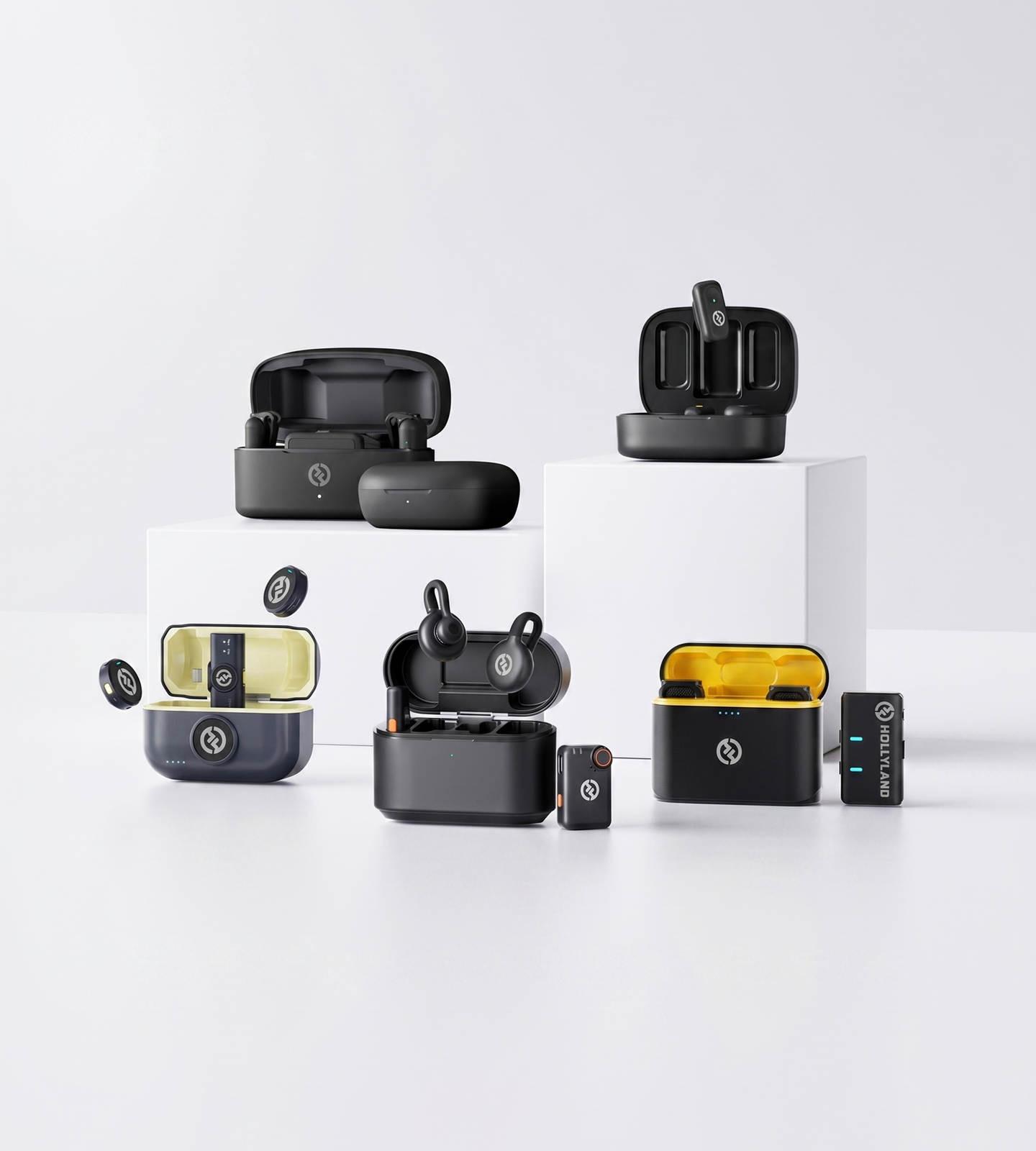
Compact Wireless Audio

Compact Wireless Microphone Systems

Hollyland's compact wireless microphone systems put broadcast-quality audio in the smallest package possible — from the featherlight 7g LARK M2S to the pro-grade LARK MAX 2 with 32-bit float recording. Built for creators, filmmakers, and journalists who need clean sound without the bulk.
Shop Now Compare Models

Compatible with cameras, iPhones & Android · Plug-and-play or app-controlled

  • From 7g — Ultra-Light Transmitters
  • ENC & AI Noise Cancellation
  • Up to 54H Total Battery Life
  • Camera & Smartphone Ready
Compact Wireless Microphone Systems
Editor's pickLARK M29g · 300m Wireless Range
4.7 / 5From 1.5M+ verified creators
Shop Models

Pick Your System

Four compact wireless mics built for every workflow — match the one that fits how you shoot.
LARK M2

LARK M2

The versatile all-rounder for camera and mobile creators

  • 9g transmitter
  • 300m LOS range
  • ENC noise cancellation
$76.00
LARK M2S

LARK M2S

The lightest, most discreet mic for on-screen talent

  • 7g transmitter
  • no-logo invisible fit
  • titanium build
$89.00
LARK MAX 2

LARK MAX 2

The professional-grade system for demanding on-location shoots

  • 32-bit float recording
  • 340m LOS range
  • AI noise cancellation
$189.00
LARK A1

LARK A1

The plug-and-play mic built for smartphone creators

  • 8g transmitter
  • smartphone plug-and-play
  • 54hr total battery
$35.90
Side-by-side

Compare Compact Wireless Mics

Stack up the key specs side by side and pick the system that fits your shoot.
Model LARK M2 LARK M2 $76.00 LARK M2S LARK M2S $89.00 LARK MAX 2 LARK MAX 2 $189.00 LARK A1 LARK A1 $35.90
Transmitter Weight9g 7g 14g 8g
Wireless Range (LOS)300m / 1000ft 300m / 1000ft 340m / 1115ft 200m / 650ft
Total Battery LifeUp to 40 hrs Up to 30 hrs Up to 36 hrs Up to 54 hrs
Recording Format48kHz / 24-bit WAV 48kHz / 24-bit 48kHz / 32-bit Float 48kHz / 24-bit
Signal-to-Noise Ratio>70dB >70dB ≥72dB ≥67dB
Max SPL115dB 116dB 128dB 128dB
Internal Recording32-bit Float, up to 14 hrs
Noise CancellationENC ENC AI Noise Cancellation 3-Level Intelligent ENC
Device CompatibilityCamera / Mobile / Combo Camera / Mobile / Combo Camera / Mobile Smartphone
Shop Shop Shop Shop
Buying Guide

How to Choose the Right Compact Wireless Microphone System

Not all compact wireless microphone systems are built for the same workflow. From transmitter size and device compatibility to battery life and audio failsafes, the right choice depends on how you shoot, what you shoot with, and how much can go wrong before it matters. Use this guide to match the right system to your setup.
  1. Size and Form Factor — Define…
  2. Device Compatibility — Know What…
  3. Battery Life — Look Beyond the…
  4. Wireless Range — LOS Numbers vs.…
  5. Audio Quality — What the Specs…
  6. Noise Cancellation — Match…
  7. One Transmitter or Two
  8. Setup Complexity — Plug-and-Play…
  9. Internal Recording — Your Audio…

Size and Form Factor — Define 'Compact' for Your Use Case

The word 'compact' covers more ground than most buyers expect. Transmitter weights in this category typically fall between 7g and 14g — but even a few grams of difference matters depending on how you intend to wear or place the mic.

Ask yourself where the transmitter will actually sit during a shoot:

  • Clipped inside a collar or under a shirt — the lighter and thinner the unit, the less visible the profile through fabric
  • Pinned to a lapel or lanyard — a few extra grams are far less noticeable in this position
  • Mounted on a camera rig — total system weight and pocket-ability matter more than transmitter weight alone

If discreet, wearable fit is a hard requirement — for documentary shooting, event presenting, or interviews — prioritize the smallest and lightest transmitters available. If you're building a camera-mounted rig and audio monitoring is part of the picture, a slightly heavier system with expanded pro features may be the better trade-off.


Device Compatibility — Know What You're Plugging Into

This is one of the most common purchase mistakes in the wireless mic category. Before choosing a kit, identify your primary recording device:

  • Camera only — Look for a receiver designed to sit on a cold shoe with a 3.5mm TRS output.
  • Smartphone only — Prioritize direct plug-in receivers with Lightning or USB-C connectors. Plug-and-play compatibility eliminates the need for a separate audio interface.
  • Both — Combo kits include adapters or cables for multiple device types and are the most versatile option for creators who move between setups.

The LARK A1 is purpose-built for smartphone-first workflows. The LARK M2 and LARK M2S come in camera, mobile, and combo versions. If you regularly switch between a camera and a phone, the combo version almost always delivers better long-term value than buying adapters separately.


Battery Life — Look Beyond the Per-Charge Figure

Spec sheets list transmitter and receiver battery life per charge. But the more useful number for real-world shooting is total system battery life — which factors in how many additional charges the case can deliver before it needs a wall outlet.

How to match battery capacity to your workflow:

  • Short-form content, under 2 hours — Any system in this range will cover you on a single charge with significant headroom.
  • Half-day shoots (3–5 hours) — Per-charge TX life is the relevant figure. Look for units rated 9–11 hours.
  • Full-day or multi-day location shoots — Total system battery life (30 to 54+ hours across the range) is what keeps you running without hunting for power. This is where charging case capacity becomes a genuine field advantage.

Also check whether the case supports pass-through charging — useful for topping up on travel without removing units from the case.


Wireless Range — LOS Numbers vs. Real-World Conditions

Manufacturers rate range under line-of-sight (LOS) conditions — open air, no obstructions. Real-world shooting involves non-line-of-sight (NLOS) conditions: walls, bodies, interference from other wireless devices. NLOS range is the number that actually governs most indoor and event shooting.

How to read range specs for your environment:

  • Studio, classroom, or home setup — Even conservative NLOS ratings (40–70m) comfortably cover typical room distances.
  • Outdoor run-and-gun — LOS range gives you operational freedom. Interference resistance matters more here than the headline number.
  • Event halls, conference spaces, urban shoots — Dense RF environments are the hardest test. Look for systems with proven NLOS performance and multi-device handling, not just maximum LOS figures.

If you're shooting in environments with heavy wireless traffic, this is one area where it pays to read past the spec sheet and into real-world test reviews.


Audio Quality — What the Specs Actually Tell You

A few numbers worth understanding before you buy:

Bit depth — 24-bit vs. 32-bit float

  • 24-bit / 48kHz is broadcast-standard and more than sufficient for YouTube, social media, online courses, and most commercial video work.
  • 32-bit float eliminates clipping risk entirely. Even if audio peaks unexpectedly — a subject raises their voice, a door slams — the recording recovers cleanly in post without distortion. This matters most in live, unrepeatable situations where you cannot ask for another take.

Signal-to-noise ratio (SNR)

Higher is better. An SNR of 70dB or above delivers clean, low-noise audio in most conditions. The gap between 67dB and 72dB may be subtle in a quiet room but becomes noticeable in louder, less controlled environments.

Maximum SPL

This is the loudness threshold before audio distorts. Higher SPL handling gives you more headroom in loud environments — live events, outdoor shoots, crowded spaces.


Noise Cancellation — Match Processing Strength to Environment

Most modern compact wireless systems include some form of environmental noise cancellation (ENC). But the depth, adjustability, and effectiveness of that processing varies considerably.

Think about where you record:

  • Quiet interiors (home studio, classroom, office) — Basic ENC handles light background noise and room tone without overprocessing.
  • Outdoor shooting — Multi-level AI noise cancellation makes a real difference for wind, traffic, and ambient crowd noise. Adjustable strength is important here — you want enough processing to clean the signal without artifacts on the voice.
  • Loud or unpredictable environments — Look for systems with the strongest cancellation available and, ideally, user-adjustable levels so you can dial in processing to match the environment rather than applying a fixed, one-size-fits-all filter.

One practical note: aggressive noise cancellation at maximum strength can occasionally affect voice naturalness. Systems that give you level control — or multiple modes — offer more flexibility than single-setting processing.


One Transmitter or Two?

For solo shooting — a presenter, vlogger, educator, or single-subject interview — a standard 1 TX + 1 RX configuration covers everything you need.

For two-person formats — podcasts, interview-style videos, host + guest shoots — a dual-transmitter setup (2 TX + 1 RX) is significantly better. Each speaker gets their own channel, giving you cleaner, more mixable audio in post and eliminating the awkwardness of passing or sharing a single mic.

If you switch between solo and interview setups, check whether a system supports both 1-TX and 2-TX modes from the same receiver. This saves you from buying a second system to cover both use cases.

For larger or more complex productions, some systems support connecting multiple transmitters to a single receiver — which substantially expands what a compact setup can manage on a multi-subject shoot.


Setup Complexity — Plug-and-Play vs. App Control

Not every creator needs an app. But some benefit significantly from having one.

  • Plug-and-play systems auto-pair and are ready to record immediately. Ideal for creators who want zero friction between idea and execution, or who find audio menus intimidating.
  • App-controlled systems offer deeper customization: gain levels, EQ, noise cancellation strength, monitoring settings. Useful when you're adapting to different recording environments and want precise control without touching post-production.

A practical middle ground: systems that default to plug-and-play but unlock app control for users who want it. This avoids the all-or-nothing trade-off and lets your workflow grow into the system over time.


Internal Recording — Your Audio Safety Net

Onboard backup recording — where the transmitter stores a local audio file in addition to transmitting wirelessly — is a growing consideration for professional and semi-professional users.

If the wireless signal is interrupted, if a receiver glitches, or if an environmental obstacle degrades transmission, internal recording ensures a clean capture exists regardless. For journalists, event videographers, or documentary filmmakers working in unpredictable conditions, this removes the risk of losing audio that cannot be re-recorded.

For controlled-environment creators — studio educators, home podcasters, scripted content — internal recording is a useful backup but rarely the deciding factor. For anyone working in live, uncontrolled, or high-stakes situations, it shifts from 'nice to have' toward essential.

The LARK MAX 2 includes 32-bit float internal recording as a core feature, making it the strongest choice when professional-grade redundancy and clipping-free audio are both non-negotiable.

Every Shoot. Every Format.

Built for the Way You Actually Shoot

From solo smartphone creators to professional field crews, these compact wireless systems are designed around real shooting scenarios — not spec sheets. Find the setup that matches the way you work.

Solo Run-and-Gun Filming

Clip on the transmitter, hit record, and move freely — no sound engineer required. At 7–9g, these mics stay hidden under clothing and off your mind, so you can focus entirely on the shot.
  • Solo Creator
  • Clip-On
  • Hands-Free

Smartphone Content Creation

Plug straight into your iPhone or Android and start rolling. No pairing menus, no driver installs — just clean wireless audio from the first take, direct to the device already in your hand.
  • Plug-and-Play
  • Mobile-First
  • Zero Setup

Interviews and Podcast Recording

Mic up both host and guest simultaneously with dual-TX configurations. Whether you're in a studio or across a café table, you get consistent, balanced audio from both voices — every time.
  • Dual-TX
  • Podcast
  • Field Interview

Outdoor and Travel Content

The entire kit fits in a jacket pocket. With up to 54 hours of total system battery life and built-in noise cancellation handling wind and ambient interference, you can shoot all day — wherever the story takes you.
  • Portable Kit
  • All-Day Battery
  • Noise Cancellation

Online Courses and Live Sessions

Deliver professional-quality voice audio for recorded courses, webinars, and coaching calls. The discreet form factor keeps attention on what you're saying, not the gear you're wearing.
  • Course Recording
  • Webinar
  • Discreet Wear

Professional On-Location Production

When every take counts, 32-bit float internal recording and up to 340m wireless range give crews the headroom and coverage to handle any environment — loud venues, complex RF, or unpredictable subjects.
  • 32-Bit Float
  • Long Range
  • Failsafe Recording
Trusted by creators

1.5M+ creators picked LARK microphones for their audio

A decade of wireless engineering for film crews and broadcasters — packaged for modern creator workflows.
  • 4.7 Avg. rating · 120K+ reviews
  • 1.5M+ Verified creators
  • 160+ Countries shipped
  • 98% Would recommend

I love my new LARK M2 mics. These were so good, and I really enjoyed testing out the new LARK M2 from Hollyland.

Sarah GraceSarah GraceTech Creator · 3.2M YouTube subscribers

The Hollyland LARK MAX is the wireless microphone system with the clearest and crispest audio of any wireless mic system I have ever tried.

GoenrockGoenrockCinematographer · 107K Instagram subscribers

LARK MAX is doing an excellent job of dropping the sound of the air conditioner, which is something l always have to remove and post with our shotgun mic.

Film RiotFilm RiotFilmmaking Educator · 2.2M YouTube subscribers
  • No Film School
  • Newsshooter
  • CineD
  • RedShark
  • CAMERA JABBER
  • Photowebexpo
FAQ

Your Questions About Compact Wireless Mics, Answered

How small are these transmitters — will they actually disappear on camera?
Genuinely small. The transmitters in this range weigh between 7g and 14g, which puts them at roughly the size of a large button or a coat button stack. - **LARK M2S** — 7g, titanium build, no-logo finish; designed specifically for an invisible fit under or over clothing - **LARK M2** — 9g, button-size form factor; sits flat against fabric without visible bulk - **LARK A1** — 8g with a magnetic clip design that makes positioning and repositioning effortless - **LARK MAX 2** — 14g, slightly larger but still compact relative to any traditional wireless system All four use a clip-on lav-style form factor. For the most discreet look on camera, the LARK M2S is the one to reach for.
Which system works with my device — camera, smartphone, or both?
Every system in this range is built around broad compatibility, and most offer multiple versions to match your setup: - **LARK M2** — available in a **Camera Version** (cold shoe mount, 3.5mm TRS out), a **Mobile Version** (Lightning/USB-C plug-in), and a **Combo Version** that covers both - **LARK M2S** — same three-version structure as the LARK M2; the Combo Version pairs camera and smartphone use in one kit - **LARK A1** — optimized for **smartphones** with plug-and-play USB-C/Lightning connection; the most friction-free option for mobile-first creators - **LARK MAX 2** — designed for **cameras and professional setups**, with cold shoe mounting and support for up to 4 transmitters on one receiver If you shoot across devices, go for a Combo Version of the LARK M2 or M2S. If it's purely smartphone-first, the LARK A1 is purpose-built for that workflow.
How long will the battery actually last on a full shoot day?
Long enough for a full day without babysitting charge levels. Here's what to expect per system: | System | TX per charge | Total system battery | |---|---|---| | LARK M2 | ~10 hours | Up to 40 hours | | LARK M2S | ~9 hours | Up to 30 hours | | LARK A1 | ~9 hours | Up to 54 hours | | LARK MAX 2 | ~11 hours | Up to 36 hours | The charging case acts as a power bank for the transmitters, so total battery life extends well beyond a single charge cycle. The LARK A1's 54-hour total is the standout figure if back-to-back shooting days are your concern. The LARK MAX 2 receiver holds up to 12 hours on its own, making it well-suited for long-form production days.
Will the signal hold up indoors or in crowded RF environments?
Yes — these systems are built for real-world conditions, not just open-field specs. Line-of-sight (LOS) range is impressive across the range, but NLOS (through walls, around obstacles) performance is what matters for most shoots: - **LARK M2 / LARK M2S**: 300m LOS; 60m NLOS (Mobile), 40m NLOS (Camera) - **LARK A1**: 200m LOS — designed for close-proximity smartphone setups where range is less critical - **LARK MAX 2**: 340m LOS, 70m NLOS — the strongest NLOS performance in the range For busy environments with competing wireless signals, the LARK MAX 2's extended NLOS range and robust transmission architecture give the most headroom. For typical indoor interview or classroom setups, any system in this range will hold a clean connection.
How do these mics handle wind, clothing rustle, and background noise?
Noise rejection is built into every system in this range, though the tier varies by model: - **LARK M2** — ENC (Environmental Noise Cancellation) filters ambient noise while keeping voice clear - **LARK M2S** — ENC as standard; the titanium build also reduces handling vibration transfer - **LARK A1** — the most advanced noise processing in the range: **3-level intelligent noise cancellation** that you can dial to match your environment, plus EQ and reverb adjustment for tighter control - **LARK MAX 2** — **AI noise cancellation** with full-chain processing; best suited for unpredictable or loud on-location environments For outdoor shooting, pair any of these with the included windscreen (fur or foam depending on model) and position the transmitter at the chest or collar to minimize clothing contact. The LARK A1's adjustable cancellation levels give you the most hands-on control over how aggressive the noise processing is.
Is the audio quality good enough to skip heavy post-production corrections?
For most use cases — yes. All four systems record at **48kHz / 24-bit**, which is broadcast-standard audio quality with a frequency response of 20Hz–20kHz and SNR figures that sit comfortably above the threshold for clean dialogue capture: - LARK M2: SNR >70dB - LARK M2S: SNR >70dB - LARK A1: SNR ≥67dB - LARK MAX 2: SNR ≥72dB The LARK MAX 2 steps up further with **32-bit float recording** — both in wireless transmission and onboard backup. 32-bit float means no clipping, no gain-setting errors, and audio that can be corrected in post even from extreme SPL peaks up to 128dB. If your shoots involve loud environments or unpredictable speakers, that's the system that removes the most risk from your workflow.
Do I need to use an app, or do these work straight out of the box?
Straight out of the box for most setups. All four systems are designed for plug-and-play use — pair the transmitter and receiver, clip on, and record. App control is available as an optional layer on select models: - **LARK M2 (Mobile Version)** — the companion app unlocks gain control, ENC toggling, and monitoring features; not required to get a working signal - **LARK M2S** — same optional app support for deeper settings access - **LARK A1** — settings like noise cancellation level, gain (6-level adjustment), and EQ are controlled directly on the device or via app; no app needed for basic use - **LARK MAX 2** — advanced features including timecode sync and monitoring configuration benefit from app access, but core recording works without it If you want zero setup friction, any system here will deliver. If you want fine-grained control over noise processing or monitoring, the app adds meaningful value without being a barrier to entry.
What happens if audio gets too loud — will it clip?
Clipping protection is handled differently depending on the model: - **LARK A1** — features **Auto-Limit Clip Protection**, which automatically pulls back gain before the signal distorts; ideal for unpredictable speakers or high-energy environments - **LARK MAX 2** — **32-bit float recording** is the most comprehensive solution: it captures such a wide dynamic range that traditional clipping essentially doesn't occur, even at 128dB SPL peaks. Audio that would be distorted in 24-bit can be fully recovered in post - **LARK M2 / LARK M2S** — rated to 115–116dB SPL; sufficient for most voice recording scenarios; setting gain conservatively before a shoot is the recommended approach For high-stakes recordings where a second take isn't an option, the LARK MAX 2's 32-bit float safety net is the most reliable protection against loud audio surprises.
Which system is right for me — how do I choose between these four?
Here's a quick way to match your needs to the right system: **LARK A1** — Best for smartphone creators who want plug-and-play simplicity, strong noise cancellation, and the longest total battery life (up to 54 hours). Magnetic clip makes it fast to deploy. **LARK M2** — Best all-rounder for creators shooting on camera, phone, or both. At 9g with ENC and 40-hour total battery, it's the most versatile entry point in the range. **LARK M2S** — Best for situations where the mic needs to disappear. At 7g with a no-logo titanium body, it's the most discreet transmitter available — suited for documentary, interview, and on-screen talent work. **LARK MAX 2** — Best for professional-level shoots where audio failure isn't an option. 32-bit float recording, AI noise cancellation, 340m range, timecode support, and 1-to-4 multi-TX capability make it the top-tier option in the range. If you're unsure, the LARK M2 Combo is the safest starting point. If you know you need pro-grade failsafes, go straight to the LARK MAX 2.
Explore further

A few more places to go from here

A curated link map of the surrounding content — related categories, the most useful guides, head-to-head comparisons and setup help.
Ready when you are

Find the Right System. Start Shooting Lighter.

From 7g transmitters to 32-bit float recording, explore compact wireless mics built for every creator.
Shop Now Compare Models
  • Free shipping over $99
  • 30-day returns
  • 1-year warranty