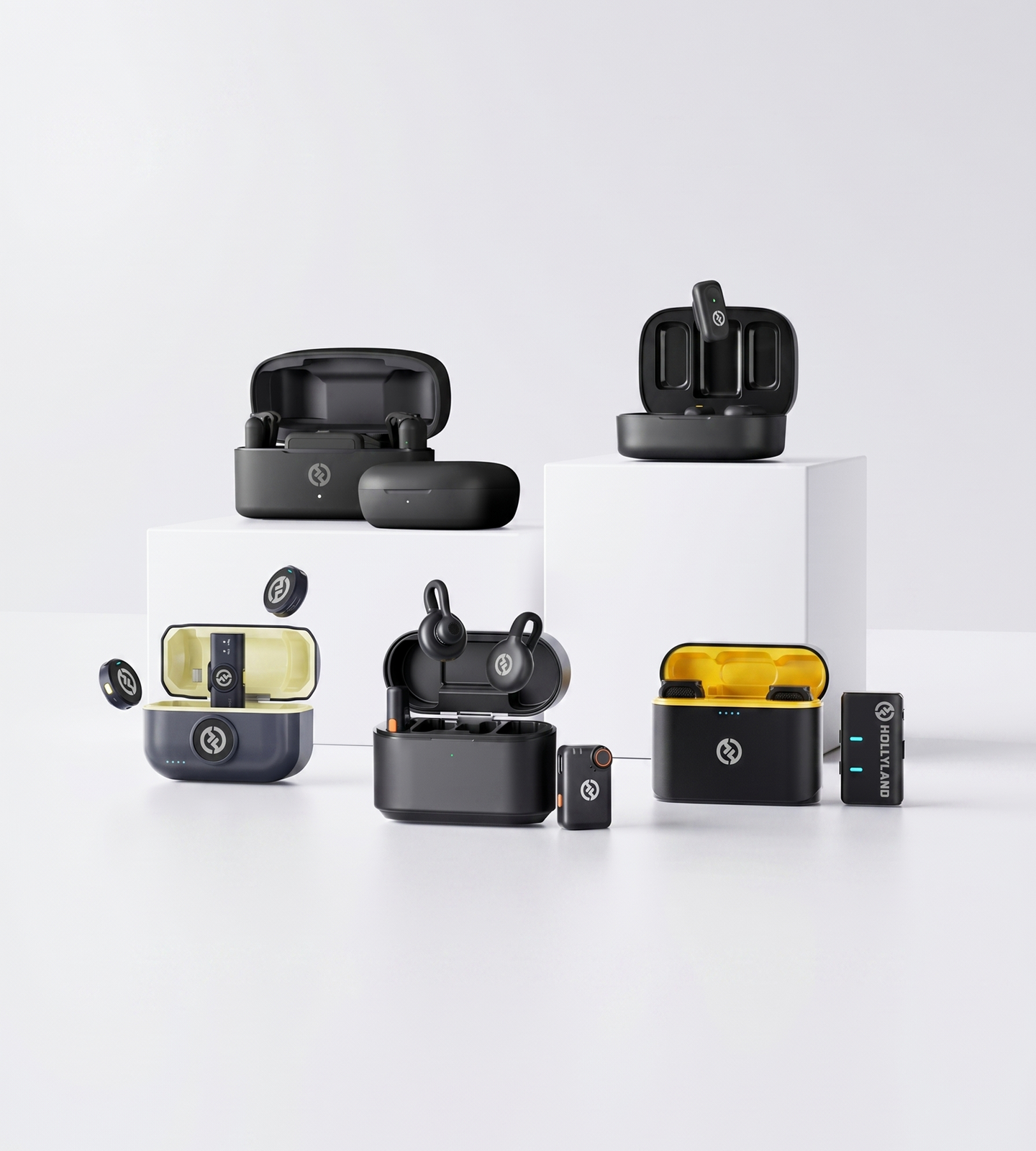
Wireless Lapel Mics

Omnidirectional Lapel Microphones

Capture every word with Hollyland's wireless lapel microphone lineup. From the ultralight LARK M2S to the pro-grade LARK MAX 2, each mic delivers omnidirectional pickup, advanced noise cancellation, and universal device compatibility — broadcast-quality audio for creators, journalists, and filmmakers at every level.
Shop Now Compare Models

Compatible with iPhone, Android, DSLR, mirrorless & cinema cameras — plug-and-play or app-controlled.

  • 360° Omnidirectional Pickup
  • ENC & AI Noise Cancellation
  • Phone & Camera Compatible
  • Internal Backup Recording
Omnidirectional Lapel Microphones
Editor's pickLARK MAX 232-Bit Float · AI Noise Cancellation
4.7 / 5From 1.5M+ verified creators
Shop Models

Choose Your Level

Four wireless lapel mics built for every workflow — find the one that fits how you shoot.
LARK M2

LARK M2

Versatile daily driver for camera and phone shooters

  • 300m LOS Range
  • 9g Transmitter
  • Universal Compatibility
$106.00
LARK M2S

LARK M2S

Ultra-discreet lapel mic designed to disappear on camera

  • No-Logo Invisible Design
  • 7g Ultralight
  • ENC Noise Cancellation
$125.00
LARK MAX 2

LARK MAX 2

Professional-grade wireless for multi-speaker and high-stakes shoots

  • 32-Bit Float Recording
  • Up to 4 TX
  • AI Noise Cancellation
$272.11
LARK A1

LARK A1

Plug-and-play audio upgrade built for mobile creators

  • Smartphone Plug-and-Play
  • 54h Total Battery
  • 128dB SPL
$50.30
Side-by-side

Compare Lapel Microphones

See every key spec side by side and find the wireless lapel mic that fits your workflow.
Model LARK M2 LARK M2 $106.00 LARK M2S LARK M2S $125.00 LARK MAX 2 LARK MAX 2 $272.11 LARK A1 LARK A1 $50.30
Best ForVersatile creators & universal compatibility On-camera creators who need discreet, logo-free placement Professional videographers & multi-speaker productions Mobile-first creators & smartphone vloggers
TX Weight9g 7g 14g 8g
Wireless Range (LOS)300m / 1,000ft 300m / 1,000ft 340m / 1,115ft 200m / 650ft
Recording Format48kHz / 24-bit 48kHz / 24-bit 48kHz / 32-bit Float 48kHz / 24-bit
SNR>70dB >70dB ≥72dB ≥67dB
Noise CancellationENC ENC AI Noise Cancellation 3-Level Intelligent Noise Cancellation
Internal Recording32-bit Float, up to 14hrs
Battery Life (TX)10hrs 9hrs 11hrs 9hrs
Total Battery Life40hrs 30hrs 36hrs 54hrs
Device CompatibilitySmartphone & Camera Smartphone & Camera Smartphone & Camera Smartphone
Shop Shop Shop Shop
Buying Guide

How to Choose a Wireless Lapel Microphone

Picking the right lapel mic isn't just about sound quality — it's about finding the one that fits your device, your workflow, and your recording environment. Here's what to weigh before you buy.
  1. Start With Your Device and Workflow
  2. Sound Quality — What the Specs…
  3. Noise Cancellation for Real-World…
  4. Size, Weight, and On-Camera…
  5. Range, Battery Life, and Shoot-Day…
  6. Ease of Use vs. Pro-Level Control
  7. Internal Recording: Your Audio…
  8. Single or Multi-Speaker — Know…

Start With Your Device and Workflow

The most important question isn't which mic sounds the best — it's where will it be plugging in?

  • Smartphone-only creators should prioritize native mobile compatibility. A mic that connects directly to iOS or Android via USB-C or Lightning removes the need for adapters and gets you recording in seconds.
  • Camera shooters need a receiver designed to connect to a 3.5mm input or cold shoe mount, with a wireless link that holds stable across a set.
  • Shooting on both? Look for combo versions that include adapters for smartphones and cameras in a single kit — one system that covers your whole workflow without compromise.

Device compatibility should be settled before you evaluate anything else. A great-sounding mic that doesn't work with your setup isn't the right mic.


Sound Quality — What the Specs Actually Mean

All wireless lapel mics on this page share a 20Hz–20kHz full-range frequency response and record at 48kHz / 24-bit — the professional audio standard for video and broadcast. Within that baseline, here's what to focus on:

  • Signal-to-Noise Ratio (SNR): Higher is cleaner. An SNR above 70dB means less background hiss audible in quiet dialogue passages — a meaningful difference in post-production.
  • Bit Depth: 24-bit handles the vast majority of professional video work. 32-bit float — available on pro-tier systems — captures a dramatically wider dynamic range and eliminates the risk of clipping, even when gain isn't set correctly in advance. Worth considering if your recording conditions are unpredictable.
  • Maximum SPL: The higher the SPL rating, the louder a source the mic can handle before distorting. A higher SPL ceiling is useful in louder environments and provides headroom for unexpected audio spikes.

Noise Cancellation for Real-World Recording

Lab-quality audio is easy in a quiet room. The real test is outdoors, in a venue, or near HVAC noise. Noise cancellation technology varies significantly across product tiers:

  • ENC (Environmental Noise Cancellation) uses hardware-level filtering to suppress steady-state background noise — wind, hum, crowd rumble, air conditioning. It's effective for most controlled production scenarios.
  • Multi-level intelligent noise cancellation lets you dial in filtering intensity based on your environment — useful when you want noise reduction without losing the natural warmth of a speaking voice.
  • AI Noise Cancellation applies machine learning to dynamically separate speech from complex, variable background noise in real time. It's the highest-performing option for unpredictable or loud field environments.

Rule of thumb: ENC is sufficient for indoor and semi-controlled settings. For outdoor field work, live events, or busy public spaces, AI-assisted noise reduction is worth stepping up for.


Size, Weight, and On-Camera Discretion

A lapel mic transmitter that catches the eye on camera pulls focus from your subject. On-camera visibility is determined by three factors:

  • Weight: Lighter transmitters clip more naturally to thin fabric and are easier to conceal. Even a few grams of difference is noticeable when worn all day. Transmitters in this range run from 7g to 14g — consider where on that spectrum suits your use case.
  • Logo visibility: For broadcast, documentary, or brand-sensitive productions, a no-logo transmitter face keeps branding off screen entirely. The LARK M2S is specifically designed with this in mind — a clean, logo-free face at just 7g.
  • Clip design: A flat, low-profile clip holds the transmitter flush against fabric and minimizes shifting during movement — important for run-and-gun or active shooting.

If your content involves close-up shots of speakers or you're shooting broadcast-style, transmitter size and appearance deserve serious weight in your decision.


Range, Battery Life, and Shoot-Day Reliability

Wireless Range

Pay attention to both LOS (line-of-sight) and NLOS (non-line-of-sight) range figures. LOS range describes performance in open space; NLOS reflects real-world conditions through walls, people, and obstacles — which is usually the more relevant number on a typical shoot.

  • Standard range: ~300m LOS / 40–60m NLOS covers most studio, indoor, and controlled outdoor setups.
  • Extended range: ~340m LOS / 70m NLOS provides extra headroom for larger venues, event spaces, or multi-room configurations.

Battery Life

Consider both per-charge transmitter life and total charging case capacity:

  • Per-charge TX life across this range runs from approximately 9 to 11 hours — enough for most full shooting days on a single charge.
  • Total case capacity ranges from 30 to 54 hours — meaning multiple full recharges without access to an outlet.

If you're running back-to-back shoot days, covering long events, or working away from reliable power, total case capacity becomes as critical as per-charge life.


Ease of Use vs. Pro-Level Control

Not every user needs advanced settings — and not every workflow benefits from them.

  • Plug-and-play setups are ideal for beginners, mobile-first creators, or anyone who needs clean audio fast without adjusting parameters. Connect and record — no configuration required.
  • App control unlocks additional tools: gain adjustment, EQ settings, noise cancellation level selection, and real-time monitoring — useful for creators who want to fine-tune on location.
  • Professional-grade controls — such as timecode sync, 32-bit float transmission, and multi-TX channel management — are built for multi-camera productions, scripted shoots, and workflows that feed into full post-production pipelines.

Match the feature depth of your mic to the complexity of your actual workflow. Advanced tools are only valuable if you have the time and experience to use them effectively.


Internal Recording: Your Audio Safety Net

Wireless signals can drop — from interference, distance, obstacles, or RF congestion. When they do, internal recording is what saves the take.

A transmitter that records audio directly to onboard memory means there's always a backup, independent of the wireless link. This matters most for:

  • Live events and ceremonies where retakes aren't possible
  • Documentary and field work with variable environmental conditions
  • High-stakes productions where losing a take is not an option

For users in these scenarios, internal recording capability — and the quality of that recording — should be a firm requirement, not an optional extra. The LARK MAX 2 includes 32-bit float internal recording for up to 14 hours, offering a broadcast-grade safety net at every stage of the signal chain.


Single or Multi-Speaker — Know Your Setup

The number of people you need to record simultaneously shapes your entire system configuration.

  • 1-to-1 setups (one transmitter, one receiver) cover solo presenters, single-subject interviews, and individual content creators — this is the standard configuration for most use cases.
  • Dual-transmitter setups capture two speakers into a single receiver simultaneously, ideal for two-person interviews, host-and-guest formats, or side-by-side documentary subjects.
  • Multi-TX systems scale further — supporting panels, roundtables, or event coverage with several speakers. The LARK MAX 2 supports up to 4 transmitters on a single receiver, making it the right choice when your productions consistently involve three or more speakers.

If you're recording more than two people regularly, a system with expandable TX capacity will serve you far better than trying to work around a 1-to-1 setup.

Where It Fits

One Collection. Every Recording Scenario.

From self-shot vlogs to multi-camera film sets, Hollyland's omnidirectional lapel microphones are built around the way real creators and professionals work. Find your workflow below.

Vlogging & Content Creation

Clip on and move freely. Ultralight transmitters under 10g stay out of frame while omnidirectional pickup captures your voice cleanly — whether you're facing the lens or turning away mid-take.
  • Hands-Free
  • Run-and-Gun
  • Solo Creator

Interviews & Field Journalism

Mic up your subject quickly and roll without worrying about boom placement or framing. Strong wireless range and discreet clip designs keep your audio reliable from the first question to the last.
  • On-Camera Interview
  • Field Reporting
  • Discreet Placement

Live Streaming & Online Education

Plug directly into your phone or camera and go live with clean, stable audio. Noise cancellation keeps background distractions off the stream so your audience hears exactly what you want them to.
  • Plug & Play
  • Mobile-Ready
  • Noise Cancellation

Two-Person & Multi-Speaker Shoots

Connect multiple transmitters to a single receiver and capture every voice in a panel discussion, interview, or group scene — synchronized audio, no signal juggling between takes.
  • Dual TX
  • Panel Recording
  • Multi-Channel

Outdoor & Noisy Environments

ENC and AI noise cancellation suppress wind, crowd noise, and ambient interference so your voice cuts through clearly — whether you're on a busy street, at a live event, or in unpredictable field conditions.
  • Wind Rejection
  • ENC
  • Outdoor Audio

Professional Film & Broadcast

When audio failure isn't an option, 32-bit float internal recording and timecode sync provide broadcast-grade reliability. Your audio is protected from the moment you hit record to the moment you sit down to edit.
  • 32-Bit Float
  • Backup Recording
  • Broadcast-Grade
Trusted by creators

1.5M+ creators picked LARK microphones for their audio

A decade of wireless engineering for film crews and broadcasters — packaged for modern creator workflows.
  • 4.7 Avg. rating · 120K+ reviews
  • 1.5M+ Verified creators
  • 160+ Countries shipped
  • 98% Would recommend

I love my new LARK M2 mics. These were so good, and I really enjoyed testing out the new LARK M2 from Hollyland.

Sarah GraceSarah GraceTech Creator · 3.2M YouTube subscribers

The Hollyland LARK MAX is the wireless microphone system with the clearest and crispest audio of any wireless mic system I have ever tried.

GoenrockGoenrockCinematographer · 107K Instagram subscribers

LARK MAX is doing an excellent job of dropping the sound of the air conditioner, which is something l always have to remove and post with our shotgun mic.

Film RiotFilm RiotFilmmaking Educator · 2.2M YouTube subscribers
  • No Film School
  • Newsshooter
  • CineD
  • RedShark
  • CAMERA JABBER
  • Photowebexpo
FAQ

Your Wireless Lapel Mic Questions, Answered

What does 'omnidirectional' mean, and why does it matter for a lapel mic?
An omnidirectional polar pattern captures sound equally from all directions — front, sides, and behind the capsule. For a lapel mic, this means your audio stays consistent no matter how you move your head, glance off-camera, or shift your body. You don't need to position it precisely or stay rigidly still. It also produces a more natural, fuller sound than directional capsules. Every microphone in the Hollyland LARK range uses an omnidirectional capsule with a full **20Hz–20kHz frequency response**, so you get clear, natural-sounding audio without fighting placement.
Will the microphone transmitter be visible on camera?
It depends on the model. The **LARK M2S** is the most discreet option in the range — its no-logo design and ultralight **7g titanium body** are built specifically for invisible on-camera placement. The **LARK M2** is also extremely compact at **9g** with a button-size profile that disappears under a lapel or collar. For broadcast, documentary, or brand video where the mic absolutely cannot appear on screen, the **LARK M2S** is the recommended choice.
Do these microphones work with my smartphone, my camera, or both?
It depends on the model and version you choose: - **LARK A1** — Designed for smartphones, plug-and-play, no adapter needed - **LARK M2** — Available in Mobile, Camera, and Combo versions - **LARK M2S** — Available in Mobile, Camera, and Combo versions - **LARK MAX 2** — Designed primarily for professional camera setups If you regularly switch between a phone and a camera, the **Combo Versions** of the LARK M2 or LARK M2S give you the most flexibility in a single kit.
How well does the noise cancellation actually work in real environments?
All four microphones include active noise reduction — the technology scales with the product tier: - **LARK M2 / LARK M2S** — ENC (Environmental Noise Cancellation) reduces wind, ambient crowd noise, and background hum - **LARK A1** — 3-level intelligent noise cancellation with adjustable EQ for creators who shoot in variable conditions - **LARK MAX 2** — AI noise cancellation for professional-grade suppression of complex, layered background noise These systems are built for real-world shooting — outdoor events, busy streets, run-and-gun locations — not just controlled studio conditions.
What happens if the wireless signal drops during a shoot?
The **LARK MAX 2** includes **32-bit float internal recording**, storing a full-quality backup directly on the transmitter for up to **14 hours**. Even if the wireless connection is interrupted, your audio is safe. For the LARK M2 and LARK M2S, Hollyland's transmission system delivers up to **300m of line-of-sight range**, while the LARK MAX 2 extends that to **340m (1115ft)**. Signal loss during typical indoor or outdoor shoots is uncommon at these distances.
How long will the battery last on a full day of shooting?
Here's a quick reference for real-world battery performance across the range: | Model | TX Battery (Per Charge) | Total (With Charging Case) | |---|---|---| | LARK A1 | ~9 hours | Up to **54 hours** | | LARK M2 | ~10 hours | Up to **40 hours** | | LARK MAX 2 | ~11 hours | Up to **36 hours** | | LARK M2S | ~9 hours | Up to **30 hours** | The charging case doubles as a portable power bank for the transmitters, so you can top up between takes without needing a wall outlet.
Which Hollyland lapel mic is right for my workflow?
Here's a quick guide based on use case: - **LARK A1** — Best for smartphone-first creators, social media content, and beginners who want plug-and-play simplicity with intelligent noise cancellation and the highest SPL headroom in the lineup (128dB) - **LARK M2** — Best for solo creators and vloggers who need a lightweight, versatile mic across multiple devices, especially in the Combo Version - **LARK M2S** — Best when on-camera discretion is non-negotiable: broadcast, documentary, brand video, or on-screen talent - **LARK MAX 2** — Best for professional videographers, filmmakers, and multi-speaker productions requiring 32-bit float recording, AI noise cancellation, timecode, and up to 4 TX connections on a single receiver
Are these microphones complicated to set up, or can I start recording immediately?
All LARK series microphones are designed for fast deployment. The **LARK A1**, **LARK M2**, and **LARK M2S** all support **plug-and-play** operation — connect, clip, record. No pairing menus, no driver installs, no manual syncing. The LARK M2 and LARK M2S also support optional **app control** if you want to fine-tune gain, ENC level, or monitoring settings. The **LARK MAX 2** offers more professional features — timecode, 32-bit float, low-latency monitoring — but is still designed for quick on-location setup when time matters.
Can I record two speakers at the same time?
Yes. The **LARK MAX 2** supports up to **4 transmitters connected to a single receiver**, making it the right choice for two-person interviews, panel discussions, ENG crews, or any multi-speaker production scenario. For single-speaker use, the LARK M2, LARK M2S, and LARK A1 all perform excellent as standalone systems. Some LARK M2 kits also support dual-TX configurations — check the specific kit version for details.
Is the audio quality good enough for professional video production?
Every microphone in the LARK range records at **48kHz / 24-bit** with a full **20Hz–20kHz frequency response** — the standard benchmark for professional audio production. The **LARK MAX 2** goes further with **32-bit float recording**, delivering an enormous dynamic range with virtually zero risk of clipping, even during sudden volume spikes. SNR performance ranges from ≥67dB on the LARK A1 to ≥72dB on the LARK MAX 2, with maximum SPL handling of up to **128dB** on both the LARK A1 and LARK MAX 2. Whether you're producing YouTube content or a broadcast documentary, there's a tier in this range built for your production level.
Explore further

A few more places to go from here

A curated link map of the surrounding content — related categories, the most useful guides, head-to-head comparisons and setup help.
Ready when you are

Hear the Difference. Find Your Fit.

Four wireless lapel mics — lightweight, noise-cancelling, and built for phones, cameras, or both.
Shop Now Compare Models
  • Free shipping over $99
  • 30-day returns
  • 1-year warranty