


LARK M2
Reliable all-day wireless for camera and mobile workflows
- 24-bit / 48kHz
- ENC
- 9g Transmitter
 Canada
(English / $
CAD)
Canada
(English / $
CAD)


Video Solutions

Intercom Systems

Wireless Microphones

Cameras
Video Solutions
View all
Video Accessories
Intercom Accessories

Mic Accessories

Camera Accessories
Video Accessories
View all
Hollyland Monitor Calibrator-Wireless Video Transmission System Accessory

Monitor Hood (7-Inch)

Mars 4K Transmitter

Mars 4K Receiver

D-Tap to Locking DC Power Adapter Cable

Crab Clamp

NP-F970 Battery

NP-F550 Battery

Mini HDMI to HDMI Cable

Micro HDMI to HDMI Cable

SDI Cable (1000mm)

SDI Cable (500mm)

Cold Shoe Gimbal

Rotatable Cold Shoe Mount

Side & Bottom Mounted Aluminum Handle

Screw Fitting for Stabilizer

Cylindrical Antenna (2.4GHz & 5GHz)

Paddle Antenna (2.4GHz & 5GHz)

View all


Canada / English
Compatible with DSLR, mirrorless cameras, and smartphones — plug-and-play ready.
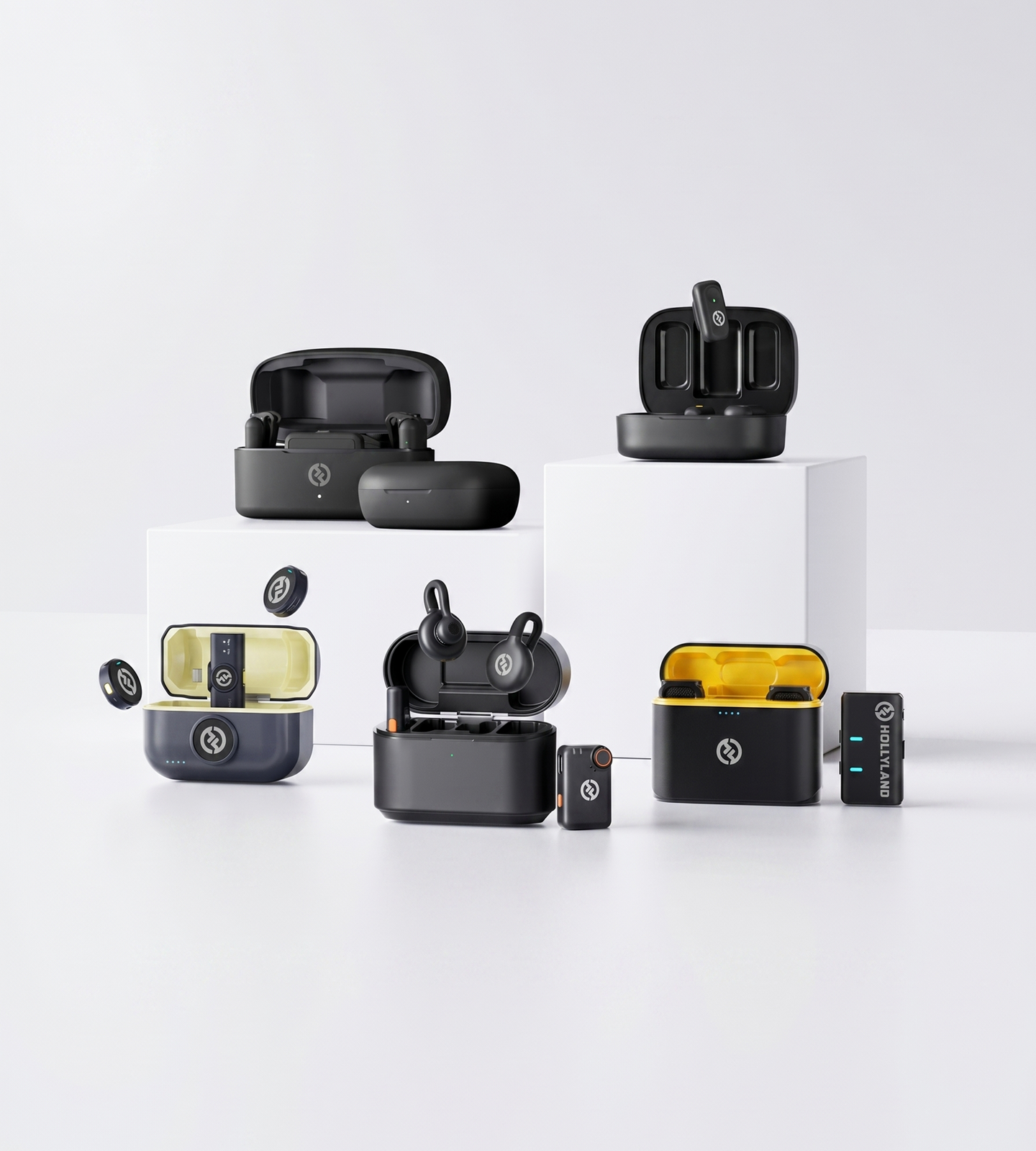
Reliable all-day wireless for camera and mobile workflows

Low-profile wireless for interviews and on-camera talent

For high-end productions that demand full audio control

Smartphone-native audio for mobile-first content creators
| Model |
 LARK M2
$106.00
LARK M2
$106.00
|
 LARK M2S
$125.00
LARK M2S
$125.00
|
 LARK MAX 2
$269.38
LARK MAX 2
$269.38
|
 LARK A1
$50.30
LARK A1
$50.30
|
|---|---|---|---|---|
| Audio Recording | 24-bit, 48kHz | 24-bit, 48kHz | 32-bit Float / 24-bit, 48kHz | 24-bit, 48kHz |
| Wireless Range (LOS) | Up to 300m / 1000ft | Up to 300m / 1000ft | Up to 340m / 1115ft | Up to 200m / 650ft |
| Noise Cancellation | ENC | ENC | AI Noise Cancellation | 3-Level Intelligent NC |
| Max SPL | 115dB | 116dB | 128dB | 128dB |
| Transmitter Weight | 9g | 7g | 14g | 8g |
| Total Battery Life | Up to 40 hours | Up to 30 hours | Up to 36 hours | Up to 54 hours |
| Device Compatibility | Camera / Mobile / Universal | Camera / Mobile / Universal | Camera / Universal | Smartphone |
| Best For | All-around professional use | Interviews & branded content | High-end film & full-crew production | Mobile-first content creators |
| Shop | Shop | Shop | Shop |
For professional audio, bit depth and sample rate are the foundation — and the specs worth scrutinizing first.
Studio recordings are easy. Real-world shoots aren't. Traffic, wind, HVAC systems, crowd noise — every environment will try to compromise your audio. Noise cancellation is no longer a bonus feature; for most professional workflows, it's a requirement.
When to prioritize it: Any shoot you can't acoustically control — outdoors, event venues, crowded locations — demands strong noise cancellation performance. Evaluate it as a core spec, not an afterthought.
Range specs are almost always quoted as Line of Sight (LOS) — a clean, unobstructed path between transmitter and receiver. Most real-world shoots don't offer that.
A system with strong LOS range but poor NLOS performance can be a liability on indoor or crowded shoots. Look for both figures before deciding.
The most capable wireless microphone is useless if it doesn't integrate cleanly with your recording device. Compatibility is one of the most common friction points when switching wireless mic systems.
Camera-mounted receivers are the standard for videographers and filmmakers. Look for a dedicated camera version with a 3.5mm TRS output to feed directly into your camera's mic input — no adapters, no app required, no latency from conversion.
Mobile-native microphone systems plug directly into your phone (USB-C or Lightning), with no separate receiver unit. These systems are engineered for creators who shoot primarily on iPhone or Android. The LARK A1 is built specifically for this workflow, with plug-and-play smartphone compatibility plus mobile-first controls including EQ adjustment, multi-level gain, and auto-limit clip protection.
If you regularly switch between camera and smartphone, look for a combo version that ships with multiple output adapters. This eliminates the need to invest in parallel systems for different devices — a practical consideration for creators whose gear setup changes shoot to shoot.
A microphone system that dies mid-shoot isn't just an inconvenience — it's a production failure. Evaluating battery life means looking beyond the single-charge headline number.
Think of the charging case as an active battery pack, not just a storage solution. A case that recharges transmitters two or three times means you can top up between setups without hunting for power on location.
For interviews, documentaries, and any shoot where talent wears the transmitter on camera, physical size and appearance matter — both for comfort and visual discretion.
On fast-moving shoots, setup time is production time. The faster a system is ready, the more time you spend recording.
Most professional wireless systems now offer both — plug-and-play as the default, app control as an optional layer. If your shoots are fast and unpredictable, lead with plug-and-play performance as the baseline spec. If you want granular control and have the workflow to support it, app integration becomes a differentiator.
If you regularly record interviews, panels, or multi-talent shoots, the number of transmitters a single receiver can handle simultaneously is a critical spec.
If your work is scaling toward multi-speaker production, factor transmitter-to-receiver ratios into your buying decision early. Upgrading later is possible but costlier than selecting a scalable system from the start.
I love my new LARK M2 mics. These were so good, and I really enjoyed testing out the new LARK M2 from Hollyland.
The Hollyland LARK MAX is the wireless microphone system with the clearest and crispest audio of any wireless mic system I have ever tried.
LARK MAX is doing an excellent job of dropping the sound of the air conditioner, which is something l always have to remove and post with our shotgun mic.
 Technical Support:
support.us@hollyland.com
Technical Support:
support.us@hollyland.com
Order Support:
store.us@hollyland.com
Technical Support:
support.us@hollyland.com
Order Support:
store.us@hollyland.com