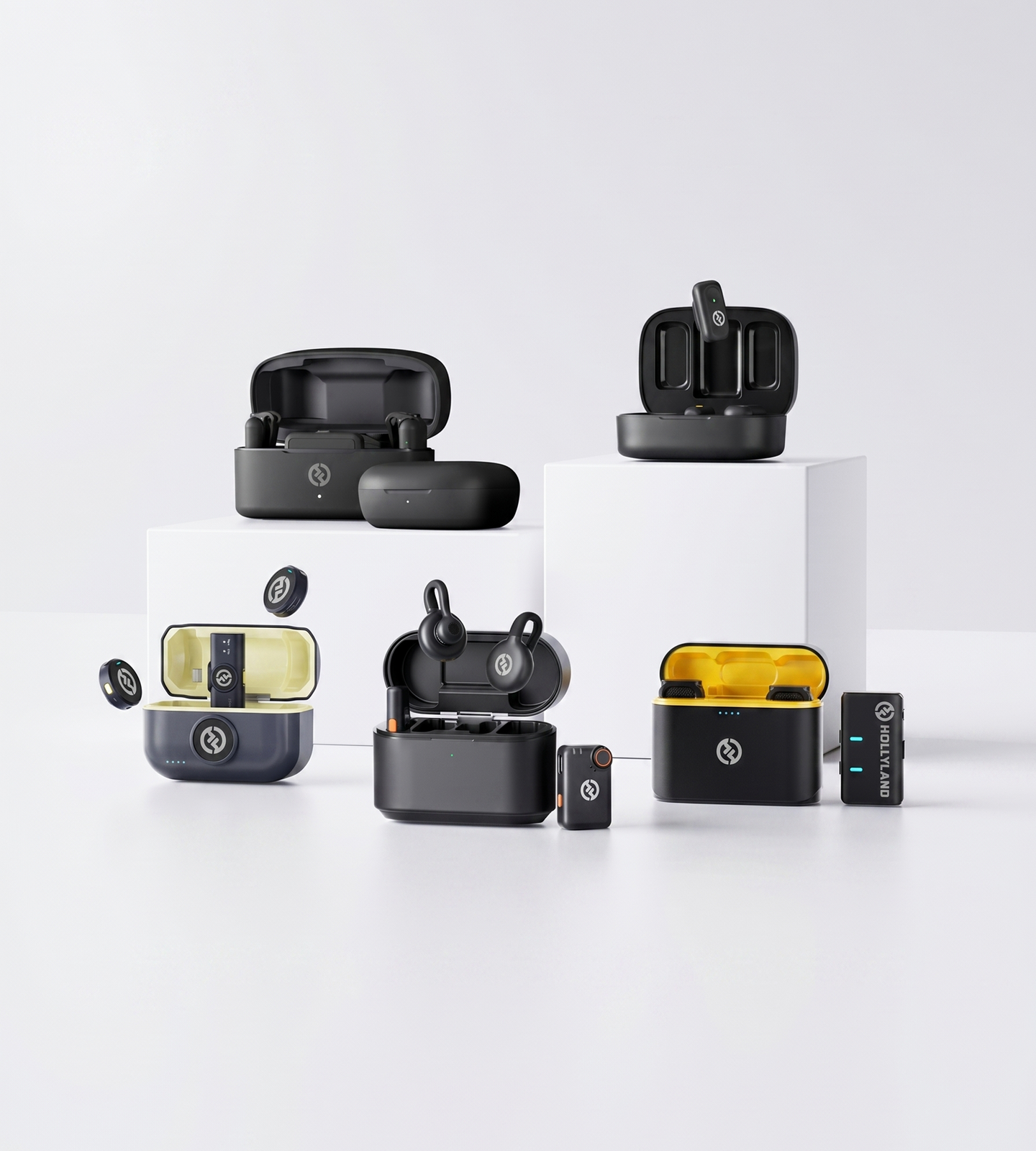
Mini Wireless Mics

Mini USB Microphones

Hollyland's wireless clip-on microphones pack studio-grade audio into a form factor smaller than a button. Plug-and-play ready for smartphones, laptops, and cameras — no drivers needed. With ENC noise cancellation and 300m wireless range, they're the smarter alternative to any USB mic.
Shop Now Compare Models

Compatible with iPhone, Android, laptop & camera · No drivers required · From 7g

  • Instant Plug & Play
  • 48kHz Studio-Grade Audio
  • ENC Noise Cancellation
  • Works with Any Device
Mini USB Microphones
Editor's pickLARK M2Button-Size · ENC Noise Cancellation
4.7 / 5From 1.5M+ verified creators
Shop Models

Find Your Mic

Four compact wireless microphones matched to every workflow, from quick smartphone clips to professional-grade production.
LARK M2

LARK M2

Everyday wireless audio for creators and remote workers

  • Button-size design
  • ENC noise cancellation
  • 48kHz / 24-bit
$106.00
LARK M2S

LARK M2S

Stay invisible on camera without compromising sound

  • 7g ultralight
  • No-logo invisible fit
  • ENC noise cancellation
$125.00
LARK MAX 2

LARK MAX 2

Step up to pro-grade wireless audio in a compact build

  • 32-bit float recording
  • AI noise cancellation
  • 340m wireless range
$267.34
LARK A1

LARK A1

Snap on and record — built for smartphone creators

  • Magnetic compact design
  • 3-level noise cancellation
  • Up to 54-hour battery
$50.30
Side-by-side

Which Mini Mic Is Right for You?

Compare Hollyland's compact wireless mics side by side to match your setup, workflow, and recording goals.
Model LARK M2 LARK M2 $106.00 LARK M2S LARK M2S $125.00 LARK MAX 2 LARK MAX 2 $267.34 LARK A1 LARK A1 $50.30
Transmitter Weight9g 7g 14g 8g
Recording Format48kHz / 24-bit 48kHz / 24-bit 48kHz / 32-bit Float 48kHz / 24-bit
Noise CancellationENC Environmental Noise Cancellation ENC Environmental Noise Cancellation AI Noise Cancellation 3-Level Intelligent Noise Cancellation
Total Battery LifeUp to 40 hours Up to 30 hours Up to 36 hours Up to 54 hours
Wireless Range (LOS)300m / 1000ft 300m / 1000ft 340m / 1115ft 200m / 650ft
Device CompatibilityPhone, Laptop & Camera (Combo Version) Phone, Laptop & Camera (Combo Version) Phone, Laptop & Camera Smartphones
Best ForAll-around creators & remote workers On-camera creators needing an invisible fit Pro creators & serious podcasters Mobile-first & entry-level creators
Shop Shop Shop Shop
Buying Guide

How to Choose the Right Mini Microphone

Mini microphones aren't all built the same. Whether you're upgrading from a built-in mic or deciding between wired and wireless, these are the factors that actually matter — so you can choose based on your real workflow, not just the smallest footprint.
  1. Wired USB vs. Wireless: Know Your…
  2. Size and Portability: What "Mini"…
  3. Audio Quality: Does Small Mean Worse
  4. Noise Cancellation: Non-Negotiable…
  5. Device Compatibility: Make Sure It…
  6. Battery Life: Critical for…
  7. Ease of Setup: Truly Plug-and-Play…
  8. Matching Microphone Type to Your…

Wired USB vs. Wireless: Know Your Options First

The traditional mini USB microphone plugs directly into a laptop or phone — instant audio, no pairing, no fuss. That simplicity is genuinely useful. But it comes with trade-offs: you're tethered to your device, usually limited to one connection type, and dependent on your computer's USB port being available and clean.

Compact wireless clip-on microphones have closed that gap significantly. They now match — and often exceed — the audio quality of wired USB mics, while removing the cable entirely.

Here's a practical comparison:

  • Setup simplicity: Both can be plug-and-play. Many wireless systems ship pre-paired and connect instantly when you plug the receiver into your device.
  • Portability: Wireless wins here. No cable means one less thing to manage — especially important for on-camera shooting or moving between rooms.
  • Device flexibility: Wired USB mics are often device-specific. Wireless systems with combo kits work across smartphones, laptops, and cameras from a single purchase.
  • Audio quality: Modern compact wireless mics record at 48kHz / 24-bit or higher — the same standard as professional USB mics.
  • Background noise handling: Many wireless clip-ons include built-in ENC or AI noise cancellation that wired USB mics at a similar price point rarely offer.

If you record only at a fixed desk, a traditional wired mic is a perfectly valid choice. If you move, shoot video, or use more than one device, a compact wireless system is likely the smarter investment.


Size and Portability: What "Mini" Actually Means

Not all compact microphones are equally portable. Before buying, ask:

  • How much does the transmitter weigh? Look for units in the 7–10g range for something that clips to your collar without dragging on fabric. Anything heavier starts to feel like a compromise.
  • Does the receiver add bulk? For wireless setups, evaluate the receiver size too — especially if it needs to plug into your phone's charging port or sit in your camera's hot shoe.
  • Will it show on camera? If you create video content, consider whether the mic design is visible and whether that matters for your aesthetic. Some creators prefer a no-logo, low-profile design that disappears on-screen; others don't mind.
  • How does the clip work? A lightweight mic with a poor clip mechanism is more frustrating than one slightly heavier with a secure magnetic or spring-loaded attachment.

Audio Quality: Does Small Mean Worse?

It used to. That's no longer true at this price tier — but specs still vary meaningfully. Here's what to look for:

Sample Rate and Bit Depth

The baseline for professional-quality audio is 48kHz / 24-bit. This is sufficient for video content, podcasting, and virtual meetings. If you're working in demanding production environments or want maximum editing headroom, look for 32-bit float recording, which handles volume spikes and prevents clipping without manual gain adjustment.

Signal-to-Noise Ratio (SNR)

A higher SNR means less background hiss and a cleaner signal, especially in quiet settings. Look for ≥67dB as a minimum; ≥70dB is preferable for voice-focused recording.

Maximum SPL

This measures how loud a sound source the mic can handle before distorting. For typical speech and interviews, most mics are adequate. If you record in louder environments or want extra headroom, look for 115dB SPL or higher.

Frequency Response

A range of 20Hz–20kHz covers the full spectrum of human voice and most instruments. Any quality mic in this category should hit this range — but check that the response is smooth across that range, not just technically capable at the extremes.


Noise Cancellation: Non-Negotiable for Real-World Recording

Background noise is the most common reason clean audio fails — and a core concern for anyone recording outside a treated studio. Look for one of the following:

  • ENC (Environmental Noise Cancellation): Hardware-level filtering built directly into the microphone. Effective against consistent ambient sounds — fans, air conditioning, light traffic, keyboard noise.
  • AI Noise Cancellation: Software-driven processing that intelligently separates voice from background noise in real time. Better suited to unpredictable or complex sound environments like cafés or shared offices.
  • Adjustable noise cancellation levels: Some mics let you dial in the intensity of noise reduction (e.g., low, medium, high) depending on your recording environment. This flexibility is worth prioritizing if you record in different spaces regularly.

For quiet, controlled environments, ENC is usually enough. For home offices, travel, or outdoor recording, look for AI-powered or multi-level noise cancellation.


Device Compatibility: Make Sure It Works With Everything You Own

A microphone that only works with one device type is a hidden limitation. Before buying, confirm:

  • Smartphone support: Check the connection type — USB-C, Lightning, or 3.5mm — and whether adapters are included.
  • Laptop / desktop support: Is it driver-free on both Windows and macOS? True plug-and-play is worth confirming rather than assuming.
  • Camera support: If you shoot on a mirrorless or DSLR camera, verify the receiver outputs a compatible signal (typically 3.5mm TRS/TRRS).
  • Combo kits: If you regularly switch between your phone, laptop, and camera, a universal combo version — which includes multiple adapters or receivers in a single kit — removes the need to buy separate accessories later.

For creators who work across multiple devices, multi-device compatibility is one of the most important factors to check upfront.


Battery Life: Critical for Wireless, Easy to Overlook

If you're going wireless, battery performance is a primary spec — not a secondary one.

  • Per-charge transmitter runtime: Most quality compact wireless mics offer 9–11 hours per charge, which covers a full workday or shoot day comfortably.
  • Total runtime with charging case: A well-designed charging case can extend total battery life to 30–54 hours — multiple days of use without needing a wall outlet. This is especially valuable for travel-heavy workflows.
  • Onboard backup recording: Some advanced models record audio directly to the transmitter as a backup, independently of the wireless signal. This is a meaningful safety net for professional shoots where a dropped connection could mean lost footage.

For casual users — meetings, short-form videos — standard per-charge runtime is more than enough. For full-day production or frequent travel, prioritize systems with high-capacity charging cases and backup recording options.


Ease of Setup: Truly Plug-and-Play or Just Close?

The appeal of a USB mic is that it just works. When evaluating any mini microphone — wired or wireless — hold it to the same standard:

  • No drivers required: Your computer or phone should recognize the mic immediately without additional software. If a driver download is needed, that's a friction point worth knowing in advance.
  • Pre-paired out of the box: For wireless systems, the transmitter and receiver should already be synced when you open the box — no manual pairing process.
  • App control as an optional layer: Some microphones offer companion app features like gain adjustment, EQ, and noise cancellation settings. The best implementations make the app useful, not mandatory — the mic should function fully without it.

If you're an experienced creator who wants fine-grained control over gain levels, EQ, reverb, or recording format, look for a mic that offers those options. Just confirm that those controls are available without locking out basic functionality for users who simply want to clip on and record.


Matching Microphone Type to Your Workflow

Use these questions to narrow your decision:

  • Recording at a fixed desk only? A compact wired mic does the job — look for plug-and-play compatibility and good SNR specs.
  • Creating video content or moving while recording? A wireless clip-on mic is the better fit. Prioritize a lightweight transmitter and reliable ENC.
  • Switching between phone, laptop, and camera? Look for a universal combo kit with multiple adapters and a single charging case.
  • Recording in noisy or unpredictable environments? Prioritize AI or multi-level noise cancellation over basic ENC.
  • Doing professional production work? Look for 32-bit float recording, a high SNR (≥70dB), and extended battery life with a charging case.
  • Entry-level or budget-first? Focus on 48kHz / 24-bit audio, true plug-and-play operation, and a secure clip design — you don't need advanced features to get clean audio.
Built for Every Creator

One Mic. Every Situation.

From a home desk to a moving shoot, compact wireless mics keep your audio clean and your setup frictionless. Here's where they make the biggest difference.

Video Content Creation

Vlogs, talking-head videos, and voiceovers demand clear dialogue — but bulky rigs disrupt natural performance. Button-sized clip-on mics capture 48kHz/24-bit audio while staying nearly invisible on camera, so your content sounds polished whether you're filming solo or on a full set.
  • Vlogging
  • On-Camera Audio
  • Voiceovers

Remote Work & Virtual Meetings

Built-in laptop microphones pick up everything — keyboard clicks, room reverb, the neighbor's lawnmower. A plug-and-play clip-on mic with ENC noise cancellation upgrades your call audio in seconds, with no drivers to install and no settings to dig through.
  • Home Office
  • Video Calls
  • Zero Setup

Podcasting & Interviews

Planned episode or spontaneous conversation — compact wireless mics let you record wherever the moment happens. With internal recording backup and long battery life on select models, no take gets lost to a dropped connection or a dying battery.
  • Solo Recording
  • Interviews
  • On-the-Go

Mobile & Smartphone Recording

Your phone is already a capable camera — the right mic completes the setup. Magnetic clip-on designs connect directly to your device with no extra gear, no adapters, and no lag, delivering broadcast-quality audio in a package that fits in any pocket.
  • Smartphone Audio
  • Run-and-Gun
  • Plug & Play

Live Streaming

Viewers leave streams when the audio breaks down. Low-latency wireless transmission keeps your voice locked to your video feed, and AI noise cancellation removes background distractions before they ever reach your audience — even in loud or unpredictable environments.
  • Real-Time Audio
  • Low Latency
  • Stream-Ready

Students & Educators

Online classes, recorded lectures, and presentations all depend on a clear, consistent voice signal. Ultra-lightweight transmitters clip on discreetly and stay out of the way, letting instructors focus on the lesson instead of fiddling with their tech stack.
  • Online Learning
  • Recorded Lectures
  • Lightweight
Trusted by creators

1.5M+ creators picked LARK microphones for their audio

A decade of wireless engineering for film crews and broadcasters — packaged for modern creator workflows.
  • 4.7 Avg. rating · 120K+ reviews
  • 1.5M+ Verified creators
  • 160+ Countries shipped
  • 98% Would recommend

I love my new LARK M2 mics. These were so good, and I really enjoyed testing out the new LARK M2 from Hollyland.

Sarah GraceSarah GraceTech Creator · 3.2M YouTube subscribers

The Hollyland LARK MAX is the wireless microphone system with the clearest and crispest audio of any wireless mic system I have ever tried.

GoenrockGoenrockCinematographer · 107K Instagram subscribers

LARK MAX is doing an excellent job of dropping the sound of the air conditioner, which is something l always have to remove and post with our shotgun mic.

Film RiotFilm RiotFilmmaking Educator · 2.2M YouTube subscribers
  • No Film School
  • Newsshooter
  • CineD
  • RedShark
  • CAMERA JABBER
  • Photowebexpo
FAQ

Mini Microphone, Big Questions — Answered

Are these microphones truly plug-and-play, or do I need to install drivers or software?
Genuinely plug-and-play — no drivers, no software, no setup headaches. The LARK M2, LARK M2S, LARK A1, and LARK MAX 2 are all recognized instantly by your device the moment you connect the receiver. Clip on the transmitter, plug in the receiver, and you're recording. The LARK M2 and LARK M2S do offer optional app control for deeper adjustments on mobile, but the app is never required to get started.
Will audio quality actually be good from something this small?
Compact size and professional sound are no longer a trade-off. Every microphone in this collection records at **48kHz/24-bit** — the same standard used in professional audio production — with a full **20Hz–20kHz frequency response**. Signal-to-noise ratios exceed 70dB across the lineup (the LARK MAX 2 reaches ≥72dB), which means what you capture is clean, detailed, and clear. The LARK MAX 2 also supports **32-bit float recording**, which preserves every detail of your audio even in unpredictable environments. These mics outperform any built-in laptop or smartphone microphone by a significant margin.
Will these mics pick up too much background noise?
All four microphones include active noise reduction technology built in — no extra accessories or apps required. The **LARK M2** and **LARK M2S** both feature **ENC (Environmental Noise Cancellation)** to filter out common ambient sounds like fans, air conditioning, and traffic. The **LARK A1** adds **3-Level Intelligent Noise Cancellation**, letting you dial in how aggressively noise is reduced based on your environment. The **LARK MAX 2** goes furthest with **AI Noise Cancellation** for the most adaptive, intelligent background filtering in the lineup.
Do these microphones work with both my smartphone and my laptop?
Yes — and that's a key advantage over traditional wired USB mics, which are often locked to one connection type. The **LARK M2 Combo** and **LARK M2S Combo** versions are designed explicitly for universal compatibility, working across smartphones, laptops, and cameras with the appropriate receivers included. The **LARK A1** is plug-and-play with smartphones. Before purchasing, check the individual product page to confirm the receiver connection types (USB-C, Lightning, or 3.5mm) align with your specific devices.
Is a wireless clip-on mic actually better than plugging in a wired USB microphone?
For most creators and remote workers, yes. A wired USB mic anchors you to your desk and introduces cable clutter. A wireless clip-on mic delivers the same plug-and-play ease with complete cable freedom — so you can move around your space, record at a distance from your camera, or capture audio anywhere without managing tethered connections. Wireless range is also substantial: the **LARK M2** and **LARK M2S** reach up to **300m line-of-sight**, while the **LARK MAX 2** extends to **340m**. The result is a cleaner setup, a cleaner shot, and a cleaner recording.
How long does the battery last?
All four microphones are built for full-day use without interruption: - **LARK M2** — Up to 10 hours per transmitter charge; up to **40 hours total** with the charging case - **LARK M2S** — Up to 9 hours per transmitter charge; up to **30 hours total** - **LARK A1** — Up to 9 hours per transmitter charge; up to **54 hours total** — the longest runtime in the lineup - **LARK MAX 2** — Up to 11 hours per transmitter charge; up to **36 hours total**; plus **32-bit float internal recording** for up to 14 hours as an independent backup For extended shoots or travel days, any of these mics will reliably outlast your recording session.
How small and light are these microphones really?
Small enough that you'll forget you're wearing one. The **LARK M2S** is the lightest at just **7g** — roughly the weight of two paperclips. The **LARK A1** comes in at approximately **8g**, the **LARK M2** at approximately **9g**, and the **LARK MAX 2** at approximately **14g**. All four clip discreetly to a lapel, collar, or shirt pocket. The **LARK M2S** features a no-logo, low-profile design that's nearly invisible on camera, while the **LARK MAX 2** uses an excimer nano-coated, skin-friendly material built to hold up with regular wear.
Which Hollyland mini microphone is the right one for me?
It depends on your primary use case and how far you want to take your audio setup: - **LARK A1** — Best for smartphone-first and entry-level creators who want intelligent noise cancellation, magnetic clip convenience, and up to 54 hours of total battery life - **LARK M2** — Ideal for creators and remote workers who need a button-size, plug-and-play mic with ENC and broad device compatibility out of the box - **LARK M2S** — The best choice for on-camera creators who need an ultralight, virtually invisible mic with a premium titanium finish and no-logo design - **LARK MAX 2** — The professional upgrade for creators who want 32-bit float recording, AI noise cancellation, low-latency wireless monitoring, and the ability to connect up to 4 transmitters to a single receiver Not sure? Every product page includes full specs, compatibility details, and use-case guidance to help you find the right fit.
Explore further

A few more places to go from here

A curated link map of the surrounding content — related categories, the most useful guides, head-to-head comparisons and setup help.
Ready when you are

Find the Right Mic for Every Moment

Plug-and-play wireless audio from 7g. 48kHz/24-bit quality and ENC noise cancellation, ready when you are.
Shop Now Compare Models
  • Free shipping over $99
  • 30-day returns
  • 1-year warranty