


LARK M2
Lightweight everyday vlogging and solo content
- Plug & Play
- ENC Noise Cancellation
- 9g Ultra-Light TX
 Canada
(English / $
CAD)
Canada
(English / $
CAD)


Video Solutions

Intercom Systems

Wireless Microphones

Cameras
Video Solutions
View all
Video Accessories
Intercom Accessories

Mic Accessories

Camera Accessories
Video Accessories
View all
Hollyland Monitor Calibrator-Wireless Video Transmission System Accessory

Monitor Hood (7-Inch)

Mars 4K Transmitter

Mars 4K Receiver

D-Tap to Locking DC Power Adapter Cable

Crab Clamp

NP-F970 Battery

NP-F550 Battery

Mini HDMI to HDMI Cable

Micro HDMI to HDMI Cable

SDI Cable (1000mm)

SDI Cable (500mm)

Cold Shoe Gimbal

Rotatable Cold Shoe Mount

Side & Bottom Mounted Aluminum Handle

Screw Fitting for Stabilizer

Cylindrical Antenna (2.4GHz & 5GHz)

Paddle Antenna (2.4GHz & 5GHz)

View all


Canada / English
Works with all iPhone models · Lightning & USB-C · No app needed to start
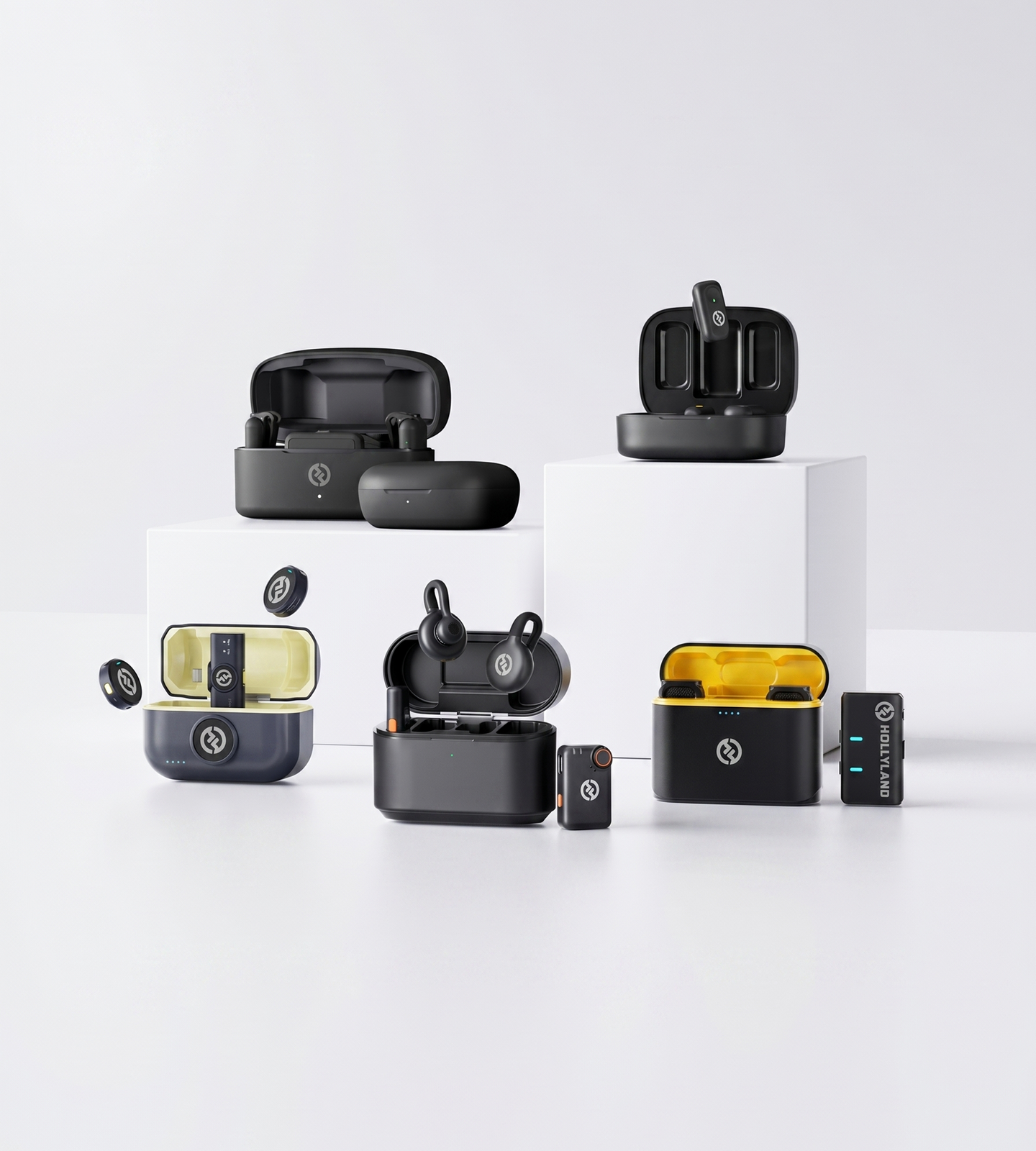
Lightweight everyday vlogging and solo content

On-camera creators who need to disappear on screen

Professional multi-person shoots with zero audio compromise

Interviews and podcasts with all-day battery confidence
| Model |
 LARK M2
$106.00
LARK M2
$106.00
|
 LARK M2S
$125.00
LARK M2S
$125.00
|
 LARK MAX 2
$271.50
LARK MAX 2
$271.50
|
 LARK A1
$50.30
LARK A1
$50.30
|
|---|---|---|---|---|
| Best For | Vloggers & solo creators | On-screen & aesthetic-focused creators | Pro filmmakers & live streamers | Creators needing advanced audio control |
| iPhone Connection | Plug & Play + App Control | Plug & Play + App Control | Plug & Play | Plug & Play (smartphone-ready) |
| Noise Cancellation | ENC | ENC | AI Noise Cancellation | 3-Level Intelligent NC |
| Wireless Range | 60m NLOS / 300m LOS | 60m NLOS / 300m LOS | 70m NLOS / 340m LOS | 200m LOS |
| Total Battery Life | 40 hours | 30 hours | 36 hours | 54 hours |
| Transmitter Weight | 9g | 7g | 14g | 8g |
| Audio Format | 24-bit / 48kHz | 24-bit / 48kHz | 32-bit Float / 24-bit | 24-bit / 48kHz |
| Standout Feature | Button-size ultra-mini design | No-logo invisible fit + titanium build | 32-bit float recording + wireless monitoring | Auto-limit clip protection + 6-level gain |
| Shop | Shop | Shop | Shop |
Before comparing features, confirm which port your iPhone uses — because not every mic connects to every model out of the box.
Wireless mics designed for smartphone use come in Mobile Versions that plug directly into your iPhone via the correct port. Some models also offer a Combo Version that bundles both Lightning and USB-C connectors in one kit — useful if you shoot across multiple devices or want to future-proof your purchase.
If you're unsure which port your iPhone has, check the bottom of the device near the charging slot.
How you prefer to work has a direct impact on which mic fits your workflow.
Plug and play means the mic is ready the moment you connect the receiver to your iPhone — no Bluetooth pairing, no app download, no configuration required. This is the right mode for:
App control unlocks deeper settings: adjustable gain, EQ, noise cancellation levels, and real-time monitoring from your phone. It's worth using when:
Many mics in this range support both modes — plug in for instant recording, open the app when you want more control. For most creators, plug and play is enough day to day.
For iPhone video, the benchmark you want is 24-bit / 48kHz recording. That's broadcast-quality audio with enough dynamic range to sound clean whether you're recording a quiet interview or a loud outdoor vlog.
Beyond that, a few numbers are worth understanding:
Signal-to-Noise Ratio (SNR) — Measures how much clean signal you're getting relative to background noise. Higher is better; ≥67dB is a solid baseline, ≥72dB delivers noticeably cleaner audio in quiet or controlled environments.
Maximum SPL — The loudest sound the mic can handle before distorting. A higher SPL ceiling (such as 128dB) gives you more headroom when recording loud subjects, live events, or unexpectedly noisy settings.
Auto-limit / Clip Protection — Automatically pulls back the gain when audio peaks spike, preventing distortion even if you can't monitor levels in real time. This is a significant safety net for solo iPhone creators who can't always watch their meters.
32-bit Float Recording — A professional-tier feature that captures audio at a fixed format regardless of gain setting, making it virtually impossible to clip. Relevant for filmmakers and producers where a retake isn't always an option.
Wireless range is typically listed two ways:
NLOS is the number that reflects most real-world shooting conditions. A 60–70m NLOS range covers the vast majority of indoor and outdoor iPhone shooting scenarios comfortably. You'd only need to push beyond that for large venue coverage, long-distance event recording, or situations where the transmitter and receiver are separated by significant obstacles.
When comparing mics, treat LOS range as a maximum and NLOS range as the practical working figure.
The transmitter is the piece your subject clips on — and how it looks and feels matters more than people expect.
Look for:
For travel and outdoor shooting, think about the total kit footprint as well. A charging case that fits the transmitter and receiver together keeps your bag light and your rig minimal — which matters on long travel days.
Battery life is quoted in two ways, and both matter depending on your shoot schedule.
For half-day or single-day shoots, per-charge life is rarely a concern. For multi-day travel, full-weekend events, or back-to-back production days, total case life is the figure that protects you. A case with 40–54 hours of total charge means you can top up between shoots without hunting for a power outlet.
Most iPhone creators aren't shooting in soundproofed studios. Common real-world challenges include:
Environmental Noise Cancellation (ENC) is hardware-based processing that filters background sound from the source before it reaches your recording. AI noise cancellation goes further, using trained models to isolate voice from complex noise profiles in real time.
Some mics offer adjustable noise cancellation levels — letting you dial in the right amount of filtering without over-processing a naturally warm or expressive voice. This is worth prioritizing if your recording environments vary shoot to shoot.
| Your situation | What to prioritize |
|---|---|
| Solo vlogger, fast setups | Plug and play, ultra-light TX, ENC |
| Two-person interviews | Dual-TX system, single RX into iPhone |
| Travel and outdoor filming | Long total battery life, compact case, reliable NLOS range |
| Live streaming from iPhone | Low-latency transmission, real-time wireless monitoring |
| Polished video production | App control, adjustable gain and EQ, clip protection |
| Professional filmmaking | 32-bit float recording, AI noise cancellation, multi-mic support |
For creators who want fast, reliable audio without a learning curve, a plug-and-play mic with ENC — like the LARK M2 or LARK A1 — covers most everyday iPhone recording scenarios comfortably.
For professional-level workflows where audio quality is non-negotiable and a bad take isn't an option, the LARK MAX 2 adds 32-bit float recording, AI noise cancellation, wireless monitoring, and support for up to four transmitters on a single receiver — a different class of tool for a different level of production.
Wireless mics for iPhone span a wide price range, and it helps to understand what each step up adds:
Entry level — Plug and play simplicity, solid 24-bit audio, ENC noise cancellation, compact and lightweight design. Covers social content, interviews, and everyday video without overcomplicated setup.
Mid range — Adds app control, premium build materials (including options like titanium), invisible-fit aesthetics for on-screen talent, and higher SPL headroom for louder environments.
Professional tier — Introduces 32-bit float recording, AI-powered noise cancellation, low-latency audio monitoring, timecode support, and multi-transmitter capability. Built for creators who treat audio as seriously as they treat video.
The right tier isn't the most expensive one — it's the one that matches how you actually work. Identify your most common shooting scenario, your main pain point with audio, and how much post-production time you're willing to spend fixing sound. That usually points clearly to the right level.
I love my new LARK M2 mics. These were so good, and I really enjoyed testing out the new LARK M2 from Hollyland.
The Hollyland LARK MAX is the wireless microphone system with the clearest and crispest audio of any wireless mic system I have ever tried.
LARK MAX is doing an excellent job of dropping the sound of the air conditioner, which is something l always have to remove and post with our shotgun mic.
 Technical Support:
support.us@hollyland.com
Technical Support:
support.us@hollyland.com
Order Support:
store.us@hollyland.com
Technical Support:
support.us@hollyland.com
Order Support:
store.us@hollyland.com