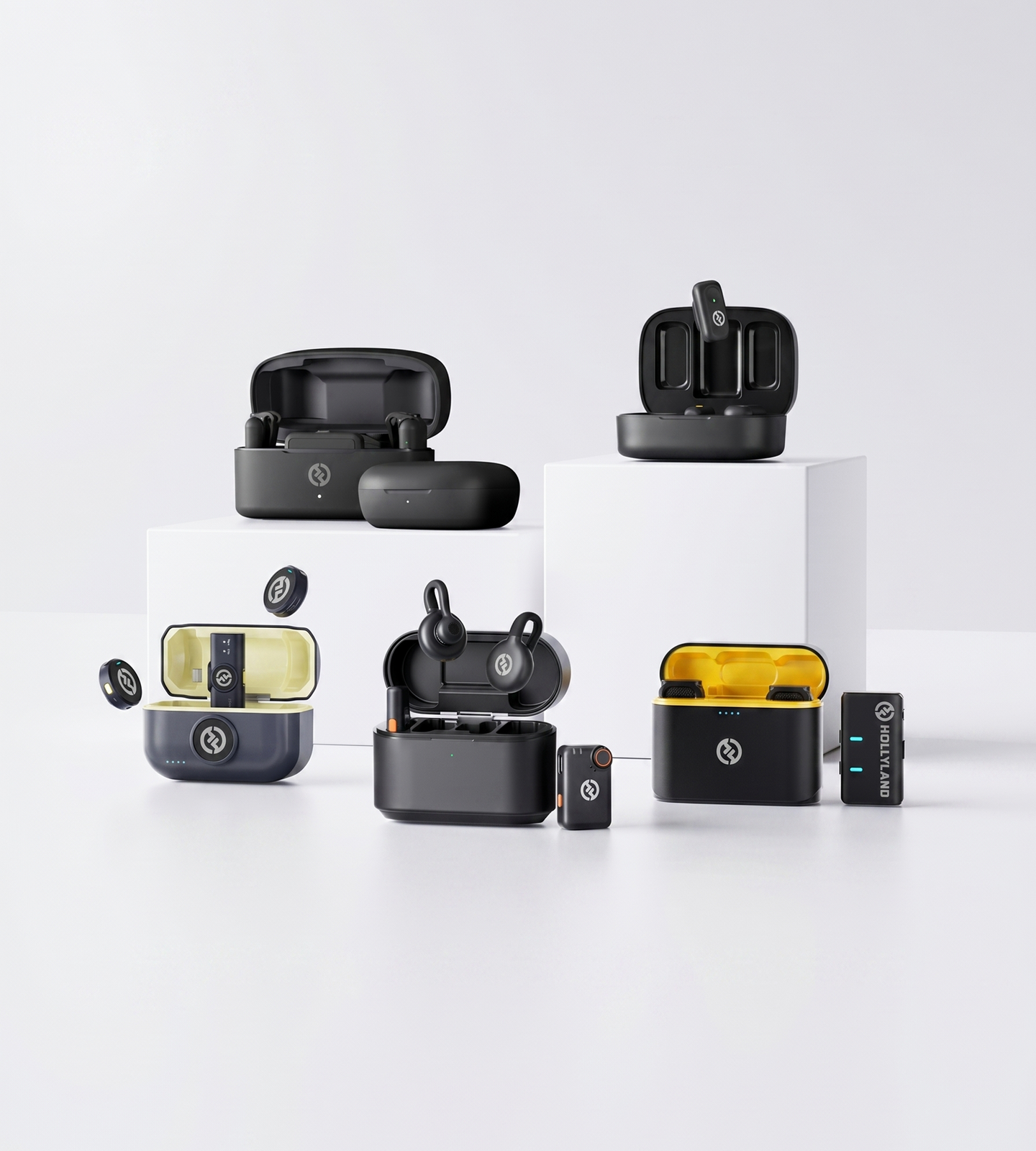
Clip-On Microphones

Clip-On Microphones

Hollyland LARK wireless clip-on microphones deliver broadcast-quality audio in an ultra-light, camera-invisible design. Built for creators, journalists, and filmmakers — with ENC noise cancellation, plug-and-play setup, and all-day battery life across every tier.
Shop Now Compare Models

Works with iPhone, Android, DSLR & mirrorless cameras — plug-and-play, no drivers needed

  • 24 & 32-Bit Broadcast Audio
  • ENC & AI Noise Cancellation
  • Camera-Invisible Fit
  • Clip On. Press Record. Done.
Clip-On Microphones
Editor's pickLARK MAX 232-Bit Float · AI Noise Cancel
4.7 / 5From 1.5M+ verified creators
Shop Models

Find Your Match

Four clip-on mics built for every workflow — compare by use case and pick the one that fits.
LARK M2

LARK M2

Reliable wireless audio for everyday creators on the move

  • ENC Noise Cancellation
  • 9g Transmitter
  • Up to 40hrs Battery
$106.00
LARK M2S

LARK M2S

Stay invisible on camera without compromising on sound

  • No-Logo Titanium Design
  • 7g Ultra-Light
  • ENC Noise Cancellation
$125.00
LARK MAX 2

LARK MAX 2

Pro-grade multi-mic recording with timecode and 32-bit float

  • 32-bit Float Internal Recording
  • AI Noise Cancellation
  • Timecode Sync
$267.47
LARK A1

LARK A1

Plug into your smartphone and start recording instantly

  • Smartphone Plug & Play
  • 3-Level Noise Cancellation
  • Up to 54hrs Battery
$50.30
Side-by-side

Find Your Perfect Clip-On Mic

Compare key specs side by side to match the right wireless mic to your recording style and gear.
Model LARK M2 LARK M2 $106.00 LARK M2S LARK M2S $125.00 LARK MAX 2 LARK MAX 2 $267.47 LARK A1 LARK A1 $50.30
Best ForCreators & vloggers On-camera presenters Filmmakers & pro producers Mobile-first & beginners
TX Weight9g 7g 14g 8g
Recording Format48kHz / 24-bit 48kHz / 24-bit 48kHz / 32-bit Float 48kHz / 24-bit
SNR>70dB >70dB ≥72dB ≥67dB
Wireless Range (LOS)300m / 1000ft 300m / 1000ft 340m / 1115ft 200m / 650ft
Total Battery LifeUp to 40 hours Up to 30 hours Up to 36 hours Up to 54 hours
Noise CancellationENC ENC AI Noise Cancellation Intelligent (3-Level)
Compatible DevicesCamera & Smartphone Camera & Smartphone Camera & Smartphone Smartphones
Shop Shop Shop Shop
Buying Guide

How to Choose the Right Clip-On Microphone

The best clip-on microphone is the one that disappears on your body, sounds clean in your environment, and connects seamlessly to your gear. Before you buy, here are the key factors worth evaluating — so you get the right fit the first time.
  1. Audio Quality: The Numbers That…
  2. Noise Cancellation: Choosing the…
  3. Device Compatibility: Match the…
  4. Size and Visibility: The Mic…
  5. Wireless Range and Battery Life:…
  6. Advanced Features: When the Basics…
  7. Matching Features to Your Workflow

Audio Quality: The Numbers That Actually Matter

Specs like SNR and bit depth aren't just for engineers — they directly shape how your voice sounds to an audience.

Signal-to-Noise Ratio (SNR) measures how much clean signal you capture relative to background noise. For spoken-word recording and video content, look for 70dB SNR or higher. Anything lower introduces audible hiss, particularly in quiet passages or during post-processing.

Bit depth determines your recording's dynamic range:

  • 24-bit delivers broadcast-quality audio that's more than sufficient for content creation, interviews, live events, and online publishing.
  • 32-bit float extends that dynamic range dramatically, making it nearly impossible to clip audio — even if gain is set incorrectly. If you record in unpredictable environments or want maximum flexibility in post-production, this is a meaningful upgrade.

A full 20Hz–20kHz frequency response ensures your voice is captured with natural warmth and detail — not thin or over-compressed.


Noise Cancellation: Choosing the Right Level of Protection

Background noise is the most common way good-looking video ends up with unusable audio. The question isn't whether you need noise cancellation — it's how much.

ENC (Environmental Noise Cancellation) works at the hardware level, suppressing ambient noise — wind, room hum, HVAC, crowd noise — before it enters your recording chain. It's the standard baseline for modern clip-on mics and handles most indoor and semi-controlled outdoor environments reliably.

AI Noise Cancellation applies intelligent signal processing on top of ENC, more aggressively isolating your voice and stripping away complex, layered background sounds. It's particularly valuable when:

  • Recording outdoors in busy, windy, or open environments
  • Your space isn't acoustically treated
  • You're at a live event or press conference with unpredictable ambient noise

For studio or controlled indoor use, ENC is typically sufficient. For field recording, run-and-gun shooting, or anywhere you can't control your acoustic environment, AI noise cancellation is a genuine performance upgrade.


Device Compatibility: Match the Mic to Your Setup

Compatibility is the most common source of pre-purchase hesitation — and it's a legitimate concern. Confirm these details before committing:

What device will receive the audio?

  • Camera receivers typically output via 3.5mm TRS and are designed for DSLRs, mirrorless cameras, and portable recorders.
  • Smartphone receivers connect via USB-C or Lightning, enabling plug-and-play recording directly to your phone.
  • Combo versions include both connection types in one kit — the most flexible option if your workflow spans multiple devices.

Do you want app control or pure plug-and-play? Most clip-on mics work out of the box without any setup. App connectivity adds control over gain, EQ, noise cancellation levels, and monitoring — useful for creators who want precision, but not necessary for beginners or fast-turnaround workflows.

Are you planning to expand your setup later? If there's any chance you'll add a second mic down the line, buy into a system that supports multi-transmitter connections from the start.


Size and Visibility: The Mic Nobody Notices

For on-camera presenters, journalists, and video creators, a visible microphone is a distraction. The best clip-on mics are engineered to disappear entirely.

Key physical characteristics to evaluate:

  • Transmitter weight — lighter is always better for long shoots. Under 10g is the benchmark for all-day wearability without fatigue or visible sagging.
  • Form factor — compact, button-sized designs sit flatter against the body and catch less light on camera.
  • Logo and finish — if any part of the mic will be visible in frame, a no-logo or neutral-finish design reads far more professionally than branded hardware.
  • Clip mechanism — a well-designed clip should hold firmly without pulling fabric, piercing delicate material, or generating handling noise. Consider your most common wardrobe before buying.

Wireless Range and Battery Life: Built for Real Shoots

Wireless range is typically quoted in two values. Always focus on the NLOS figure for realistic expectations:

  • LOS (line-of-sight) — the maximum range in open, unobstructed space. This is the headline number in most spec sheets.
  • NLOS (non-line-of-sight) — the practical range through walls, bodies, and obstacles. For most real-world use cases, 40–70m NLOS covers indoor studio work, on-stage presentations, and standard event setups comfortably.

If your presenter needs to move far from the camera or you're recording at large outdoor events, confirm the NLOS range matches your actual shooting distance — not just the LOS figure.

Battery life — look beyond the per-charge number and evaluate total system battery life across the transmitter, receiver, and charging case combined. For full-day productions or travel shoots, a system offering 30–54 total hours of combined battery provides genuine reassurance without constant recharging.


Advanced Features: When the Basics Aren't Enough

For professional and semi-professional workflows, a few additional capabilities can make a significant difference in reliability and post-production efficiency.

Internal Backup Recording

When a wireless signal drops mid-take, onboard recording keeps capturing audio directly to the transmitter. For journalists, documentary filmmakers, and event videographers — where retakes often aren't possible — this is a critical safety net, not a luxury feature.

32-Bit Float Internal Recording

Paired with internal recording, 32-bit float means your backup audio is virtually immune to clipping. Even if gain is set incorrectly before a take, the audio is recoverable in post. This matters most in high-pressure, single-take situations.

Timecode Sync

For multi-camera productions or setups pairing a dedicated audio recorder with video cameras, timecode synchronizes all clips automatically in post — eliminating manual alignment and saving significant editing time.

Multi-Transmitter Support

If you regularly mic more than one person, check how many transmitters your receiver can handle simultaneously. Creator-focused systems typically support 1–2 transmitters — suited to solo recording and two-person interviews. Professional-grade receivers can connect up to 4 transmitters at once, making them the right choice for panels, group interviews, and event production.


Matching Features to Your Workflow

Your Use Case Features to Prioritize
Mobile content creation and vlogging Smartphone compatibility, plug-and-play setup, compact lightweight design
On-camera presenting or journalism No-logo finish, sub-10g weight, ENC noise cancellation, stable clip
Outdoor and field recording AI noise cancellation, strong NLOS wireless range
Two-person interviews or dual-speaker setups Dual-transmitter support, 24-bit audio quality, reliable connection
Professional filmmaking, documentary, or events 32-bit float internal recording, timecode sync, multi-TX support, AI noise cancellation

The right clip-on microphone doesn't have to be the most feature-rich option available — it just has to match the environment you're recording in, the devices you're recording to, and the level of post-production flexibility your workflow actually demands.

Who It's For

One Clip. Every Scene.

From solo vlogs to full film productions, Hollyland clip-on mics are built around how you actually create — lightweight enough to forget you're wearing one, capable enough to make every word broadcast-ready.

Content Creators & Vloggers

Post-ready audio without the setup headache. Clip on, press record, and put your focus back on the content. ENC noise cancellation keeps your voice clean whether you're filming in a busy café, on the street, or in an untreated room — and at just 7–9g, you'll barely notice it's there.
  • Solo Recording
  • ENC Noise Cancellation
  • Outdoor-Friendly

Mobile & Smartphone Creators

Your phone is already your studio — your mic should keep up. Plug-and-play compatibility means no adapters, no configuration, and no learning curve. Connect to your iPhone or Android and start shooting in seconds, exactly the way you work.
  • Smartphone-Native
  • Plug & Play
  • Zero Setup

Podcasters & Online Educators

Every episode and every lesson depends on audio your audience can trust. Long battery life, stable wireless transmission, and 24-bit recording keep your voice natural and consistent — whether you're at your desk, in a home studio, or recording on the road.
  • Broadcast Quality
  • Long Battery Life
  • Remote Recording

Journalists & Field Interviewers

Two voices, one clean recording — no tangled cables required. Multi-transmitter support and reliable long-range wireless let you move freely through studios, crowded venues, or unpredictable field environments without missing a word from either side of the conversation.
  • Multi-Speaker
  • Field Recording
  • Wireless Freedom

Presenters & Public Speakers

Roam the full stage without your audio falling behind. Long-range wireless transmission stays locked in across large rooms and live venues, while a low-profile clip and logo-free finish keep the attention exactly where it belongs — on you.
  • On-Stage Use
  • Long Wireless Range
  • Discreet Wear

Filmmakers & Video Producers

When a take can't be repeated, professional safeguards matter. Internal 32-bit float recording, timecode sync, AI noise cancellation, and support for up to four transmitters from a single receiver give your production the reliability and flexibility a demanding set requires.
  • 32-bit Float Recording
  • Timecode Sync
  • Multi-Mic Setup
Trusted by creators

1.5M+ creators picked LARK microphones for their audio

A decade of wireless engineering for film crews and broadcasters — packaged for modern creator workflows.
  • 4.7 Avg. rating · 120K+ reviews
  • 1.5M+ Verified creators
  • 160+ Countries shipped
  • 98% Would recommend

I love my new LARK M2 mics. These were so good, and I really enjoyed testing out the new LARK M2 from Hollyland.

Sarah GraceSarah GraceTech Creator · 3.2M YouTube subscribers

The Hollyland LARK MAX is the wireless microphone system with the clearest and crispest audio of any wireless mic system I have ever tried.

GoenrockGoenrockCinematographer · 107K Instagram subscribers

LARK MAX is doing an excellent job of dropping the sound of the air conditioner, which is something l always have to remove and post with our shotgun mic.

Film RiotFilm RiotFilmmaking Educator · 2.2M YouTube subscribers
  • No Film School
  • Newsshooter
  • CineD
  • RedShark
  • CAMERA JABBER
  • Photowebexpo
FAQ

Your Clip-On Mic Questions, Answered

Will these microphones work with my smartphone, camera, or laptop?
Yes — but the right model depends on your primary device. The **LARK A1** is purpose-built for smartphones, connecting directly via USB-C or Lightning with zero setup. The **LARK M2** and **LARK M2S** are available in a **Combo Version** that supports both cameras and smartphones, as well as dedicated Camera and Mobile versions for each. The **LARK MAX 2** connects to cameras and audio recorders via 3.5mm or USB-C and is built for professional video workflows. If you need one mic that works across multiple devices, the LARK M2 or LARK M2S Combo Version is your most flexible option.
Which Hollyland clip-on microphone is right for me?
It comes down to your use case and production level: - **LARK A1** — Best for smartphone-first creators. Magnetic clip design, 3-level intelligent noise cancellation, EQ and reverb control, and up to 54 hours total battery life. Ideal for beginners and mobile content creators. - **LARK M2** — A reliable all-rounder for general creators. Ultra-light at 9g, ENC noise cancellation, 300m wireless range, and up to 40 hours total battery. - **LARK M2S** — Made for creators who are always on camera. At just 7g with a titanium, no-logo design, it's the most discreet transmitter in the lineup. Same core performance as the LARK M2 with a premium invisible aesthetic. - **LARK MAX 2** — Built for professionals. 32-bit float internal recording, AI noise cancellation, timecode sync, and support for up to 4 transmitters on a single receiver. Designed for filmmakers, journalists, and multi-subject productions.
How well do these microphones handle background noise?
Every microphone in this collection includes dedicated noise reduction technology. The **LARK M2** and **LARK M2S** feature **ENC (Environmental Noise Cancellation)** that actively filters ambient noise during wireless transmission. The **LARK A1** offers **3-Level Intelligent Noise Cancellation**, letting you dial in the right level of suppression for your environment. The **LARK MAX 2** uses **AI Noise Cancellation** for the most advanced real-time processing — particularly effective for outdoor shoots, busy locations, or untreated rooms. While no microphone fully replaces a treated studio space, all four models significantly reduce the impact of background noise in real-world recording conditions.
Will the microphone be visible on camera?
All four transmitters are compact enough to stay out of the shot with standard placement technique, and some are designed specifically to disappear on screen. The **LARK M2S** is the standout option for camera-conscious creators: its **titanium, no-logo design** weighs just 7g, making it nearly invisible even in close-up frames. The **LARK M2** weighs 9g in a button-size form factor. The **LARK A1** features a **magnetic compact clip** at 8g. Even the professional **LARK MAX 2** at 14g is remarkably compact for its feature set. Clipped to a lapel, collar, or hidden under light clothing, any of these mics can be kept entirely out of frame.
How complicated is setup? Do I need to pair or configure anything?
Setup is designed to be fast and friction-free across the entire lineup. The **LARK A1** connects directly to your smartphone — plug in the receiver, clip on the transmitter, and you're recording. No pairing, no app required. The **LARK M2** and **LARK M2S** auto-pair with their receivers the moment they're switched on, and both support optional **app control** for advanced adjustments like gain and EQ when you want them. The **LARK MAX 2** includes professional features like timecode and multi-TX management, but its interface is designed for fast, intuitive use in the field. For most users, any of these mics is ready to record in under 60 seconds.
How far can I move from the receiver before the signal drops?
Hollyland clip-on mics are built for strong, stable wireless performance. In open line-of-sight (LOS) conditions: - **LARK MAX 2**: up to **340m / 1,115ft** - **LARK M2 / LARK M2S**: up to **300m / 1,000ft** - **LARK A1**: up to **200m / 650ft** For non-line-of-sight (NLOS) conditions — indoors, through walls, or in a crowd — range is naturally reduced. Camera versions of the LARK M2 and M2S reach up to **40m NLOS**; mobile versions reach up to **60m NLOS**. The LARK MAX 2 reaches **70m NLOS**. For the vast majority of event presentations, interviews, and location shoots, these ranges provide significant freedom of movement with no dropouts.
How long does the battery last on a single charge?
Battery life is strong across the lineup, and each model ships with a charging case that extends total runtime significantly: - **LARK A1**: ~9 hours per TX charge; **up to 54 hours** total with the charging case — the longest in the range. - **LARK M2**: ~10 hours per TX charge; **up to 40 hours** total with the charging case. - **LARK MAX 2**: ~11 hours per mic, ~12 hours on the camera RX; **up to 36 hours** total. Internal recording runs for up to **14 hours** independently. - **LARK M2S**: ~9 hours per TX charge; **up to 30 hours** total with the charging case. For full-day shoots or back-to-back recording sessions, pop the transmitters back in their case between setups to stay powered throughout.
Is wireless audio quality really as good as a wired lavalier microphone?
For the vast majority of content creation, interview, and presentation applications — yes. All four microphones record at **48kHz / 24-bit** with a full **20Hz–20kHz frequency response**, delivering clean, broadcast-quality audio. Signal-to-noise ratios range from **≥67dB on the LARK A1** to **≥72dB on the LARK MAX 2**, meaning very low self-noise and clear, natural-sounding recordings. The **LARK MAX 2** raises the bar further with **32-bit float recording**, capturing a wider dynamic range than traditional wired lavs and eliminating clipping even in unpredictable audio environments. For professional film, broadcast, or documentary work, it's a genuine wired-grade alternative without the cable.
Can I record two or more speakers at the same time with one receiver?
Yes. The **LARK M2** and **LARK M2S** both include a **2-transmitter, 1-receiver system** as standard, making them ready for two-person interviews or dual-presenter setups straight out of the box. The **LARK MAX 2** is the most scalable option: a single receiver supports **up to 4 transmitters simultaneously**, making it the right choice for panel discussions, group interviews, or multi-subject documentary productions. Each transmitter feeds an independent audio channel to the receiver, giving you clean, separate tracks in post.
What is 32-bit float recording, and do I need it?
32-bit float is a recording format that captures an exceptionally wide dynamic range — meaning the transmitter records both very quiet and very loud audio simultaneously, without clipping and without needing you to pre-set gain levels. It's particularly valuable in unpredictable audio environments like live events, run-and-gun shoots, or field interviews where levels can change suddenly. The **LARK MAX 2** supports **32-bit float internal recording** directly on the transmitter, storing a backup for up to **14 hours** — so even if your wireless signal is disrupted, your audio is safe. If you're a professional filmmaker, journalist, or event videographer who can't afford to lose a take, this feature is worth serious consideration. For everyday content creation, the **24-bit recording** on the LARK A1, M2, and M2S delivers more than enough quality.
Explore further

A few more places to go from here

A curated link map of the surrounding content — related categories, the most useful guides, head-to-head comparisons and setup help.
Ready when you are

Clip On. Sound Better. Start Today.

Four wireless mics. All under 15g. All with 24-bit audio and noise cancellation — find yours.
Shop Now Compare Models
  • Free shipping over $99
  • 30-day returns
  • 1-year warranty