Professional Microphones
From run-and-gun shoots to full production, Hollyland professional wireless microphones deliver studio-grade audio without compromise. 24-bit and 32-bit float recording, AI noise cancellation, and ultra-light transmitters from 7g — built for creators who demand broadcast-quality sound on every job. Shop Now Compare ModelsCompatible with DSLR, mirrorless cameras, and smartphones — plug-and-play ready.
- 32-Bit Float Recording
- Up to 340m Wireless Range
- AI Noise Cancellation
- Transmitters from 7g
 Editor's pickLARK MAX 232-Bit Float · AI Noise Cancellation4.7 / 5From 1.5M+ verified creatorsShop Models
Find Your Mic
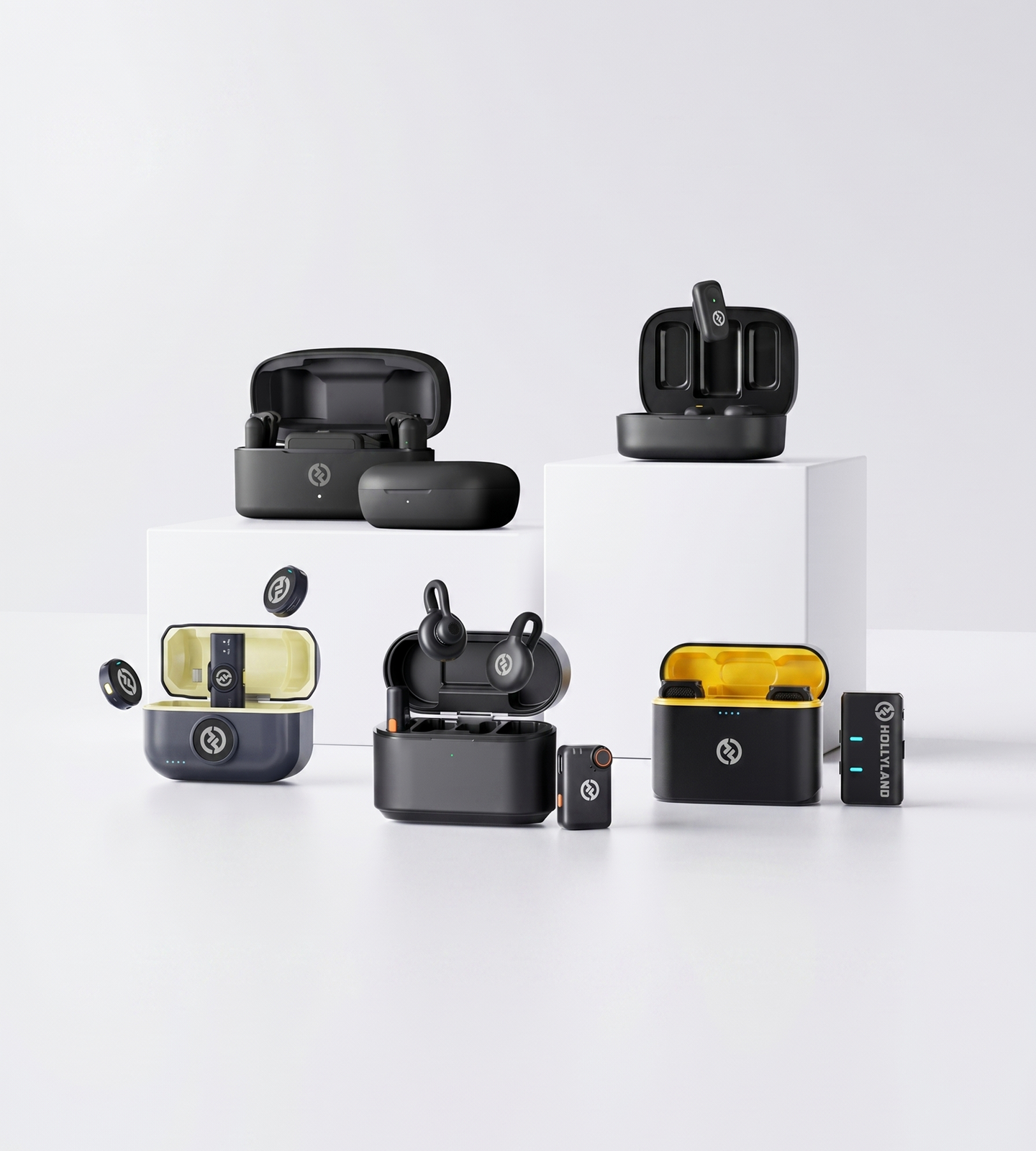
Six professional wireless microphones, each built for a different way you shoot.
LARK M2
Reliable all-day wireless for camera and mobile workflows
- 24-bit / 48kHz
- ENC
- 9g Transmitter

LARK A1
Smartphone-native audio for mobile-first content creators
- 128dB SPL
- 3-Level Noise Cancellation
- 54hr Battery

LARK M3
Scalable multi-mic system for multi-camera and multi-person productions
- 32-bit Float
- Up to 4 TX & 4 RX
- 9g Transmitter

LARK M2S
Low-profile wireless for interviews and on-camera talent
- 7g Titanium Build
- No-Logo Design
- ENC

LARK MAX 2
For high-end productions that demand full audio control
- 32-bit Float
- AI Noise Cancellation
- 340m Range

LARK A2
AI-powered smartphone mic for creators who demand studio-grade audio on the go
- AI Noise Cancellation
- 24-bit / 48kHz
- 42hr Battery
Compare Professional Wireless Microphones
Find the right wireless mic for your workflow — from mobile content creation to full production shoots.| Model |
 LARK M2
$76.00 |
 LARK A1
$39.90 |
 LARK M3
$99.00 |
 LARK M2S
$99.00 |
 LARK MAX 2
$170.10 |
 LARK A2
$29.99 |
|---|---|---|---|---|---|---|
| Audio Recording | 24-bit, 48kHz | 24-bit, 48kHz | 32-bit Float / 24-bit, 48kHz | 24-bit, 48kHz | 32-bit Float / 24-bit, 48kHz | 24-bit, 48kHz |
| Wireless Range (LOS) | Up to 300m / 1000ft | Up to 200m / 650ft | Up to 300m / 1000ft | Up to 300m / 1000ft | Up to 340m / 1115ft | Up to 200m / 656ft |
| Noise Cancellation | ENC | 3-Level Intelligent NC | Adaptive AI Noise Cancellation | ENC | AI Noise Cancellation | AI Noise Cancellation |
| Max SPL | 115dB | 128dB | 125dB | 116dB | 128dB | 120dB |
| Transmitter Weight | 9g | 8g | 9g | 7g | 14g | 8.5g |
| Total Battery Life | Up to 40 hours | Up to 54 hours | Up to 48 hours | Up to 30 hours | Up to 36 hours | Up to 42 hours |
| Device Compatibility | Camera / Mobile / Universal | Smartphone | Camera / Mobile / Universal | Camera / Mobile / Universal | Camera / Universal | Smartphone |
| Best For | All-around professional use | Mobile-first content creators | Scalable multi-mic & multi-camera production | Interviews & branded content | High-end film & full-crew production | AI-powered mobile content creation |
| Shop | Shop | Shop | Shop | Shop | Shop |
How to Choose the Right Professional Wireless Microphone
Not every wireless mic is built for professional work — and not every professional mic is built for your workflow. From audio specs to setup speed, here are the factors that actually separate a great wireless microphone from an expensive disappointment.- Audio Quality: Start With the…
- Noise Cancellation: What Actually…
- Wireless Range: LOS vs. NLOS —…
- Device Compatibility: Match the…
- Battery Life: Planning for a…
- Form Factor and On-Body Comfort
- Setup Speed: Plug-and-Play vs.…
- Multi-Transmitter Support:…
Audio Quality: Start With the Numbers That Matter
Bit Depth and Sample Rate
For professional audio, bit depth and sample rate are the foundation — and the specs worth scrutinizing first.
- 24-bit / 48kHz is the broadcast-standard recording format. It delivers clean, full-frequency audio with sufficient dynamic range for post-production workflows and handles most professional shooting conditions reliably.
- 32-bit float goes further. It captures a vastly wider dynamic range, which means audio that would normally clip at a loud peak — a sudden shout, an unexpected crowd burst — can be recovered cleanly in post without re-recording. If you work in environments where you can't stop to adjust gain mid-shoot, 32-bit float is a meaningful upgrade, not just a spec-sheet number.
Frequency Response and SNR
- A 20Hz–20kHz frequency response covers the full range of human hearing, ensuring voice is captured with natural presence, warmth, and clarity — not just intelligibility.
- Signal-to-Noise Ratio (SNR) measures how clean the audio signal is relative to background noise floor. Look for ratings of 70dB or higher for results that hold up in professional post-production.
Noise Cancellation: What Actually Works on Location
Studio recordings are easy. Real-world shoots aren't. Traffic, wind, HVAC systems, crowd noise — every environment will try to compromise your audio. Noise cancellation is no longer a bonus feature; for most professional workflows, it's a requirement.
ENC vs. AI Noise Cancellation
- ENC (Environmental Noise Cancellation) is hardware-based filtering that targets steady-state background noise — wind, hum, room ambience. It's consistent, reliable, and now standard across professional wireless microphone systems.
- AI Noise Cancellation applies a more intelligent layer, using machine learning to distinguish voice from complex, mixed noise environments where multiple competing sound sources make simple filtering insufficient.
When to prioritize it: Any shoot you can't acoustically control — outdoors, event venues, crowded locations — demands strong noise cancellation performance. Evaluate it as a core spec, not an afterthought.
Wireless Range: LOS vs. NLOS — Know the Difference
Range specs are almost always quoted as Line of Sight (LOS) — a clean, unobstructed path between transmitter and receiver. Most real-world shoots don't offer that.
What to Look For
- LOS range sets the ceiling. Higher numbers matter for open environments — outdoor events, large film locations, wide-open venues.
- NLOS (Non-Line of Sight) range is the number that applies indoors. Bodies, walls, furniture, and equipment interrupt the signal path. Expect NLOS performance to be significantly lower than LOS specs — often 60–70% lower — and factor this into how you position your receiver on set.
- Antenna placement has an outsized effect on real-world NLOS performance. Keeping the receiver's antenna elevated and unobstructed makes a measurable difference regardless of which system you use.
A system with strong LOS range but poor NLOS performance can be a liability on indoor or crowded shoots. Look for both figures before deciding.
Device Compatibility: Match the Mic to Your Gear
The most capable wireless microphone is useless if it doesn't integrate cleanly with your recording device. Compatibility is one of the most common friction points when switching wireless mic systems.
Camera-Based Workflows
Camera-mounted receivers are the standard for videographers and filmmakers. Look for a dedicated camera version with a 3.5mm TRS output to feed directly into your camera's mic input — no adapters, no app required, no latency from conversion.
Smartphone and Mobile Workflows
Mobile-native microphone systems plug directly into your phone (USB-C or Lightning), with no separate receiver unit. These systems are engineered for creators who shoot primarily on iPhone or Android. The LARK A1 is built specifically for this workflow, with plug-and-play smartphone compatibility plus mobile-first controls including EQ adjustment, multi-level gain, and auto-limit clip protection. The LARK A2 takes the same smartphone-native approach further with AI-powered noise cancellation and voice tuning, dual-protection via AI Auto-Limit Clip and Safety Track, and 48kHz / 24-bit studio-grade recording — all in an ultra-compact 8.5g clip-on body with up to 42 hours total battery life.
Universal / Dual-Device Workflows
If you regularly switch between camera and smartphone, look for a combo version that ships with multiple output adapters. This eliminates the need to invest in parallel systems for different devices — a practical consideration for creators whose gear setup changes shoot to shoot.
Battery Life: Planning for a Full-Day Shoot
A microphone system that dies mid-shoot isn't just an inconvenience — it's a production failure. Evaluating battery life means looking beyond the single-charge headline number.
What to Evaluate
- Per-charge TX runtime — How long the transmitter (clipped to your talent) lasts on one charge. Look for 9–11 hours to cover most full-day shoots without a mid-session recharge.
- Total system runtime — The combined runtime across the transmitter and its charging case. This tells you how many full shooting days you get before you need a wall outlet. Systems in this range offer 30–54 hours total, depending on configuration.
- RX runtime — The receiver should match or exceed the transmitter's per-charge life. An RX that dies before the TX forces unnecessary interruptions at the wrong moments.
Think of the charging case as an active battery pack, not just a storage solution. A case that recharges transmitters two or three times means you can top up between setups without hunting for power on location.
Form Factor and On-Body Comfort
For interviews, documentaries, and any shoot where talent wears the transmitter on camera, physical size and appearance matter — both for comfort and visual discretion.
What to Consider
- Transmitter weight — Clip-on transmitters should be light enough to avoid pulling on clothing or distracting talent during a take. Professional-grade systems now range from 7–14g, which is effectively imperceptible when worn correctly.
- Visible branding — On professional or branded productions, a manufacturer logo on a transmitter visible in frame can be a concern. If aesthetic subtlety is a priority, look for transmitters with a logo-free, invisible-fit design. The LARK M2S addresses this directly with a no-logo titanium build designed specifically for on-camera talent.
- Clip design and mounting flexibility — Look for a clip that attaches securely and cleanly to collars, lapels, and fabric edges without bulk or visible bulk under clothing.
Setup Speed: Plug-and-Play vs. App-Controlled Workflows
On fast-moving shoots, setup time is production time. The faster a system is ready, the more time you spend recording.
Two Workflow Models
- Plug-and-play — Power on, plug in, record. No pairing sequence, no app required. Best for run-and-gun shooting, documentary coverage, journalism, and any workflow where speed of setup is the priority.
- App-controlled — A companion app unlocks extended settings: gain adjustment, noise cancellation levels, EQ profiles, and monitoring preferences. Adds meaningful flexibility for creators who have time to configure before rolling.
Most professional wireless systems now offer both — plug-and-play as the default, app control as an optional layer. If your shoots are fast and unpredictable, lead with plug-and-play performance as the baseline spec. If you want granular control and have the workflow to support it, app integration becomes a differentiator.
Multi-Transmitter Support: Capturing More Than One Speaker
If you regularly record interviews, panels, or multi-talent shoots, the number of transmitters a single receiver can handle simultaneously is a critical spec.
- Single TX → Single RX is the standard configuration for solo creators, vloggers, and single-subject shoots.
- Dual TX → Single RX covers the most common interview and two-speaker scenario without requiring additional receiver hardware.
- Multi-TX support (up to 4 TX per RX) — as offered by the LARK MAX 2 and the new LARK M3 — opens up event coverage, panel discussions, and larger ensemble recording without building out multiple independent receiver chains. The LARK M3 goes further with a fully modular 4 TX & 4 RX architecture, allowing one transmitter to simultaneously feed up to four receivers — ideal for multi-camera productions where every camera needs an isolated audio feed.
If your work is scaling toward multi-speaker production, factor transmitter-to-receiver ratios into your buying decision early. Upgrading later is possible but costlier than selecting a scalable system from the start.
Use CasesBuilt for the Way You Actually Work
From solo vlog runs to full production days, every mic in this lineup is engineered around real-world workflows — not lab benchmarks. Find your scenario below.Vlogging & Solo Camera Shoots
Go wire-free without giving up broadcast-quality audio. Ultra-light transmitters clip on in seconds and pair instantly with your camera, so you're rolling before the moment passes — and a single charge carries you through an entire shoot day.- Wireless Freedom
- Plug & Play
- All-Day Battery
Interviews & Multi-Talent Recording
Capture every voice in the room with equal clarity. A single receiver can pair with up to four transmitters simultaneously, making dual-talent sit-downs and multi-speaker panels just as manageable as a solo setup.- Dual-Talent
- Multi-Speaker
- Clean Separation
Run-and-Gun & Event Coverage
Shoots move fast — your audio gear has to keep up. These mics pair instantly, hold a stable signal in NLOS conditions, and cut through crowd noise and wind with environmental noise cancellation, so you capture the story, not the room.- Fast Setup
- ENC Noise Cancellation
- NLOS Reliable
Smartphone & Mobile Content Creation
Plug directly into your smartphone and start recording — no app required, no complicated settings. Intelligent noise cancellation and 128dB SPL handling deliver studio-grade audio for reels, short-form content, and social media, wherever you happen to be shooting.- Smartphone-Native
- Social Media Ready
- Instant Setup
Live Streaming
When you're live, there's no fixing it in post. Low-latency wireless transmission and real-time monitoring keep your audio clean and in sync from the first second — whether you're stationary at a desk or moving through a crowd.- Low Latency
- Real-Time Monitoring
- Stream-Ready
Commercial & Narrative Production
High-stakes shoots demand professional-grade reliability. 32-bit float recording eliminates clipping no matter how unpredictable the environment gets, AI noise cancellation handles chaotic locations, and timecode sync keeps audio locked to picture — at ranges up to 340m.- 32-Bit Float
- Timecode Sync
- AI Noise Cancellation
1.5M+ creators picked LARK microphones for their audio
A decade of wireless engineering for film crews and broadcasters — packaged for modern creator workflows.- 4.7 Avg. rating · 120K+ reviews
- 1.5M+ Verified creators
- 160+ Countries shipped
- 98% Would recommend
I love my new LARK M2 mics. These were so good, and I really enjoyed testing out the new LARK M2 from Hollyland.
The Hollyland LARK MAX is the wireless microphone system with the clearest and crispest audio of any wireless mic system I have ever tried.
LARK MAX is doing an excellent job of dropping the sound of the air conditioner, which is something l always have to remove and post with our shotgun mic.
- No Film School
- Newsshooter
- CineD
- RedShark
- CAMERA JABBER
- Photowebexpo
Your Questions About Professional Wireless Microphones, Answered
Are Hollyland wireless microphones actually professional quality, or does going wireless mean compromising audio? No compromise required. Every microphone in this lineup records at **24-bit/48kHz** — the same bit depth used in broadcast and professional film production. The LARK MAX 2 goes further with **32-bit float recording**, which captures such a wide dynamic range that clipping is virtually eliminated even in unpredictable audio environments. All models cover the full **20Hz–20kHz** frequency range, and signal-to-noise ratios reach up to **72dB** on the LARK MAX 2 — figures that hold up against wired professional microphones. The transmission is clean, the signal chain is stable, and the results are indistinguishable from wired setups in most production scenarios. Which microphone is compatible with my camera or smartphone? Compatibility depends on your primary shooting device: - **Camera users** — The LARK M2 (Camera Version), LARK M2S (Camera Version), and LARK MAX 2 connect directly to cameras via 3.5mm TRS output. Combo Versions include adapters that expand camera compatibility further. - **Smartphone users** — The **LARK A1** and **LARK A2** are purpose-built for smartphones, with plug-and-play support for both iOS and Android. The LARK A2 adds AI noise cancellation, voice tuning, and dual clip protection for creators who want more from their mobile audio. The LARK M2 and LARK M2S Mobile Versions also support smartphones natively. - **Both cameras and smartphones** — The Combo Versions of the LARK M2 and LARK M2S include both TRS and TRRS outputs, covering cameras and phones in a single kit. If you regularly switch between devices, a Combo Version gives you the most flexibility without buying a second system. How far will the wireless signal actually reach on a real shoot — not just line-of-sight? Line-of-sight (LOS) range is the marketed maximum, but real-world shoots involve walls, crowds, and RF interference. Here's what to expect from each system: | Microphone | LOS Range | NLOS Range | |---|---|---| | LARK MAX 2 | 340m / 1,115ft | 70m / 230ft | | LARK M3 | 300m / 1,000ft | 40–60m | | LARK M2 | 300m / 1,000ft | 40–60m | | LARK M2S | 300m / 1,000ft | 40–60m | | LARK A1 | 200m / 650ft | — | For most professional scenarios — interviews, event coverage, run-and-gun documentary work — the NLOS range is more than sufficient. The **LARK MAX 2** offers the strongest signal penetration through obstacles, making it the recommended choice for large venues or densely crowded environments. How long will the battery last on a full-day shoot? Every Hollyland wireless mic in this collection is built for all-day use. Total system battery life per kit: - **LARK A1**: Up to **54 hours** total (TX: ~9 hrs per charge) - **LARK M2**: Up to **40 hours** total (TX: ~10 hrs per charge, RX: ~9 hrs per charge) - **LARK A2**: Up to **42 hours** total (TX: ~7 hrs per charge, 1.5H Quick Charge supported) - **LARK MAX 2**: Up to **36 hours** total (mic: ~11 hrs per charge, RX: ~12 hrs per charge) - **LARK M3**: Up to **48 hours** total (TX: ~8 hrs per charge, Camera RX: ~9 hrs per charge; charging case provides 2 additional full TX recharges) - **LARK M2S**: Up to **30 hours** total (TX: ~9 hrs per charge) Transmitters and receivers recharge via the included charging case, so you can top up between setups without managing individual cables. For multi-day productions, the LARK A1 and LARK M3 offer the longest combined system runtimes across the full lineup. Will the microphone clip or distort if audio gets unexpectedly loud? Audio clipping is one of the most common points of failure in wireless recording — and one that's been specifically engineered against across this lineup. The **LARK MAX 2** uses **32-bit float recording**, which delivers a dynamic range so wide that audio cannot practically clip, even during sudden loud peaks. This makes it ideal for live events, unpredictable environments, and any scenario where you can't monitor levels in real time. The **LARK M3** also records in **32-bit float (48kHz)**, with a maximum SPL of **125dB** — meaning it handles everything from quiet dialogue to loud crowd bursts without clipping, across all four independent isolated tracks simultaneously. The **LARK A2** features **Dual-Protection: AI Auto-Limit Clip and Safety Track**, which work together to catch sudden peaks and preserve a clean backup track — delivering up to **120dB SPL** handling for smartphone creators shooting in demanding environments. The **LARK A1** features built-in **Auto-Limit Clip Protection** and handles up to **128dB SPL**, giving it robust performance at concerts, crowded venues, and high-energy shoots. The **LARK M2** and **LARK M2S** handle up to **115–116dB SPL**, which is more than sufficient for interviews, corporate events, outdoor shoots, and the majority of professional recording conditions. How effective is the noise cancellation in real outdoor and noisy environments? The noise cancellation across this lineup is designed for real shooting conditions, not just controlled studio environments. - **LARK MAX 2**: **AI Noise Cancellation** intelligently isolates voice from background interference in real time — wind, crowd noise, HVAC systems, and city ambience are filtered at the transmission level before they reach your recording. - **LARK M2 & LARK M2S**: **ENC (Environmental Noise Cancellation)** applies dedicated hardware-level filtering to reduce low-frequency rumble and ambient background noise during transmission. - **LARK A2**: **AI-Powered Noise Cancellation & Voice Tuning** uses machine learning to separate voice from complex mixed-noise environments, with an additional voice tuning layer that enhances vocal clarity — purpose-built for smartphone creators shooting in unpredictable locations. - **LARK A1**: **3-Level Intelligent Noise Cancellation** lets you dial in the right level of filtering for your environment — light suppression for quiet shoots, aggressive filtering for busy locations. For windy outdoor shoots, pair any transmitter with the included windscreen and activate noise cancellation for best results. How complicated is setup? Do I need to configure an app before I can start recording? Every microphone in this collection supports **plug-and-play operation** out of the box. Connect the receiver to your camera or phone, clip on the transmitter, and you're recording — no pairing sequences or app configuration required to get started. For users who want more control, optional app connectivity is available on the LARK M2 (Mobile Version), LARK M2S, LARK A1, and LARK MAX 2. Through the Hollyland app, you can adjust noise cancellation level, fine-tune gain, and access advanced monitoring settings. The LARK A1 also supports **6-level gain adjustment and EQ/reverb control** via app. But the baseline experience is always fast: power on, plug in, shoot. Which microphone is right for me? The right choice depends on your primary workflow and production level: - **LARK MAX 2** — The flagship professional system. Built for filmmakers, documentary crews, and production teams who need 32-bit float recording, AI noise cancellation, timecode sync, wireless audio monitoring, and multi-transmitter support (up to 4 TX per RX). Choose this when audio failure is not an option. - **LARK M3** — The scalable multi-mic system. 32-bit float / 24-bit 48kHz recording, Adaptive AI Noise Cancellation, 300m range, and a fully modular 4 TX & 4 RX architecture with 4 independent isolated tracks. At just 9g per transmitter and up to 48 hours total battery life, it's the best choice for multi-camera productions, panel recordings, and any shoot where multiple people need individual mics feeding multiple devices simultaneously. - **LARK M2** — The professional all-rounder. 24-bit audio, ENC, 300m range, and a 9g transmitter that disappears under clothing. Broad device compatibility and plug-and-play simplicity make it ideal for videographers, content creators, and journalists across camera and mobile workflows. - **LARK M2S** — Identical professional performance to the M2, but refined into a titanium-finished, no-logo design at just 7g. The best choice for interview shoots, documentary work, and branded content where the microphone might appear on camera. - **LARK A2** — The AI-upgraded smartphone mic. 48kHz / 24-bit studio-grade audio, AI noise cancellation and voice tuning, dual clip protection (AI Auto-Limit Clip + Safety Track), and up to 42 hours total battery life in an 8.5g clip-on body. The best choice for smartphone creators who want professional-grade AI audio tools without a camera rig. - **LARK A1** — Built specifically for smartphone-first creators. Intelligent noise cancellation, auto-clip protection, and EQ control in an 8g magnetic body. The professional choice for social media content, mobile journalism, and short-form video production. Every model in this lineup covers the full 20Hz–20kHz frequency range and is rated for all-day battery life — so whichever you choose, it's a professional decision. Explore furtherA few more places to go from here
A curated link map of the surrounding content — related categories, the most useful guides, head-to-head comparisons and setup help.Related categories
Buying guides
Comparisons
Support & setup
Find Your Professional Wireless Mic
Choose from six options with 24-bit or 32-bit float audio, AI noise cancellation, and up to 340m wireless range. Shop Now Compare Models- Free shipping over $99
- 30-day returns
- 1-year warranty